
Homework Answers
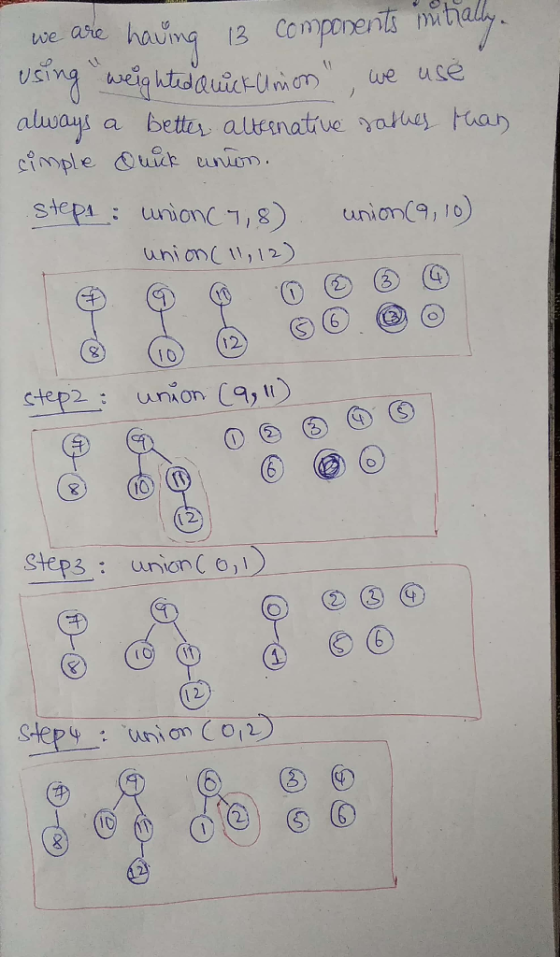
In the simple QUICK UNION, we just join the components without any calculation. In the WEIGHTED QUICK UNION, we calculate the number of components in the two parts before joining.
We always place them in an intelligent way as explained in the below figure:
Hence it gives a better performance.
The solution to the given problem is as follows:
===
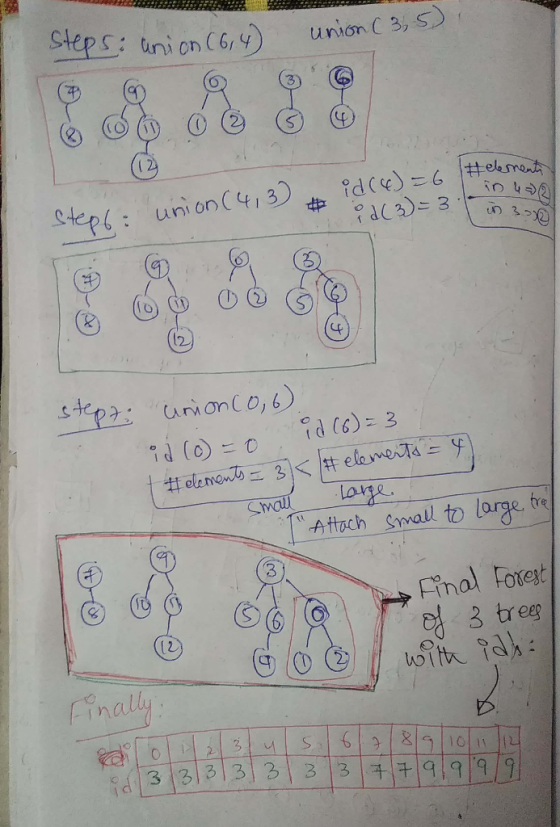
Hence. we can see that there are 3 trees in the forest after all the unions have been performed.
The id[] array contents are as follows:
|
component |
0 |
1 |
2 |
3 |
4 |
5 |
6 |
7 |
8 |
9 |
10 |
11 |
12 |
|
id value |
3 |
3 |
3 |
3 |
3 |
3 |
3 |
7 |
7 |
9 |
9 |
9 |
9 |
===================================================================
NOTE: Please hit the LIKE button if you like
the Solution and Appreciate our time. It would
really boost us to help you better.
If there are any doubts, HIT the LIKE and comment down here.. we
are right here to help you.
Happy Learning..!!!
quick-union smaller tree smaller larger tree tree larger tree might put the larger tree lower
Add Answer to:
Give a set with 13 elements, show the final result of executing the following instructions with...
When 1) Using a set of values from 0 to 10, perform the following unions using...
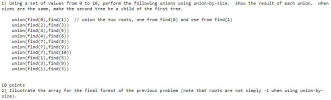 When 1) Using a set of values from 0 to 10, perform the following unions using union-by-size. Show the result of each union. sizes are the same, make the second tree be a child of the first tree. union(find(), find(1)) // union the two roots, one from find(e) and one from find(1) union(find(2), find (3) union(find(4), find(5)) union(find(4), find (6) union(find(7), find (8) union(find(7), find (9)) union(find(7), find (10) union(find(1), find(5)) union(find(3), find (9)) union(find(1), find (3) 10 points 2)...
_______________________________________________________________________________________________ java language-trace instructions". (20 points) Show the contents of the array below, once the contents...
 _______________________________________________________________________________________________
java language-trace
instructions". (20 points) Show the contents of the array below, once the contents of the array below, once the "pivot" element is placed at its location after each call of the "Partition” algorithm, in the process of running Quick-Sort on said array. Arrange the data in ascending order (Trom Arrange the data in ascending order (from smallest to largest value). Always select the first element of the partition as "pivot" in data cat B. Apply sorting on...
_______________________________________________________________________________________________
java language-trace
instructions". (20 points) Show the contents of the array below, once the contents of the array below, once the "pivot" element is placed at its location after each call of the "Partition” algorithm, in the process of running Quick-Sort on said array. Arrange the data in ascending order (Trom Arrange the data in ascending order (from smallest to largest value). Always select the first element of the partition as "pivot" in data cat B. Apply sorting on...
Zhang: CSE 330 Winter 2019 Final Examination (I hour 50 minutes) 7IPage Show the result of...
 Zhang: CSE 330 Winter 2019 Final Examination (I hour 50 minutes) 7IPage Show the result of inserting 18, 12, 3, 14,5, 6, 10, 16, 2, 9, 26, 8, and 11, one at a time, into an initially empty binary heap. 4. Show the result of performing TWO deleteMinO operations in the following binary heap. s. 5 9 0 11) (60(25 16
• P1 (10 pts) Show the result of inserting 2, 9, 5, 8, 6, 4, 3,...
 • P1 (10 pts) Show the result of inserting 2, 9, 5, 8, 6, 4, 3, 1 into an initially empty AVL tree (draw a resulting tree after inserting each number; you need to draw 8 AVL trees). • P2 (5 pts) What is the minimum number of nodes in an AVL tree of height 8? • P3 (5 pts) Show the result of deleting the element with key 9' from the following splay tree. • P4 (5 pts) Show...
This question has been answered before, but no codes given as the answer were right. please...
This question has been answered before, but no codes given as the answer were right. please help. In the mathematical theory of sets, a set is defined as a collection of distinct items of the same type. In some programming languages, sets are built-in data types; unfortunately, this is not the case in C++. However, we can simulate a set using a one-dimensional array. Some operations can be performed on sets. We will consider three(3) of them: union, intersection and...
Using a Linux command-line interpreter, show the screenshots for executing the following commands: (1) display the...
Using a Linux command-line interpreter, show the screenshots for executing the following commands: (1) display the current working directory, (2) list the contents of a directory, (3) change directory, (4) create a directory, (5) clear the screen, (6) copy a file from a directory into another directory, (7) delete a directory, (8) delete a file, (9) report information for a single process or set of processes, and (10) report a real-time statistics for current processes.
Using Java programming language, build a class called IntegerSet. Instructions - Create class IntegerSet An IntegerSet...
Using Java programming language, build a class called IntegerSet. Instructions - Create class IntegerSet An IntegerSet object holds integers in the range 0-100 Represented by an array of booleans, such that array element a[i] is set to true if integer i is in the set, and false otherwise Create these constructors and methods for the class IntegerSet() public IntegerSet union(IntegerSet iSet) public IntegerSet intersection(IntegerSet iSet) public IntegerSet insertElement(int data) public IntegerSet deleteElement(int data) public boolean isEqualTo(IntegerSet iSet) public String toString()...
5. A three-heap with n elements can be stored in an array A, where A[O] contains...
 5. A three-heap with n elements can be stored in an array A, where A[O] contains the root of the tree. a) Draw the three-heap that results from inserting 5, 2, 8, 3, 6, 4, 9, 7, 1 in that order into an initially empty three-heap. You do not need to show the array representation of the heap. You are only required to show the final tree, although if you draw intermediate trees. b) Assuming that elements are placed in...
**Only need to answer question 27** Union(2,10) - So each key above is in its own...
 **Only need to answer question 27**
Union(2,10) - So each key above is in its own set so if we
perform union(2,10) im assuming it should make a set that contains
both key such as s1 = {2, 10} or using an array for
example
-1
-1
2
10
-1 meaning vertices in own set then this should result in after
union as
-2
2
2
10
-2 being the number of vertices, positive 2 being the parent of
10...
**Only need to answer question 27**
Union(2,10) - So each key above is in its own set so if we
perform union(2,10) im assuming it should make a set that contains
both key such as s1 = {2, 10} or using an array for
example
-1
-1
2
10
-1 meaning vertices in own set then this should result in after
union as
-2
2
2
10
-2 being the number of vertices, positive 2 being the parent of
10...
In java 0 0 1 Hạshing Lab 1. Given the following key values, show what the...
 In java
0 0 1 Hạshing Lab 1. Given the following key values, show what the data structures would look like after insertions 27 53 13 10 138 109 49 174 26 24 (no preprocessing necessary: pk=key) a. Linear array of 10 elements using division hashing b. Bucket hashing of 10 elements (N=10) and the linear-quotient collision path algorithm ip = (px) %N N= 13, 4k+3 prime = 19 Array: Array: LOHashing: 1. ip = pk %N 1 2 2....
In java
0 0 1 Hạshing Lab 1. Given the following key values, show what the data structures would look like after insertions 27 53 13 10 138 109 49 174 26 24 (no preprocessing necessary: pk=key) a. Linear array of 10 elements using division hashing b. Bucket hashing of 10 elements (N=10) and the linear-quotient collision path algorithm ip = (px) %N N= 13, 4k+3 prime = 19 Array: Array: LOHashing: 1. ip = pk %N 1 2 2....
 When 1) Using a set of values from 0 to 10, perform the following unions using union-by-size. Show the result of each union. sizes are the same, make the second tree be a child of the first tree. union(find(), find(1)) // union the two roots, one from find(e) and one from find(1) union(find(2), find (3) union(find(4), find(5)) union(find(4), find (6) union(find(7), find (8) union(find(7), find (9)) union(find(7), find (10) union(find(1), find(5)) union(find(3), find (9)) union(find(1), find (3) 10 points 2)...
 _______________________________________________________________________________________________
java language-trace
instructions". (20 points) Show the contents of the array below, once the contents of the array below, once the "pivot" element is placed at its location after each call of the "Partition” algorithm, in the process of running Quick-Sort on said array. Arrange the data in ascending order (Trom Arrange the data in ascending order (from smallest to largest value). Always select the first element of the partition as "pivot" in data cat B. Apply sorting on...
_______________________________________________________________________________________________
java language-trace
instructions". (20 points) Show the contents of the array below, once the contents of the array below, once the "pivot" element is placed at its location after each call of the "Partition” algorithm, in the process of running Quick-Sort on said array. Arrange the data in ascending order (Trom Arrange the data in ascending order (from smallest to largest value). Always select the first element of the partition as "pivot" in data cat B. Apply sorting on...
 Zhang: CSE 330 Winter 2019 Final Examination (I hour 50 minutes) 7IPage Show the result of inserting 18, 12, 3, 14,5, 6, 10, 16, 2, 9, 26, 8, and 11, one at a time, into an initially empty binary heap. 4. Show the result of performing TWO deleteMinO operations in the following binary heap. s. 5 9 0 11) (60(25 16
 • P1 (10 pts) Show the result of inserting 2, 9, 5, 8, 6, 4, 3, 1 into an initially empty AVL tree (draw a resulting tree after inserting each number; you need to draw 8 AVL trees). • P2 (5 pts) What is the minimum number of nodes in an AVL tree of height 8? • P3 (5 pts) Show the result of deleting the element with key 9' from the following splay tree. • P4 (5 pts) Show...
 5. A three-heap with n elements can be stored in an array A, where A[O] contains the root of the tree. a) Draw the three-heap that results from inserting 5, 2, 8, 3, 6, 4, 9, 7, 1 in that order into an initially empty three-heap. You do not need to show the array representation of the heap. You are only required to show the final tree, although if you draw intermediate trees. b) Assuming that elements are placed in...
 **Only need to answer question 27**
Union(2,10) - So each key above is in its own set so if we
perform union(2,10) im assuming it should make a set that contains
both key such as s1 = {2, 10} or using an array for
example
-1
-1
2
10
-1 meaning vertices in own set then this should result in after
union as
-2
2
2
10
-2 being the number of vertices, positive 2 being the parent of
10...
**Only need to answer question 27**
Union(2,10) - So each key above is in its own set so if we
perform union(2,10) im assuming it should make a set that contains
both key such as s1 = {2, 10} or using an array for
example
-1
-1
2
10
-1 meaning vertices in own set then this should result in after
union as
-2
2
2
10
-2 being the number of vertices, positive 2 being the parent of
10...
 In java
0 0 1 Hạshing Lab 1. Given the following key values, show what the data structures would look like after insertions 27 53 13 10 138 109 49 174 26 24 (no preprocessing necessary: pk=key) a. Linear array of 10 elements using division hashing b. Bucket hashing of 10 elements (N=10) and the linear-quotient collision path algorithm ip = (px) %N N= 13, 4k+3 prime = 19 Array: Array: LOHashing: 1. ip = pk %N 1 2 2....
In java
0 0 1 Hạshing Lab 1. Given the following key values, show what the data structures would look like after insertions 27 53 13 10 138 109 49 174 26 24 (no preprocessing necessary: pk=key) a. Linear array of 10 elements using division hashing b. Bucket hashing of 10 elements (N=10) and the linear-quotient collision path algorithm ip = (px) %N N= 13, 4k+3 prime = 19 Array: Array: LOHashing: 1. ip = pk %N 1 2 2....
Most questions answered within 3 hours.
-
Where is the error in this code sequence?
String s1 = "Hello";
String s2 = "ello";...
asked 10 months ago -
Financial data for Joel de Paris, Inc., for last year
follow:
Joel de Paris, Inc.
Balance...
asked 10 months ago -
Consider this reaction:
Al2(SO4)3 (aq)+ BaCl3
(aq) Al2Cl6 (aq)- +
3BaSO4(s) . What is the...
asked 10 months ago -
Suppose that Savneet is considering increasing her
recent random sample from 20 car rentals to 40...
asked 10 months ago -
Trucks arrive at an unloading terminal at an average rate of 120
per hour.
Trucks arrive...
asked 10 months ago -
Why are methanol and ethanol completely soluble in water while
octanol is not very little soluble....
asked 10 months ago -
A facilities manager at a university reads in a research report
that the mean amount of...
asked 10 months ago -
When the CuSO4 is rehydrated by adding water to the anhydrous
compound, is this an endothermic...
asked 10 months ago -
A ray of sunlight is passing from diamond into crown glass; the
angle of incidence is...
asked 10 months ago -
A block of mass 0.249 kg is placed on top of a light, vertical
spring of...
asked 10 months ago -
how do the kidneys compensate in the presences of acidosis
a) trigger hyperventilate
b) reserve acid...
asked 10 months ago -
Question 501 pts
The rental rate of capital to the firm increases. Which of the
following...
asked 10 months ago