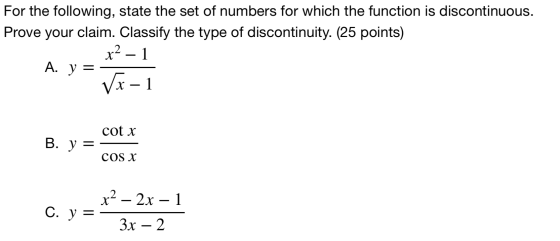
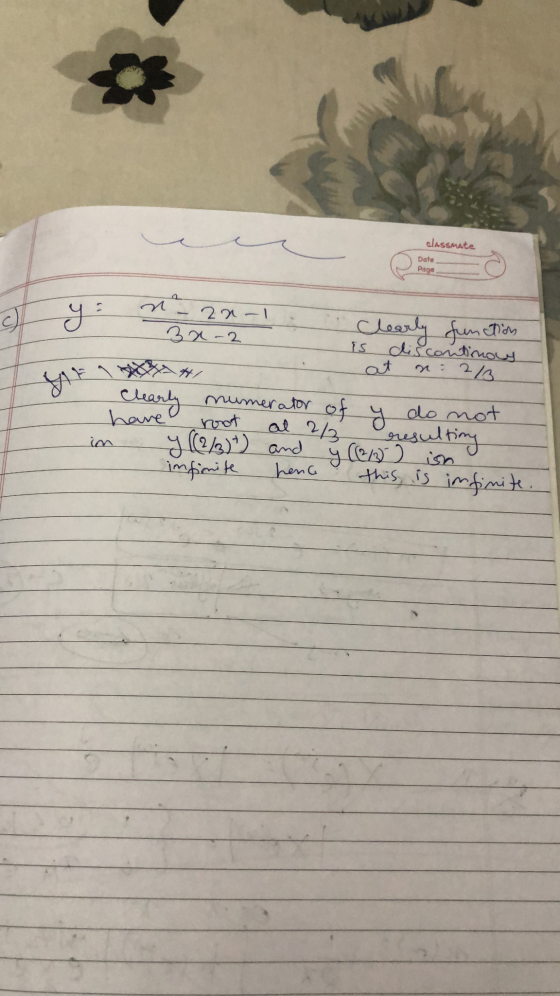
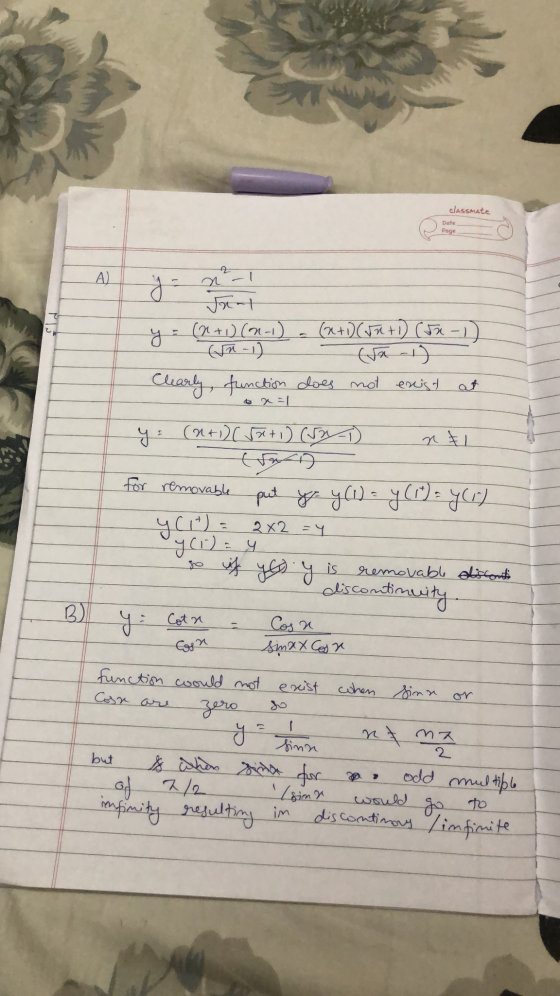
I know a is removable, but need proof. B is discontinuous/infinite but need proof. C is infinite but need proof. They can be proved with definitions or with examples.
Homework Answers
Add Answer to:
I know a is removable, but need proof. B is
discontinuous/infinite but need proof. C is...
I need to know how to proof (b) part. I didn't understand the original answer. 3....
 I need to know how to proof (b) part. I didn't understand the
original answer.
3. (a) Write the sum 147+10 (6n -2) using sigma notation. Solution: 2n i=1 (b) Use Mathematical Induction to prove that for all n 2 1, the above expression is equal to n(6n-1
I need to know how to proof (b) part. I didn't understand the
original answer.
3. (a) Write the sum 147+10 (6n -2) using sigma notation. Solution: 2n i=1 (b) Use Mathematical Induction to prove that for all n 2 1, the above expression is equal to n(6n-1
(O)(w) Give the size of each set and also whether it is discrete or continuous. If...
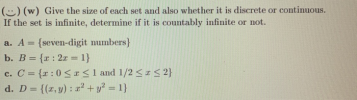 (O)(w) Give the size of each set and also whether it is discrete or continuous. If the set is infinite, determine if it is countably infinite or not. a. A = {seven-digit numbers} b. B = {r: 2x = 1} c. C = {3:0 <r<1 and 1/2 <r <2} d. D = {(x,y): x2 + y2 = 1} e. E = {2:02 + 3x + 2 = 0} f, F = {positive even integers }
Subject: Proof Writing (functions) In need of help on this proof problem, *Prove the Following:* Here...
 Subject: Proof Writing (functions)
In need of help on this proof problem,
*Prove the Following:*
Here are the definitions that we may need for this problem:
1) Let f: A B be given, Let S and T be subsets of A Show that f(S UT) = f(s) U f(T) Definition 1: A function f from set A to set B (denoted by f: A+B) is a set of ordered Pairs of the form (a,b) where a A and b B...
Subject: Proof Writing (functions)
In need of help on this proof problem,
*Prove the Following:*
Here are the definitions that we may need for this problem:
1) Let f: A B be given, Let S and T be subsets of A Show that f(S UT) = f(s) U f(T) Definition 1: A function f from set A to set B (denoted by f: A+B) is a set of ordered Pairs of the form (a,b) where a A and b B...
Hi, I really need help on both parts a and b of this Complex Analysis question....
 Hi, I really need help on both parts a and b of this Complex
Analysis question. Thanks!
1. Define exp(iy) := cos(y) + i sin(y). a. Prove, using trigonometry, that exp(iy+iy') = exp(iy). expliy') for y, y' ER two real numbers. b. Prove directly (using Taylor series for sin and cos) that expliy) = " where n! denotes the factorial of n. Hint: you may use the fact that an infinite sum of complex numbers an converges if and only...
Hi, I really need help on both parts a and b of this Complex
Analysis question. Thanks!
1. Define exp(iy) := cos(y) + i sin(y). a. Prove, using trigonometry, that exp(iy+iy') = exp(iy). expliy') for y, y' ER two real numbers. b. Prove directly (using Taylor series for sin and cos) that expliy) = " where n! denotes the factorial of n. Hint: you may use the fact that an infinite sum of complex numbers an converges if and only...
Can I know how to do part(c)? I know how to do (a)(b). By (a) and...
 Can I know how to do part(c)? I know how to do
(a)(b).
By (a) and (b), I get this 4 results.
1. ▾.F = 2xz5-2xz+3xz2
2. ▾xF = (2xy) i + (5x2z4-z3) j
-(2yz) k
3. ▾.(▾xF) = 0
4. ▾x(▾f) = 0
Next, i need to calculate part (c).
I want the solution of part(c), so don't give me the result of
part(a) and (b) again,
thanks!
1. (25 marks) (a) Evaluate . F and V. (V x...
Can I know how to do part(c)? I know how to do
(a)(b).
By (a) and (b), I get this 4 results.
1. ▾.F = 2xz5-2xz+3xz2
2. ▾xF = (2xy) i + (5x2z4-z3) j
-(2yz) k
3. ▾.(▾xF) = 0
4. ▾x(▾f) = 0
Next, i need to calculate part (c).
I want the solution of part(c), so don't give me the result of
part(a) and (b) again,
thanks!
1. (25 marks) (a) Evaluate . F and V. (V x...
need to fix. please have good handwriting 3). since we know that XXE A, X na...
 need to fix. please have good handwriting
3). since we know that XXE A, X na sa therefore, if aina2 *a. E[az] XE[a] by symmetricity aa~a, A2E[a ] but also aie [a ] and az € [az] ~ Coy reflexivity So, [a. In = [az] iait (az] - and dit [a ] P 02] us lalu these needs to be proved. You can't just [a.] u ç[az] - say them Problem 7.1 Let be an equivalence relation on a set...
need to fix. please have good handwriting
3). since we know that XXE A, X na sa therefore, if aina2 *a. E[az] XE[a] by symmetricity aa~a, A2E[a ] but also aie [a ] and az € [az] ~ Coy reflexivity So, [a. In = [az] iait (az] - and dit [a ] P 02] us lalu these needs to be proved. You can't just [a.] u ç[az] - say them Problem 7.1 Let be an equivalence relation on a set...
We already know the functions defined by y =C+a•f[b(x-d)] with the assumption that b>0. To see...
 We already know the functions defined by y =C+a•f[b(x-d)] with the assumption that b>0. To see what happens when b<0, work parts (a)-(f) in order. (a) Use an even-odd identity to write y = sin(-2x) as a function of 2x. y= (b) How is your answer to part (a) related to y = sin(2x)? O It is the negative of y = sin (2x). olt equals y = sin (2x). (c) Use an even-odd identity to write y = cos(...
We already know the functions defined by y =c+a+f[b(x-d)] with the assumption that b>0. To see...
 We already know the functions defined by y =c+a+f[b(x-d)] with the assumption that b>0. To see what happens when b<0, work parts (a)-(f) in order. (a) Use an even-odd identity to write y = sin (-2x) as a function of 2x. y = (b) How is your answer to part (a) related to y = sin (2x)? O It is the negative of y=sin (2x). It equals y=sin (2x). (c) Use an even-odd identity to write y = cos(-5x) as...
i need help with all parts. i will rate. thank you very much. Let C be...
 i need help with all parts. i will rate.
thank you very much.
Let C be the closed curve consisting of two pieces. One piece is the upper-half circle of radius 3, centered at the origin, oriented counter-clockwise. The other piece is the horizontal line segment from (-3,0) to (3,0). Evaluate the line integral $ (x2 + y2)dx + (6xy—y?)dy = с (-3,0) (3,0) O 36 O 72 O 31 91/2 The level set of f(x,y) = 12 is a...
i need help with all parts. i will rate.
thank you very much.
Let C be the closed curve consisting of two pieces. One piece is the upper-half circle of radius 3, centered at the origin, oriented counter-clockwise. The other piece is the horizontal line segment from (-3,0) to (3,0). Evaluate the line integral $ (x2 + y2)dx + (6xy—y?)dy = с (-3,0) (3,0) O 36 O 72 O 31 91/2 The level set of f(x,y) = 12 is a...
Hello! I need some help with these questions. It would be awesome if you could write...
 Hello! I need some help with these questions. It would be awesome
if you could write the answer choice (A,B,C,D...etc.) because
sometimes it’s hard for me to read the final answer in certain
handwriting styles. Thank you so much!!
To verify the identity tan(++an tanattan x2+tanろーtanatanxatan-what should 1-tan x tan 2tan 2 tan x3-tan tan x3 you do first? tan x +tan 1+ tan A tan xo tan tan xi-tan (x2 + Otan(q+x2+13) = 1+tan xi tan (x2 +13) O...
Hello! I need some help with these questions. It would be awesome
if you could write the answer choice (A,B,C,D...etc.) because
sometimes it’s hard for me to read the final answer in certain
handwriting styles. Thank you so much!!
To verify the identity tan(++an tanattan x2+tanろーtanatanxatan-what should 1-tan x tan 2tan 2 tan x3-tan tan x3 you do first? tan x +tan 1+ tan A tan xo tan tan xi-tan (x2 + Otan(q+x2+13) = 1+tan xi tan (x2 +13) O...
 I need to know how to proof (b) part. I didn't understand the
original answer.
3. (a) Write the sum 147+10 (6n -2) using sigma notation. Solution: 2n i=1 (b) Use Mathematical Induction to prove that for all n 2 1, the above expression is equal to n(6n-1
I need to know how to proof (b) part. I didn't understand the
original answer.
3. (a) Write the sum 147+10 (6n -2) using sigma notation. Solution: 2n i=1 (b) Use Mathematical Induction to prove that for all n 2 1, the above expression is equal to n(6n-1
 (O)(w) Give the size of each set and also whether it is discrete or continuous. If the set is infinite, determine if it is countably infinite or not. a. A = {seven-digit numbers} b. B = {r: 2x = 1} c. C = {3:0 <r<1 and 1/2 <r <2} d. D = {(x,y): x2 + y2 = 1} e. E = {2:02 + 3x + 2 = 0} f, F = {positive even integers }
 Subject: Proof Writing (functions)
In need of help on this proof problem,
*Prove the Following:*
Here are the definitions that we may need for this problem:
1) Let f: A B be given, Let S and T be subsets of A Show that f(S UT) = f(s) U f(T) Definition 1: A function f from set A to set B (denoted by f: A+B) is a set of ordered Pairs of the form (a,b) where a A and b B...
Subject: Proof Writing (functions)
In need of help on this proof problem,
*Prove the Following:*
Here are the definitions that we may need for this problem:
1) Let f: A B be given, Let S and T be subsets of A Show that f(S UT) = f(s) U f(T) Definition 1: A function f from set A to set B (denoted by f: A+B) is a set of ordered Pairs of the form (a,b) where a A and b B...
 Hi, I really need help on both parts a and b of this Complex
Analysis question. Thanks!
1. Define exp(iy) := cos(y) + i sin(y). a. Prove, using trigonometry, that exp(iy+iy') = exp(iy). expliy') for y, y' ER two real numbers. b. Prove directly (using Taylor series for sin and cos) that expliy) = " where n! denotes the factorial of n. Hint: you may use the fact that an infinite sum of complex numbers an converges if and only...
Hi, I really need help on both parts a and b of this Complex
Analysis question. Thanks!
1. Define exp(iy) := cos(y) + i sin(y). a. Prove, using trigonometry, that exp(iy+iy') = exp(iy). expliy') for y, y' ER two real numbers. b. Prove directly (using Taylor series for sin and cos) that expliy) = " where n! denotes the factorial of n. Hint: you may use the fact that an infinite sum of complex numbers an converges if and only...
 Can I know how to do part(c)? I know how to do
(a)(b).
By (a) and (b), I get this 4 results.
1. ▾.F = 2xz5-2xz+3xz2
2. ▾xF = (2xy) i + (5x2z4-z3) j
-(2yz) k
3. ▾.(▾xF) = 0
4. ▾x(▾f) = 0
Next, i need to calculate part (c).
I want the solution of part(c), so don't give me the result of
part(a) and (b) again,
thanks!
1. (25 marks) (a) Evaluate . F and V. (V x...
Can I know how to do part(c)? I know how to do
(a)(b).
By (a) and (b), I get this 4 results.
1. ▾.F = 2xz5-2xz+3xz2
2. ▾xF = (2xy) i + (5x2z4-z3) j
-(2yz) k
3. ▾.(▾xF) = 0
4. ▾x(▾f) = 0
Next, i need to calculate part (c).
I want the solution of part(c), so don't give me the result of
part(a) and (b) again,
thanks!
1. (25 marks) (a) Evaluate . F and V. (V x...
 need to fix. please have good handwriting
3). since we know that XXE A, X na sa therefore, if aina2 *a. E[az] XE[a] by symmetricity aa~a, A2E[a ] but also aie [a ] and az € [az] ~ Coy reflexivity So, [a. In = [az] iait (az] - and dit [a ] P 02] us lalu these needs to be proved. You can't just [a.] u ç[az] - say them Problem 7.1 Let be an equivalence relation on a set...
need to fix. please have good handwriting
3). since we know that XXE A, X na sa therefore, if aina2 *a. E[az] XE[a] by symmetricity aa~a, A2E[a ] but also aie [a ] and az € [az] ~ Coy reflexivity So, [a. In = [az] iait (az] - and dit [a ] P 02] us lalu these needs to be proved. You can't just [a.] u ç[az] - say them Problem 7.1 Let be an equivalence relation on a set...
 We already know the functions defined by y =C+a•f[b(x-d)] with the assumption that b>0. To see what happens when b<0, work parts (a)-(f) in order. (a) Use an even-odd identity to write y = sin(-2x) as a function of 2x. y= (b) How is your answer to part (a) related to y = sin(2x)? O It is the negative of y = sin (2x). olt equals y = sin (2x). (c) Use an even-odd identity to write y = cos(...
 We already know the functions defined by y =c+a+f[b(x-d)] with the assumption that b>0. To see what happens when b<0, work parts (a)-(f) in order. (a) Use an even-odd identity to write y = sin (-2x) as a function of 2x. y = (b) How is your answer to part (a) related to y = sin (2x)? O It is the negative of y=sin (2x). It equals y=sin (2x). (c) Use an even-odd identity to write y = cos(-5x) as...
 i need help with all parts. i will rate.
thank you very much.
Let C be the closed curve consisting of two pieces. One piece is the upper-half circle of radius 3, centered at the origin, oriented counter-clockwise. The other piece is the horizontal line segment from (-3,0) to (3,0). Evaluate the line integral $ (x2 + y2)dx + (6xy—y?)dy = с (-3,0) (3,0) O 36 O 72 O 31 91/2 The level set of f(x,y) = 12 is a...
i need help with all parts. i will rate.
thank you very much.
Let C be the closed curve consisting of two pieces. One piece is the upper-half circle of radius 3, centered at the origin, oriented counter-clockwise. The other piece is the horizontal line segment from (-3,0) to (3,0). Evaluate the line integral $ (x2 + y2)dx + (6xy—y?)dy = с (-3,0) (3,0) O 36 O 72 O 31 91/2 The level set of f(x,y) = 12 is a...
 Hello! I need some help with these questions. It would be awesome
if you could write the answer choice (A,B,C,D...etc.) because
sometimes it’s hard for me to read the final answer in certain
handwriting styles. Thank you so much!!
To verify the identity tan(++an tanattan x2+tanろーtanatanxatan-what should 1-tan x tan 2tan 2 tan x3-tan tan x3 you do first? tan x +tan 1+ tan A tan xo tan tan xi-tan (x2 + Otan(q+x2+13) = 1+tan xi tan (x2 +13) O...
Hello! I need some help with these questions. It would be awesome
if you could write the answer choice (A,B,C,D...etc.) because
sometimes it’s hard for me to read the final answer in certain
handwriting styles. Thank you so much!!
To verify the identity tan(++an tanattan x2+tanろーtanatanxatan-what should 1-tan x tan 2tan 2 tan x3-tan tan x3 you do first? tan x +tan 1+ tan A tan xo tan tan xi-tan (x2 + Otan(q+x2+13) = 1+tan xi tan (x2 +13) O...
Most questions answered within 3 hours.
-
Where is the error in this code sequence?
String s1 = "Hello";
String s2 = "ello";...
asked 10 months ago -
Financial data for Joel de Paris, Inc., for last year
follow:
Joel de Paris, Inc.
Balance...
asked 10 months ago -
Consider this reaction:
Al2(SO4)3 (aq)+ BaCl3
(aq) Al2Cl6 (aq)- +
3BaSO4(s) . What is the...
asked 10 months ago -
Suppose that Savneet is considering increasing her
recent random sample from 20 car rentals to 40...
asked 10 months ago -
Trucks arrive at an unloading terminal at an average rate of 120
per hour.
Trucks arrive...
asked 10 months ago -
Why are methanol and ethanol completely soluble in water while
octanol is not very little soluble....
asked 10 months ago -
A facilities manager at a university reads in a research report
that the mean amount of...
asked 10 months ago -
When the CuSO4 is rehydrated by adding water to the anhydrous
compound, is this an endothermic...
asked 10 months ago -
A ray of sunlight is passing from diamond into crown glass; the
angle of incidence is...
asked 10 months ago -
A block of mass 0.249 kg is placed on top of a light, vertical
spring of...
asked 10 months ago -
how do the kidneys compensate in the presences of acidosis
a) trigger hyperventilate
b) reserve acid...
asked 10 months ago -
Question 501 pts
The rental rate of capital to the firm increases. Which of the
following...
asked 10 months ago