
Homework Answers


Add Answer to:
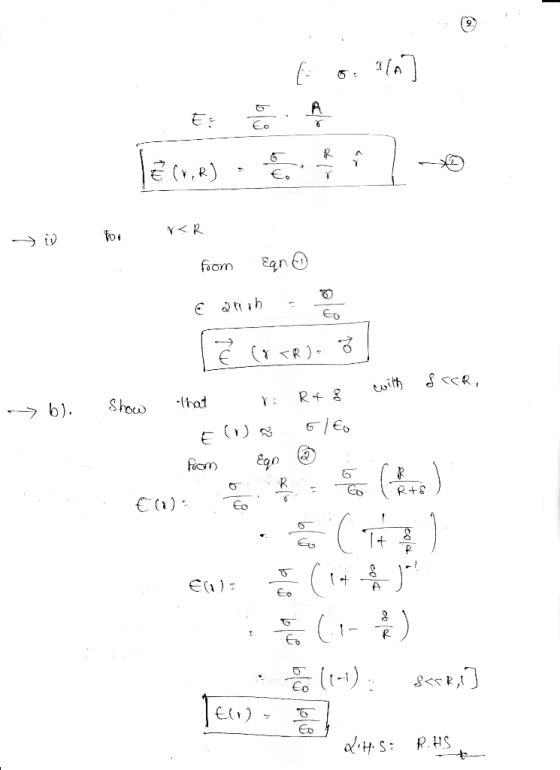
An infinitely long cylindrical conductor with radius R has a uniform surface charge density ơ on...
Q2. [20 pts) An infinitely long cylindrical conductor with radius a is placed in a uniform...
 Q2. [20 pts) An infinitely long cylindrical conductor with radius a is placed in a uniform electrical field Ē. The axis of the cylinder is perpendicular to Ē. Calculate the induced surface charge density o of the cylinder.
Consider an infinitely long, hollow cylinder of radius R with a uniform surface charge density σ....
Consider an infinitely long, hollow cylinder of radius R with a uniform surface charge density σ. 1. Find the electric field at distance r from the axis, where r < R. (Use any variable or symbol stated above along with the following as necessary: ε0.) 2. What is it for r > R? E(r>R) = ? Sketch E as a function of r, with r going from 0 to 3R. Make sure to label your axes and include scales (i.e.,...
An infinitely long, straight, cylindrical wire of radius R carries a uniform current density J. Using...
 An infinitely long, straight, cylindrical wire of radius R carries a uniform current density J. Using symmetry and Ampere's law, find the magnitude and direction of the magnetic field at a point inside the wire. For the purposes of this problem, use a cylindrical coordinate system with the current in the +z-direction, as shown coming out of the screen in the top illustration. The radial r-coordinate of each point is the distance to the central axis of the wire, and...
(1) Consider a very long uniformly charged cylinder with volume charge density p and radius R...
(1) Consider a very long uniformly charged cylinder with volume charge density p and radius R (we can consider the cylinder as infinitely long). Use Gauss's law to find the electric field produced inside and outside the cylinder. Check that the electric field that you calculate inside and outside the cylinder takes the same value at a distance R from the symmetry axis of the cylinder (on the surface of the cylinder) .
An infinitely long insulating cylinder of radius R has a volume charge density that varies with...
 An infinitely long insulating cylinder of radius R has a volume charge density that varies with the radius as given by the following expression where po. a, and bare positive constants and ris the distance from the axis of the cylinder Use Gauss's law to determine the magnitude of the electric field at r R. (Use the following as necessary: E0. Po. a, b, r, and R 2πεο 2.03b c) c) 2. R 3.b e) Po
An infinitely long insulating cylinder of radius R has a volume charge density that varies with...
 An infinitely long insulating cylinder of radius R has a volume charge density that varies with the radius as p po (a-where po a and b are positive constants and ris the distance from the axis of the cylinder. Use Gauss's law to determine the magnitude of the electric field at radial distances (a) r< R and (b)r>R
Problem 1. An infinitely long cylindrical shell extending between r-I m and r=3 m contains uniform...
 Problem 1. An infinitely long cylindrical shell extending between r-I m and r=3 m contains uniform charge density p.o. (a) Apply Gauss's law to find D in all regions. (b) In what situations can Gauss's law be applied? (c) What are the benefits of using Gauss's law over using Coulomb 's law.
Problem 1. An infinitely long cylindrical shell extending between r-I m and r=3 m contains uniform charge density p.o. (a) Apply Gauss's law to find D in all...
Problem 1. An infinitely long cylindrical shell extending between r-I m and r=3 m contains uniform charge density p.o. (a) Apply Gauss's law to find D in all regions. (b) In what situations can Gauss's law be applied? (c) What are the benefits of using Gauss's law over using Coulomb 's law.
Problem 1. An infinitely long cylindrical shell extending between r-I m and r=3 m contains uniform charge density p.o. (a) Apply Gauss's law to find D in all...
An infinitely long solid cylindrical insulator of radius 20.0 cm has a non-uniform volume charge density...
 An infinitely long solid cylindrical insulator of radius 20.0 cm has a non-uniform volume charge density of ρ-Ars where ρ is in C/m when r is in meters. Calculate the magnitude of the electric field at a distance of 10.00 cm from the axis of the cylinder.
A long, cylindrical non-conductor of radius R and length L is placed with it long axis...
 A long, cylindrical non-conductor of radius R and length L is placed with it long axis along the Z-axis as shown The cylinder has a total charge Q distributed non-uniformly thrpughout its volume. The charge density is only a function of the radial distance "r" from the cylinder axis and varies as ρ(r):- where α is a constant Vr. 2 +9R2 c) What coordinate system will you use? L (xy,z), (p,o,Z), (,o,)) d) What variables will the magnitude of the...
A long cylindrical charge distribution of radius 2.0 cm has a surface charge density σ =...
A long cylindrical charge distribution of radius 2.0 cm has a surface charge density σ = 18.0 [nC/m2] What is the approximate strength of the E-field a distance R = 12.0 [cm] from the central axis of the cylinder? Question 5 options: |E|= 2.7 x 10+10 [N/C] |E|= 27 [N/C] |E|= 1.8 x 10+12 [N/C] |E|= 2700 [N/C] |E|= 340 [N/C]
 Q2. [20 pts) An infinitely long cylindrical conductor with radius a is placed in a uniform electrical field Ē. The axis of the cylinder is perpendicular to Ē. Calculate the induced surface charge density o of the cylinder.
 An infinitely long, straight, cylindrical wire of radius R carries a uniform current density J. Using symmetry and Ampere's law, find the magnitude and direction of the magnetic field at a point inside the wire. For the purposes of this problem, use a cylindrical coordinate system with the current in the +z-direction, as shown coming out of the screen in the top illustration. The radial r-coordinate of each point is the distance to the central axis of the wire, and...
 An infinitely long insulating cylinder of radius R has a volume charge density that varies with the radius as given by the following expression where po. a, and bare positive constants and ris the distance from the axis of the cylinder Use Gauss's law to determine the magnitude of the electric field at r R. (Use the following as necessary: E0. Po. a, b, r, and R 2πεο 2.03b c) c) 2. R 3.b e) Po
 An infinitely long insulating cylinder of radius R has a volume charge density that varies with the radius as p po (a-where po a and b are positive constants and ris the distance from the axis of the cylinder. Use Gauss's law to determine the magnitude of the electric field at radial distances (a) r< R and (b)r>R
 Problem 1. An infinitely long cylindrical shell extending between r-I m and r=3 m contains uniform charge density p.o. (a) Apply Gauss's law to find D in all regions. (b) In what situations can Gauss's law be applied? (c) What are the benefits of using Gauss's law over using Coulomb 's law.
Problem 1. An infinitely long cylindrical shell extending between r-I m and r=3 m contains uniform charge density p.o. (a) Apply Gauss's law to find D in all...
Problem 1. An infinitely long cylindrical shell extending between r-I m and r=3 m contains uniform charge density p.o. (a) Apply Gauss's law to find D in all regions. (b) In what situations can Gauss's law be applied? (c) What are the benefits of using Gauss's law over using Coulomb 's law.
Problem 1. An infinitely long cylindrical shell extending between r-I m and r=3 m contains uniform charge density p.o. (a) Apply Gauss's law to find D in all...
 An infinitely long solid cylindrical insulator of radius 20.0 cm has a non-uniform volume charge density of ρ-Ars where ρ is in C/m when r is in meters. Calculate the magnitude of the electric field at a distance of 10.00 cm from the axis of the cylinder.
 A long, cylindrical non-conductor of radius R and length L is placed with it long axis along the Z-axis as shown The cylinder has a total charge Q distributed non-uniformly thrpughout its volume. The charge density is only a function of the radial distance "r" from the cylinder axis and varies as ρ(r):- where α is a constant Vr. 2 +9R2 c) What coordinate system will you use? L (xy,z), (p,o,Z), (,o,)) d) What variables will the magnitude of the...
Most questions answered within 3 hours.
-
Where is the error in this code sequence?
String s1 = "Hello";
String s2 = "ello";...
asked 11 months ago -
Financial data for Joel de Paris, Inc., for last year
follow:
Joel de Paris, Inc.
Balance...
asked 11 months ago -
Consider this reaction:
Al2(SO4)3 (aq)+ BaCl3
(aq) Al2Cl6 (aq)- +
3BaSO4(s) . What is the...
asked 11 months ago -
Suppose that Savneet is considering increasing her
recent random sample from 20 car rentals to 40...
asked 11 months ago -
Trucks arrive at an unloading terminal at an average rate of 120
per hour.
Trucks arrive...
asked 11 months ago -
Why are methanol and ethanol completely soluble in water while
octanol is not very little soluble....
asked 11 months ago -
A facilities manager at a university reads in a research report
that the mean amount of...
asked 11 months ago -
When the CuSO4 is rehydrated by adding water to the anhydrous
compound, is this an endothermic...
asked 11 months ago -
A ray of sunlight is passing from diamond into crown glass; the
angle of incidence is...
asked 11 months ago -
A block of mass 0.249 kg is placed on top of a light, vertical
spring of...
asked 11 months ago -
how do the kidneys compensate in the presences of acidosis
a) trigger hyperventilate
b) reserve acid...
asked 11 months ago -
Question 501 pts
The rental rate of capital to the firm increases. Which of the
following...
asked 11 months ago