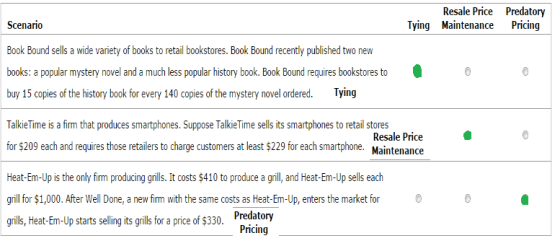
Complete the following table by indicating whether each of the scenarios describes the concept of tying, resale price maintenance, or predatory pricing.
10. Questionable business practices according to antitrust agencies
Complete the following table by indicating whether each of the scenarios describes the concept of tying, resale price maintenance, or predatory pricing.
Scenario
TalkieTime is a firm that produces smartphones. Suppose TalkieTime sells its smartphones to retail stores for $209 each and requires those retailers to charge customers at least $229 for each smartphone.
Heat-Em-Up is the only firm producing grills. It costs $410 to produce a grill, and Heat-Em-Up sells each grill for $1,000. After Well Done, a new firm with the same costs as Heat-Em-Up, enters the market for grills, Heat-Em-Up starts selling its grills for a price of $330.
Book Bound sells a wide variety of books to retail bookstores. Book Bound recently published two new books: a popular mystery novel and a much less popular history book. Book Bound requires bookstores to buy 15 copies of the history book for every 140 copies of the mystery novel ordered.
True or False: The only reason for Talkie Time to require retailers to sell smartphones at a certain price is to reduce competition and extend its market power to the retail market. Therefore, this practice is always economically inefficient.
Homework Answers
A predatory pricing is the pricing strategy where in the firm charges a price less than its marginal cost. This is done to wipe out competition.
Under a resale price maintenance, the manufaturers asks its retailers to maintain a minimum or maximum price.
Under a tying contract, the manufactuer makes it mandatory for its distributors to buy one product along with another.
FALSE- In bundling, two related goods are priced such that the price of bundled goods will be less than price of individual goods
Scenario 1 - Resale Price Maintenance
Explanation: Resale price maintenance occurs when a manufacturer agrees with a distributor on the price at which a product will be resold.
Scenario 2: Predatory Pricing
Explanation: Predatory pricing is setting a low price to drive competitors out of business with the intention of setting a monopoly price when the competition has gone
Scenario 3: Tying
Explanation: A tying arrangement is an agreement to sell one product only if the buyer agrees to also buy another different product.
Talkie Time to require retailers to sell smartphones at a certain price is not only reason to reduce competition and extend its market power to the retail market, other reasons are included. Thus it's economically efficient.
Hence, the given statement is false.
Add Answer to:
Complete the following table by indicating whether each of the scenarios describes the concept of tying, resale price maintenance, or predatory pricing.
Most questions answered within 3 hours.
-
Where is the error in this code sequence?
String s1 = "Hello";
String s2 = "ello";...
asked 10 months ago -
Financial data for Joel de Paris, Inc., for last year
follow:
Joel de Paris, Inc.
Balance...
asked 10 months ago -
Consider this reaction:
Al2(SO4)3 (aq)+ BaCl3
(aq) Al2Cl6 (aq)- +
3BaSO4(s) . What is the...
asked 10 months ago -
Suppose that Savneet is considering increasing her
recent random sample from 20 car rentals to 40...
asked 10 months ago -
Trucks arrive at an unloading terminal at an average rate of 120
per hour.
Trucks arrive...
asked 10 months ago -
Why are methanol and ethanol completely soluble in water while
octanol is not very little soluble....
asked 10 months ago -
A facilities manager at a university reads in a research report
that the mean amount of...
asked 10 months ago -
When the CuSO4 is rehydrated by adding water to the anhydrous
compound, is this an endothermic...
asked 10 months ago -
A ray of sunlight is passing from diamond into crown glass; the
angle of incidence is...
asked 10 months ago -
A block of mass 0.249 kg is placed on top of a light, vertical
spring of...
asked 10 months ago -
how do the kidneys compensate in the presences of acidosis
a) trigger hyperventilate
b) reserve acid...
asked 10 months ago -
Question 501 pts
The rental rate of capital to the firm increases. Which of the
following...
asked 10 months ago