Given the following production plan: Briefly explain the differences between a Chase Production Strategy and a...
Given the following production plan: Briefly explain the differences between a Chase Production Strategy and a Level Production Strategy, then use: (a) chase production strategy and (b) level production strategy to compute the monthly production, ending inventory or backlog, and workforce levels. A worker is capable of producing 50 units per month. Assume the beginning inventory as of January is 500 units, and the firm desires to have 200 units inventory at the end of June.
Demand production EI workforce - Month- 2000 Jan- 3000 Feb Mar- 5000 Apr-6000 May-6000 Jun-2000
Homework Answers
A chase production strategy involves producing the exact demand quantities by hiring and firing employees as required. In this strategy, the goal is to avoid inventory accumulation and keep the capacity exactly equal to the demand for all the periods. A level strategy, on the other hand, focuses on leveled resources and the same production output in every period. The protection against the fluctuation of demand is covered by the inventory built up or carried forward from the previous periods.
(a)
Chase plan:
| Jan | Feb | Mar | Apr | May | Jun | ||
| Demand | 2,000 | 3,000 | 5,000 | 6,000 | 6,000 | 2,000 | |
| Production | 1,500 | 3,000 | 5,000 | 6,000 | 6,000 | 2,200 | |
| Ending Inventory | 500 | 0 | 0 | 0 | 0 | 0 | 200 |
| Workforce | 30 | 60 | 100 | 120 | 120 | 44 | |
Calculations:
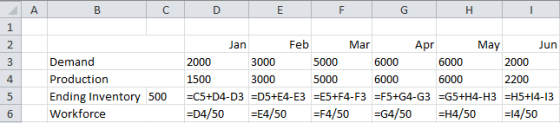
(b)
Level plan:
Total demand = 24,000
Net production required = 24000 - beginning inventory + ending inventory = 24000 - 500 + 200 = 23,700
So, monthly production level = 23700 / 6 = 3,950
| Jan | Feb | Mar | Apr | May | Jun | ||
| Demand | 2,000 | 3,000 | 5,000 | 6,000 | 6,000 | 2,000 | |
| Production | 3,950 | 3,950 | 3,950 | 3,950 | 3,950 | 3,950 | |
| Ending Inventory | 500 | 2,450 | 3,400 | 2,350 | 300 | -1,750 | 200 |
| Workforce | 79 | 79 | 79 | 79 | 79 | 79 | |
As we can see, a backorder of 1,750 units will occur in May which will be recovered in the next month.
Add Answer to:
Given the following production plan: Briefly explain the
differences between a Chase Production Strategy and a...
$75 $15 1 $20 Materials = Holding costs = Marginal cost of backorder = Hiring and...
 $75 $15 1 $20 Materials = Holding costs = Marginal cost of backorder = Hiring and training cost = Layoff costs = Straight time labor cost/hr. $250 $300 Beginning Workers Beginning inventory = Productive hours/worker/day = Paid straight hrs/day = Working days per month = Units per worker per month El ng Inventory goal (December) 110 2200 7.25 8 20 100 1000 $18 Question 8 1 pts Given the following production plan, use a level production strategy to compute the...
Given the following production plan, compute the monthly production, ending inventory/(backlog) and workforce levels using a...
Given the following production plan, compute the monthly production, ending inventory/(backlog) and workforce levels using a level production strategy. Assume that a worker can produce 30 units per month and the beginning inventory in June is 400 units, and the firm desires to have 200 units of inventory at the end of November. Month June Jul Aug Sep Oct Nov Demand 1500 2800 4200 3600 2350 1400 Production Ending Inventory Workforce
Using the information below, develop and aggregate plan by varying the workforce to produce the prior...
 Using the information below, develop and aggregate plan by varying the workforce to produce the prior month's demand. Utilize inventory and subcontract strategies along with the varying the workforce strategy. Compute the cost of this plan. 2. Subcontract cost $5O/unit Holding# $10/month Stock-out cost-$ S0/unit Hiring cost $40worker Layoffs cost $80/worker Initial inventory 100 units Units last period ?1400 units(December) Month Demand Forecast Jan 1200 Feb 1400 Mar 1600 Apr 1800 May 1800 June 2000 July 2000 Aug 1800
Q1. Prestige, Inc. needs an aggregate plan for its product line. As part of trying to...
 Q1. Prestige, Inc. needs an aggregate plan for its product line. As part of trying to maintain a lean production system, management prefers a constant workforce, no overtime, and constant production level. Relevant data follows: Item Data | Units Data Item | Data | Units Production time required labor hours per unit 4.5 Units % of monthly forecast 0% Hiring cost $10,000 Item Ending inventory target Shortage cost per person Straight time labor cost per hour $75 per unit Laying...
A. Aggregate Planning Problem 1. AUTO Inc. are in the process of developing an aggregate plan...
A. Aggregate Planning Problem 1. AUTO Inc. are in the process of developing an aggregate plan for their latest sports car, model "Sporty-Sprinty". Anticipated sales forecast in A.U. for the next four months is tabulated below: Month Jan Feb Mar April Sales forecast (A.U.) 100 200 300 600 Initial inventory (at the beginning of first month) = 100 A.U. Initial workforce level = 50 Minimum ending inventory required at the end of the plan = 30 A.U. Minimum...
Question The following table shows the monthly demand and beginning inventory of a company. A worker...
 Question The following table shows the monthly demand and beginning inventory of a company. A worker is capable of producing 50 units per month and the company wants to have zero inventory at the end of month 6. What months would there be under 50 required workers if it follows a chase production strategy? Time Running: H Attempt due: Jun 22 a 1 Hour, 26 Minut Month 4 emand 1000 1500 2500 3000 3000 1000 Beg. Inv. Regular Production Ending...
2.12. A company wants to develop a level production plan for a family of products. The...
 2.12. A company wants to develop a level production plan for a family of products. The opening inventory is 500 units, and a decrease to 100 units is expected by the end of the plan. The demand for each of the months is given in what follows. How much Production Planning System 37 should the company produce each month? What will be the ending inventory in each month? Do you see any problems with the plan? Month Jan Feb Mar...
Sales and Operations Planning ABC Manufacturing is developing their 2020 SOP. The sales plan is already...
Sales and Operations Planning ABC Manufacturing is developing their 2020 SOP. The sales plan is already developed, using the forecast obtained from Demand Management and is as follows: (the numbers are in 1000’s) Jan Feb Mar Apr May Jun Jul Aug Sep Oct Nov Dec 420 375 425 600 200 100 150 250 420 390 420 450 Other problem parameters are: Initial worker level = 500, Initial inventory = 100,000, Required ending inventory = 220,000, Cost per unit = $50,...
100 1500 Beginning Workers Beginning inventory = Productive hours/worker/day = Units per worker per month 6.75...
 100 1500 Beginning Workers Beginning inventory = Productive hours/worker/day = Units per worker per month 6.75 100 Feb Mar June Apr 13,300 May 11,000 13,250 7,200 15,700 Level Strategy Jan Demand 14,000 Beginning Inv. Net Requirements Beginning Workers Hired Fired Req. Workers Production Ending Inventory Using the level strategy, what is the ending inventory for June? 200 O 250 OO O-350
I. Describe the differences between level, chase, and mixed production plans. Use the forecast in the...
 I. Describe the differences between level, chase, and mixed production plans. Use the forecast in the table to show the differences by creating a plan of each type. There is no beginning inventory and regular production capacity is 350 units. Overtime costs $10 extra and is limited to 50 units per month. Subcontracting is limited to 100 units per month and costs $15 per unit. Back orders cost $40 per unit and there is a cost of $5 per month...
 $75 $15 1 $20 Materials = Holding costs = Marginal cost of backorder = Hiring and training cost = Layoff costs = Straight time labor cost/hr. $250 $300 Beginning Workers Beginning inventory = Productive hours/worker/day = Paid straight hrs/day = Working days per month = Units per worker per month El ng Inventory goal (December) 110 2200 7.25 8 20 100 1000 $18 Question 8 1 pts Given the following production plan, use a level production strategy to compute the...
 Using the information below, develop and aggregate plan by varying the workforce to produce the prior month's demand. Utilize inventory and subcontract strategies along with the varying the workforce strategy. Compute the cost of this plan. 2. Subcontract cost $5O/unit Holding# $10/month Stock-out cost-$ S0/unit Hiring cost $40worker Layoffs cost $80/worker Initial inventory 100 units Units last period ?1400 units(December) Month Demand Forecast Jan 1200 Feb 1400 Mar 1600 Apr 1800 May 1800 June 2000 July 2000 Aug 1800
 Q1. Prestige, Inc. needs an aggregate plan for its product line. As part of trying to maintain a lean production system, management prefers a constant workforce, no overtime, and constant production level. Relevant data follows: Item Data | Units Data Item | Data | Units Production time required labor hours per unit 4.5 Units % of monthly forecast 0% Hiring cost $10,000 Item Ending inventory target Shortage cost per person Straight time labor cost per hour $75 per unit Laying...
 Question The following table shows the monthly demand and beginning inventory of a company. A worker is capable of producing 50 units per month and the company wants to have zero inventory at the end of month 6. What months would there be under 50 required workers if it follows a chase production strategy? Time Running: H Attempt due: Jun 22 a 1 Hour, 26 Minut Month 4 emand 1000 1500 2500 3000 3000 1000 Beg. Inv. Regular Production Ending...
 2.12. A company wants to develop a level production plan for a family of products. The opening inventory is 500 units, and a decrease to 100 units is expected by the end of the plan. The demand for each of the months is given in what follows. How much Production Planning System 37 should the company produce each month? What will be the ending inventory in each month? Do you see any problems with the plan? Month Jan Feb Mar...
 100 1500 Beginning Workers Beginning inventory = Productive hours/worker/day = Units per worker per month 6.75 100 Feb Mar June Apr 13,300 May 11,000 13,250 7,200 15,700 Level Strategy Jan Demand 14,000 Beginning Inv. Net Requirements Beginning Workers Hired Fired Req. Workers Production Ending Inventory Using the level strategy, what is the ending inventory for June? 200 O 250 OO O-350
 I. Describe the differences between level, chase, and mixed production plans. Use the forecast in the table to show the differences by creating a plan of each type. There is no beginning inventory and regular production capacity is 350 units. Overtime costs $10 extra and is limited to 50 units per month. Subcontracting is limited to 100 units per month and costs $15 per unit. Back orders cost $40 per unit and there is a cost of $5 per month...
Most questions answered within 3 hours.
-
Where is the error in this code sequence?
String s1 = "Hello";
String s2 = "ello";...
asked 10 months ago -
Financial data for Joel de Paris, Inc., for last year
follow:
Joel de Paris, Inc.
Balance...
asked 10 months ago -
Consider this reaction:
Al2(SO4)3 (aq)+ BaCl3
(aq) Al2Cl6 (aq)- +
3BaSO4(s) . What is the...
asked 10 months ago -
Suppose that Savneet is considering increasing her
recent random sample from 20 car rentals to 40...
asked 10 months ago -
Trucks arrive at an unloading terminal at an average rate of 120
per hour.
Trucks arrive...
asked 10 months ago -
Why are methanol and ethanol completely soluble in water while
octanol is not very little soluble....
asked 10 months ago -
A facilities manager at a university reads in a research report
that the mean amount of...
asked 10 months ago -
When the CuSO4 is rehydrated by adding water to the anhydrous
compound, is this an endothermic...
asked 10 months ago -
A ray of sunlight is passing from diamond into crown glass; the
angle of incidence is...
asked 10 months ago -
A block of mass 0.249 kg is placed on top of a light, vertical
spring of...
asked 10 months ago -
how do the kidneys compensate in the presences of acidosis
a) trigger hyperventilate
b) reserve acid...
asked 10 months ago -
Question 501 pts
The rental rate of capital to the firm increases. Which of the
following...
asked 10 months ago