How to remove all occurrences of 2 from list2. Then display the list. Python import random...
How to remove all occurrences of 2 from list2. Then display the list. Python
import random
list1 = []
for i in range (10):
list1.append(random.randint(1,4))
print('List 1:')
print(list1)
list2 = []
list2.append(list1[5:])
print('List 2:')
print(list2)
list2.remove ******** (This is the part I am having trouble on!!)
print('List 2 with all 2s removed:')
print(list2)
Sample output:
List 1:
[4, 1, 1, 3, 3, 3, 2, 4, 2, 4]
List2:
[3, 2, 4, 2, 4]
List 2 with all 2s removed:
[3, 4, 4]
Homework Answers
Request Answer!
We need at least 10 more requests to produce the answer.
0 / 10 have requested this problem solution
The more requests, the faster the answer.
Add Answer to:
How to remove all occurrences of 2 from list2. Then display the
list. Python
import random...
Python Assignment: def sliceNdice(list2, s,e): L = len(list2) if(s>0 and s<e and e+s<=L): list1 = list2[s:e+s]...
Python Assignment: def sliceNdice(list2, s,e): L = len(list2) if(s>0 and s<e and e+s<=L): list1 = list2[s:e+s] else: list1 = [ ] return list1 refer to the code above. What is the value of L after line 2 and we call: x = sliceNdice([3,6,9,7] 2,6) 3. Refer to the previous question. What is happening at line 4? 4. For the code shown below: for num in range (1,4): print(num) What is the first value printed
How to input a list from user def SameIntheList(): list1 = list(input("Enter list1:")) list2 = list(input("Enter...
How to input a list from user def SameIntheList(): list1 = list(input("Enter list1:")) list2 = list(input("Enter list2:")) same_in_list = [] for i in list1: if i in list2: same_in_list.append(i) print(same_in_list) SameIntheList() ----------------- Enter list1:a,b,c Enter list2:a,b,g ['a', ',', 'b', ','] ---------------- I just want to display the same character in the 2 list ['a', 'b']
I try to define a PYTHON program that can print the largest factor of the number...
 I try to define a PYTHON program that can print the largest
factor of the number except for the number itself. Ex: enter n as
15, the program will print: 5. The factor of 15 is 15, 5, 3, 1, but
15 will not be counted in this case. If enter a prime number, it
will print 1.
I am not sure what I did wrong here, please point out my mistake
and advise how should I improve.
def largest_factor(n)...
I try to define a PYTHON program that can print the largest
factor of the number except for the number itself. Ex: enter n as
15, the program will print: 5. The factor of 15 is 15, 5, 3, 1, but
15 will not be counted in this case. If enter a prime number, it
will print 1.
I am not sure what I did wrong here, please point out my mistake
and advise how should I improve.
def largest_factor(n)...
How do i rewrite this code only using the list below? import java.util.ArrayList; import java.util.Collection; import...
How do i rewrite this code only using the list below? import java.util.ArrayList; import java.util.Collection; import java.util.List; import java.util.Set; import java.util.HashSet; public class RotationCheck { /** * Rotates the elements in the specified list by the specified distance. After calling this * method, the element at index {@code i} will be the element previously at index * {@code (i - distance) % list.size()}, for all values of {@code i} between {@code 0} and * {@code...
Something is preventing this python code from running properly. Can you please go through it and...
 Something is preventing this python code from running properly.
Can you please go through it and improve it so it can work. The
specifications are below the code. Thanks
list1=[]
list2=[]
def add_player():
d={}
name=input("Enter name of the player:")
d["name"]=name
position=input ("Enter a position:")
if position in Pos:
d["position"]=position
at_bats=int(input("Enter AB:"))
d["at_bats"] = at_bats
hits= int(input("Enter H:"))
d["hits"] = hits
d["AVG"]= hits/at_bats
list1.append(d)
def display():
if len(list1)==0:
print("{:15} {:8} {:8} {:8} {:8}".format("Player", "Pos", "AB",
"H", "AVG"))
print("ORIGINAL TEAM")
for x...
Something is preventing this python code from running properly.
Can you please go through it and improve it so it can work. The
specifications are below the code. Thanks
list1=[]
list2=[]
def add_player():
d={}
name=input("Enter name of the player:")
d["name"]=name
position=input ("Enter a position:")
if position in Pos:
d["position"]=position
at_bats=int(input("Enter AB:"))
d["at_bats"] = at_bats
hits= int(input("Enter H:"))
d["hits"] = hits
d["AVG"]= hits/at_bats
list1.append(d)
def display():
if len(list1)==0:
print("{:15} {:8} {:8} {:8} {:8}".format("Player", "Pos", "AB",
"H", "AVG"))
print("ORIGINAL TEAM")
for x...
(+30) Provide a python program which will Populate an array(list) of size 25 with integers in...
(+30) Provide a python program which will Populate an array(list) of size 25 with integers in the range -100 (negative 100) to +100 inclusive Display the array and its length (use the len function) Display the average of all the integers in the array Display the number of even integers (how many) Display the number of odd integers (how many) Display the number of integers > 0 (how many) Display the number of integers < 0 (how many) Display the...
How to write python code that is a dice rolling function that generates random numbers. The...
How to write python code that is a dice rolling function that generates random numbers. The dice rolling function takes two arguments: the first argument is the number of sides on the dice and the second argument is the number of dice. The function returns the sum of the random dice rolls. For example, if I call roll dice(6,2) it might return 7, which is the sum of randomly chosen numbers 4 and 3. It somewhere along the lines of:...
In Python 1 2 Write a function that removes all occurrences of a given letter from...
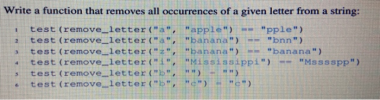 In Python
1 2 Write a function that removes all occurrences of a given letter from a string: test (remove_letter ("a", "apple") "pple") test (remove_letter ("a", "banana") "bnn") test (remove_letter (2", "banana") "banana") test (remove_letter ("i", "Mississippi") "Msssspp") test (remove letter (",) "") test (remove_letter("b","0"> MO) 4 5 ### Run the following lines. # If you get "Correct" you # did it right. if remove_letter("a", "banana") == "nn": print("Correct!") else: print("Incorrect :(")
In Python
1 2 Write a function that removes all occurrences of a given letter from a string: test (remove_letter ("a", "apple") "pple") test (remove_letter ("a", "banana") "bnn") test (remove_letter (2", "banana") "banana") test (remove_letter ("i", "Mississippi") "Msssspp") test (remove letter (",) "") test (remove_letter("b","0"> MO) 4 5 ### Run the following lines. # If you get "Correct" you # did it right. if remove_letter("a", "banana") == "nn": print("Correct!") else: print("Incorrect :(")
#python oop referencing attributes in objects # problem is the angle function in my class. import...
#python oop referencing attributes in objects # problem is the angle function in my class. import random class people(): def __init__(self,x,y,size_of_other_team): self.x=x self.y=y self.target = random.randint(0,size_of_other_team) # choose a random guy from other team def angle(self, other_teams_x, other_teams_y): # get angle between this guy and his target dx = other_teams_x[self.target]-self.x dy = other_teams_y[self.target]-self.y theta = math.atan(dy/dx) return(theta) def move(self): self.x+=1 red_guys = 10 blue_guys = 10 red_x=[] red_y=[] red=[] # objects list for i in range(red_guys): red_x.append(random.randint(0,100)) red_y.append(random.randint(0,100)) red_person =...
[Using Python] Create a program to generate one random question, from a list of 5, for...
[Using Python] Create a program to generate one random question, from a list of 5, for each repeated run. Report the number of the correct answers after all five questions have been answered. Your 5 questions should be a simple math problem, like "what is 5-4?" use a while loop based on the number of questions use a counter variable to count the number of questions asked e.g. questionCount +=1 user a counter variable to keep track of the correct...
 I try to define a PYTHON program that can print the largest
factor of the number except for the number itself. Ex: enter n as
15, the program will print: 5. The factor of 15 is 15, 5, 3, 1, but
15 will not be counted in this case. If enter a prime number, it
will print 1.
I am not sure what I did wrong here, please point out my mistake
and advise how should I improve.
def largest_factor(n)...
I try to define a PYTHON program that can print the largest
factor of the number except for the number itself. Ex: enter n as
15, the program will print: 5. The factor of 15 is 15, 5, 3, 1, but
15 will not be counted in this case. If enter a prime number, it
will print 1.
I am not sure what I did wrong here, please point out my mistake
and advise how should I improve.
def largest_factor(n)...
 Something is preventing this python code from running properly.
Can you please go through it and improve it so it can work. The
specifications are below the code. Thanks
list1=[]
list2=[]
def add_player():
d={}
name=input("Enter name of the player:")
d["name"]=name
position=input ("Enter a position:")
if position in Pos:
d["position"]=position
at_bats=int(input("Enter AB:"))
d["at_bats"] = at_bats
hits= int(input("Enter H:"))
d["hits"] = hits
d["AVG"]= hits/at_bats
list1.append(d)
def display():
if len(list1)==0:
print("{:15} {:8} {:8} {:8} {:8}".format("Player", "Pos", "AB",
"H", "AVG"))
print("ORIGINAL TEAM")
for x...
Something is preventing this python code from running properly.
Can you please go through it and improve it so it can work. The
specifications are below the code. Thanks
list1=[]
list2=[]
def add_player():
d={}
name=input("Enter name of the player:")
d["name"]=name
position=input ("Enter a position:")
if position in Pos:
d["position"]=position
at_bats=int(input("Enter AB:"))
d["at_bats"] = at_bats
hits= int(input("Enter H:"))
d["hits"] = hits
d["AVG"]= hits/at_bats
list1.append(d)
def display():
if len(list1)==0:
print("{:15} {:8} {:8} {:8} {:8}".format("Player", "Pos", "AB",
"H", "AVG"))
print("ORIGINAL TEAM")
for x...
 In Python
1 2 Write a function that removes all occurrences of a given letter from a string: test (remove_letter ("a", "apple") "pple") test (remove_letter ("a", "banana") "bnn") test (remove_letter (2", "banana") "banana") test (remove_letter ("i", "Mississippi") "Msssspp") test (remove letter (",) "") test (remove_letter("b","0"> MO) 4 5 ### Run the following lines. # If you get "Correct" you # did it right. if remove_letter("a", "banana") == "nn": print("Correct!") else: print("Incorrect :(")
In Python
1 2 Write a function that removes all occurrences of a given letter from a string: test (remove_letter ("a", "apple") "pple") test (remove_letter ("a", "banana") "bnn") test (remove_letter (2", "banana") "banana") test (remove_letter ("i", "Mississippi") "Msssspp") test (remove letter (",) "") test (remove_letter("b","0"> MO) 4 5 ### Run the following lines. # If you get "Correct" you # did it right. if remove_letter("a", "banana") == "nn": print("Correct!") else: print("Incorrect :(")
Most questions answered within 3 hours.
-
Where is the error in this code sequence?
String s1 = "Hello";
String s2 = "ello";...
asked 11 months ago -
Financial data for Joel de Paris, Inc., for last year
follow:
Joel de Paris, Inc.
Balance...
asked 11 months ago -
Consider this reaction:
Al2(SO4)3 (aq)+ BaCl3
(aq) Al2Cl6 (aq)- +
3BaSO4(s) . What is the...
asked 11 months ago -
Suppose that Savneet is considering increasing her
recent random sample from 20 car rentals to 40...
asked 11 months ago -
Trucks arrive at an unloading terminal at an average rate of 120
per hour.
Trucks arrive...
asked 11 months ago -
Why are methanol and ethanol completely soluble in water while
octanol is not very little soluble....
asked 11 months ago -
A facilities manager at a university reads in a research report
that the mean amount of...
asked 11 months ago -
When the CuSO4 is rehydrated by adding water to the anhydrous
compound, is this an endothermic...
asked 11 months ago -
A ray of sunlight is passing from diamond into crown glass; the
angle of incidence is...
asked 11 months ago -
A block of mass 0.249 kg is placed on top of a light, vertical
spring of...
asked 11 months ago -
how do the kidneys compensate in the presences of acidosis
a) trigger hyperventilate
b) reserve acid...
asked 11 months ago -
Question 501 pts
The rental rate of capital to the firm increases. Which of the
following...
asked 11 months ago