
Homework Answers
Add Answer to:
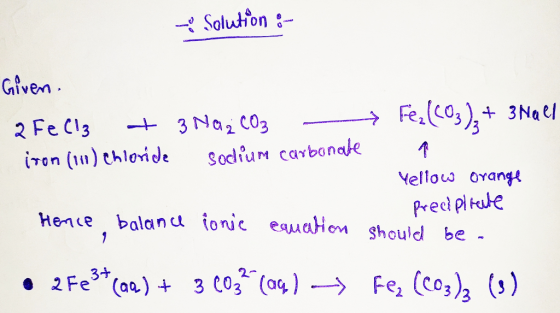
3. Design a reaction that produces an insolubie compound containing the iron(III) ion. There are several...
Choose the correct equation for the precipitation reaction of iron(III) nitrate with sodium dichromate. 2 Fe(NO3)3(aq)...
Choose the correct equation for the precipitation reaction of iron(III) nitrate with sodium dichromate. 2 Fe(NO3)3(aq) + 3 Na2CrO4(aq) --> Fe2(CrO4)3(s) + 6 NaNO3(aq) 2 Fe(NO3)3(aq) + 3 Na2CrO4(aq) --> Fe2(CrO4)3(aq) + 6 NaNO3(aq) Fe(NO3)2(aq) + Na2Cr2O7(aq) --> FeCr2O7(s) + 2 NaNO3(aq) 2 Fe(NO3)3(aq) + 3 Na2Cr2O7(aq) --> Fe2(Cr2O7)3(aq) + 6 NaNO3(aq) 2 Fe3(NO3)3(aq) + 3 Na2Cr2O7(aq) --> 3 Fe2Cr2O7(s) + 6 NaNO3(aq) 2 Fe(NO3)3(aq) + 3 Na2Cr2O7(aq) --> Fe2(Cr2O7)3(s) + 6 NaNO3(aq)
Multiple choice: 3. (5 pts.) The oxidation of copper metal by iron (III) chloride used in...
 Multiple choice: 3. (5 pts.) The oxidation of copper metal by iron (III) chloride used in the etching of circuit boards goes as follows: 2 Fe3+ (aq) + Cu (s) → 2 Fe2+ (aq) + Cu2+ (aq) The reduction potential for the Fe3+/Fe2+ and Cu2+/Cu pair are +0.772 V and -0.340 V, respectively. The concentrations are [Fe3+] = 1.24 M, [Fe2+] = .248 M, and [Cu2+] = .342 M. The electrical potential for this cell at 25.00C is: (a) +1.057...
In this experiment, we will be studying the reaction of the iron(III) ion with the thiocyanate...
 In this experiment, we will be studying the reaction of the iron(III) ion with the thiocyanate ion to form the red-colored complex ion pentaaquathiocyanatoiron(III), [Fe(H20)s(SCN)]?". As we will learn later, the Fetion in water is actually better represented as a complex ion with 6 water molecules attached to the central iron, [Fe(H20)] (aq). The SCN ion replaces one of the water molecules attached to the Fe" in the following reaction. [Fe(H2O).] (aq) + SCN (aq) [Fe(H2O)(SCN)]2(aq) + H2O(1) AH° (-)...
The metathesis reaction between iron (III) nitrate and sodium sulfide is shown below 2 Fe(NO3)3(aq) +...
The metathesis reaction between iron (III) nitrate and sodium sulfide is shown below 2 Fe(NO3)3(aq) + 3 Na2S (aq) ➝ 6 NaNO3(aq) + Fe2S3(s) How many grams of solid iron (III) sulfide can be produced by the reaction of 250.0 ml of 0.400 M iron (III) nitrate solution with 350.0 ml of 0.250 M sodium sulfide solution? Determine the final concentration of each ion in solution at the end of the precipitation reaction. Na+ NO3– Fe+3 S–2
3. (5 pts.) The oxidation of copper metal by iron (III) chloride used in the etching...
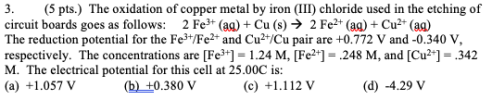 3. (5 pts.) The oxidation of copper metal by iron (III) chloride used in the etching of circuit boards goes as follows: 2 Fe3+ (aq) + Cu(s) → 2 Fe2+ (aq) + Cu2+ (aq) The reduction potential for the Fe3+/Fe2+ and Cu2+/Cu pair are +0.772 V and -0.340 V, respectively. The concentrations are [Fe3+] = 1.24 M, [Fe2+] = 248 M, and [Cu2+] = .342 M. The electrical potential for this cell at 25.00C is: (a) +1.057 V (b) +0.380...
Iron thiocyanate (FeSCN2+) is a complex ion that appears orange-red in solution. Iron(III) (Fe3+) and thiocyanate...
Iron thiocyanate (FeSCN2+) is a complex ion that appears orange-red in solution. Iron(III) (Fe3+) and thiocyanate (SCN-) are both colorless in solution. FeSCN2+ (aq) --(equilibrium)-- Fe3+ (aq) + SCN- (aq) a) If you add Fe(NO3)3 to a solution of these ions at equilibrium, in which direction will the reaction run to reach a new equilibrium? b) Silver ions react with thiocyanate ions to form a white precipitate. If you add silver ions to a solution of these ions at equilibrium,...
(a) Write the net ionic equation for the reaction of aqueous iron (II) ion reacting with...
(a) Write the net ionic equation for the reaction of aqueous iron (II) ion reacting with H2O2 in acidic medium. (b) If hydroxide ion is formed, the OH- may react with some of the Fe3+ to produce an insoluble hydroxide. Will the percent yield of the iron (III) compound containing a complex ion be affected by the formation of the insoluble hydroxide? (c) Write the balanced net ionic equation for the formtion of the insoluble hydroxide.
The following chemical reaction takes place in aqueous solution: 2 AgNO3(aq)+Na,CO3(aq) - Ag, CO3(s)+2 NaNO3(aq) Write...
 The following chemical reaction takes place in aqueous solution: 2 AgNO3(aq)+Na,CO3(aq) - Ag, CO3(s)+2 NaNO3(aq) Write the net ionic equation for this reaction.
Consider the following precipitation reaction: 2 K3PO4 (aq) + 3 Co(NO3)2 (aq) ? Co3(PO4)2 (s) +...
Consider the following precipitation reaction: 2 K3PO4 (aq) + 3 Co(NO3)2 (aq) ? Co3(PO4)2 (s) + 6 KNO3 (aq) What volume of 0.222 M K3PO4 (aq) in milliliters is needed to react with 36.75 mL of 0.250 M Co(NO3)2 (aq)? NG 5 6. Consider the following precipitation reaction: 5 Fe2+(aq) + MnO4-(aq) + 8 H+(aq) ? 5 Fe3+(aq) + Mn2+(aq) + 4 H2O(l) An iron sample weighing 0.214 g is converted into Fe2+(aq) and requires 31.57 mL of MnO4-(aq) according...
l Write the net ionic equation, including phases, that corresponds to the reaction Pb(ClO )2(aq) +...
 l
Write the net ionic equation, including phases, that corresponds to the reaction Pb(ClO )2(aq) + Na, S(aq) Pb(s) + 2 NaCIO, (aq) net ionic equation:
l
Write the net ionic equation, including phases, that corresponds to the reaction Pb(ClO )2(aq) + Na, S(aq) Pb(s) + 2 NaCIO, (aq) net ionic equation:
 Multiple choice: 3. (5 pts.) The oxidation of copper metal by iron (III) chloride used in the etching of circuit boards goes as follows: 2 Fe3+ (aq) + Cu (s) → 2 Fe2+ (aq) + Cu2+ (aq) The reduction potential for the Fe3+/Fe2+ and Cu2+/Cu pair are +0.772 V and -0.340 V, respectively. The concentrations are [Fe3+] = 1.24 M, [Fe2+] = .248 M, and [Cu2+] = .342 M. The electrical potential for this cell at 25.00C is: (a) +1.057...
 In this experiment, we will be studying the reaction of the iron(III) ion with the thiocyanate ion to form the red-colored complex ion pentaaquathiocyanatoiron(III), [Fe(H20)s(SCN)]?". As we will learn later, the Fetion in water is actually better represented as a complex ion with 6 water molecules attached to the central iron, [Fe(H20)] (aq). The SCN ion replaces one of the water molecules attached to the Fe" in the following reaction. [Fe(H2O).] (aq) + SCN (aq) [Fe(H2O)(SCN)]2(aq) + H2O(1) AH° (-)...
 3. (5 pts.) The oxidation of copper metal by iron (III) chloride used in the etching of circuit boards goes as follows: 2 Fe3+ (aq) + Cu(s) → 2 Fe2+ (aq) + Cu2+ (aq) The reduction potential for the Fe3+/Fe2+ and Cu2+/Cu pair are +0.772 V and -0.340 V, respectively. The concentrations are [Fe3+] = 1.24 M, [Fe2+] = 248 M, and [Cu2+] = .342 M. The electrical potential for this cell at 25.00C is: (a) +1.057 V (b) +0.380...
 The following chemical reaction takes place in aqueous solution: 2 AgNO3(aq)+Na,CO3(aq) - Ag, CO3(s)+2 NaNO3(aq) Write the net ionic equation for this reaction.
 l
Write the net ionic equation, including phases, that corresponds to the reaction Pb(ClO )2(aq) + Na, S(aq) Pb(s) + 2 NaCIO, (aq) net ionic equation:
l
Write the net ionic equation, including phases, that corresponds to the reaction Pb(ClO )2(aq) + Na, S(aq) Pb(s) + 2 NaCIO, (aq) net ionic equation:
Most questions answered within 3 hours.
-
Where is the error in this code sequence?
String s1 = "Hello";
String s2 = "ello";...
asked 11 months ago -
Financial data for Joel de Paris, Inc., for last year
follow:
Joel de Paris, Inc.
Balance...
asked 11 months ago -
Consider this reaction:
Al2(SO4)3 (aq)+ BaCl3
(aq) Al2Cl6 (aq)- +
3BaSO4(s) . What is the...
asked 11 months ago -
Suppose that Savneet is considering increasing her
recent random sample from 20 car rentals to 40...
asked 11 months ago -
Trucks arrive at an unloading terminal at an average rate of 120
per hour.
Trucks arrive...
asked 11 months ago -
Why are methanol and ethanol completely soluble in water while
octanol is not very little soluble....
asked 11 months ago -
A facilities manager at a university reads in a research report
that the mean amount of...
asked 11 months ago -
When the CuSO4 is rehydrated by adding water to the anhydrous
compound, is this an endothermic...
asked 11 months ago -
A ray of sunlight is passing from diamond into crown glass; the
angle of incidence is...
asked 11 months ago -
A block of mass 0.249 kg is placed on top of a light, vertical
spring of...
asked 11 months ago -
how do the kidneys compensate in the presences of acidosis
a) trigger hyperventilate
b) reserve acid...
asked 11 months ago -
Question 501 pts
The rental rate of capital to the firm increases. Which of the
following...
asked 11 months ago