
Homework Answers

Add Answer to:
I know the answer to a) is 37.7 m/s and the answer to b) is
28.36...
1 pts Question 5 5) A ball is launched straight upwards at 11 m/s from the...
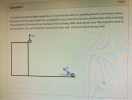 1 pts Question 5 5) A ball is launched straight upwards at 11 m/s from the side of a building which is 134 meters above the ground. At the exact same time, a projectile is launched from the ground (the base of the building). The projectile is 39 meters from the base of the building. With what speed does the projectile need to be launched, in m/s, such that the it strikes the other ball, 16 meters above the ground?
A projectile is fired from the ground, reaches a maximum height of 50.8 m and lands...
A projectile is fired from the ground, reaches a maximum height of 50.8 m and lands a distance of 39.1 m away from the launch point. What was the projectile s launch velocity? You launch a projectile toward a tall building, from a position on the ground 39.3 m away from the base of the building. The projectile s initial velocity is 45.9 m/s at an angle of 58.7 degrees above the horizontal. At what height above the ground does...
1 pts Question 6 6) A ball is launched straight upwards at 12 m/s from the...
 1 pts Question 6 6) A ball is launched straight upwards at 12 m/s from the side of a building which is 101 meters above the ground. At the exact same time, a projectile is launched from the ground (the base of the building). The projectile is 55 meters from the base of the building. If the projectile strikes the other ball 20 meters above the ground, at what angle, in degrees, does it hit the other ball? If below...
A projectile is launched horizontally at 32.4 m/s from the roof of a building 35m tall...
A projectile is launched horizontally at 32.4 m/s from the roof of a building 35m tall and experiences negligible air resistance. [A] Determine the time necessary for the projectile to reach the ground below. [B] Determine the distance from the base of the building that the projectile lands. (Range) [C] Using the horizontal and vertical components of the velocity just before the projectile reaches the ground (Vx and Vy). And determine the final velocity of the projectile (Vf).
. A projectile is projected on the ground with a velocity of 40.0 m/s at an...
. A projectile is projected on the ground with a velocity of 40.0 m/s at an angle of 60.0 degrees above the horizontal. On its way down, it lands on a rooftop of 3.0m high. What is the horizontal distance between the launching and landing points
Please help solve! 12. A playground is on the flat roof of a city school, hb...
 Please help solve!
12. A playground is on the flat roof of a city school, hb = 5.40 m above the street below (see figure). The vertical wall of the building is h = 6.90 m high, to form a 1.5 - m - high railing around the playground. A ball has fallen to the street below, and a passerby returns it by launching it at an angle of theta = 53.0� above the horizontal at a point d =...
Please help solve!
12. A playground is on the flat roof of a city school, hb = 5.40 m above the street below (see figure). The vertical wall of the building is h = 6.90 m high, to form a 1.5 - m - high railing around the playground. A ball has fallen to the street below, and a passerby returns it by launching it at an angle of theta = 53.0� above the horizontal at a point d =...
. A playground is on the flat roof of a city school, 6.00 m above the...
 . A playground is on the flat roof of a city school, 6.00 m above the street below (Fig. P3.34). The vertical wall of the building is h = 7.00 m high, to form a l-m-high railing around the playground. A ball has fallen to the street below, and a passerby returns it by launching it at an angle of = 53.0° above the horizontal at a point d = 24.0 m from the base of the building wall. The...
. A playground is on the flat roof of a city school, 6.00 m above the...
 . A playground is on the flat roof of a city school, 6.00 m above the street below (Fig. P3.34). The vertical wall of the building is h = 7.00 m high, to form a l-m-high railing around the playground. A ball has fallen to the street below, and a passerby returns it by launching it at an angle of = 53.0° above the horizontal at a point d = 24.0 m from the base of the building wall. The...
A playground is on the flat roof of a city school, 5.8 m above the street...
A playground is on the flat roof of a city school, 5.8 m above the street below (see figure). The vertical wall of the building is h = 7.20 m high, to form a 1.4-m-high railing around the playground. A ball has fallen to the street below, and a passerby returns it by launching it at an angle of θ = 53.0° above the horizontal at a point d = 24.0 m from the base of the building wall. The...
A playground is on the flat roof of a city school, 8.00 m above the street...
 A playground is on the flat roof of a city school, 8.00 m above the street below (Figure 2). The vextical wall of ihe buildin is 10.00 m hih, fming a 2.0-n h railing an playground. A ball has fallen to the street below, and a passerby returns it by launching it at an angle of 60.0° above the horizontal at a point d -25.0 m from the base of the building wall. The ball takes 2.5 s to reach...
 1 pts Question 5 5) A ball is launched straight upwards at 11 m/s from the side of a building which is 134 meters above the ground. At the exact same time, a projectile is launched from the ground (the base of the building). The projectile is 39 meters from the base of the building. With what speed does the projectile need to be launched, in m/s, such that the it strikes the other ball, 16 meters above the ground?
 1 pts Question 6 6) A ball is launched straight upwards at 12 m/s from the side of a building which is 101 meters above the ground. At the exact same time, a projectile is launched from the ground (the base of the building). The projectile is 55 meters from the base of the building. If the projectile strikes the other ball 20 meters above the ground, at what angle, in degrees, does it hit the other ball? If below...
 Please help solve!
12. A playground is on the flat roof of a city school, hb = 5.40 m above the street below (see figure). The vertical wall of the building is h = 6.90 m high, to form a 1.5 - m - high railing around the playground. A ball has fallen to the street below, and a passerby returns it by launching it at an angle of theta = 53.0� above the horizontal at a point d =...
Please help solve!
12. A playground is on the flat roof of a city school, hb = 5.40 m above the street below (see figure). The vertical wall of the building is h = 6.90 m high, to form a 1.5 - m - high railing around the playground. A ball has fallen to the street below, and a passerby returns it by launching it at an angle of theta = 53.0� above the horizontal at a point d =...
 . A playground is on the flat roof of a city school, 6.00 m above the street below (Fig. P3.34). The vertical wall of the building is h = 7.00 m high, to form a l-m-high railing around the playground. A ball has fallen to the street below, and a passerby returns it by launching it at an angle of = 53.0° above the horizontal at a point d = 24.0 m from the base of the building wall. The...
 . A playground is on the flat roof of a city school, 6.00 m above the street below (Fig. P3.34). The vertical wall of the building is h = 7.00 m high, to form a l-m-high railing around the playground. A ball has fallen to the street below, and a passerby returns it by launching it at an angle of = 53.0° above the horizontal at a point d = 24.0 m from the base of the building wall. The...
 A playground is on the flat roof of a city school, 8.00 m above the street below (Figure 2). The vextical wall of ihe buildin is 10.00 m hih, fming a 2.0-n h railing an playground. A ball has fallen to the street below, and a passerby returns it by launching it at an angle of 60.0° above the horizontal at a point d -25.0 m from the base of the building wall. The ball takes 2.5 s to reach...
Most questions answered within 3 hours.
-
Where is the error in this code sequence?
String s1 = "Hello";
String s2 = "ello";...
asked 10 months ago -
Financial data for Joel de Paris, Inc., for last year
follow:
Joel de Paris, Inc.
Balance...
asked 10 months ago -
Consider this reaction:
Al2(SO4)3 (aq)+ BaCl3
(aq) Al2Cl6 (aq)- +
3BaSO4(s) . What is the...
asked 10 months ago -
Suppose that Savneet is considering increasing her
recent random sample from 20 car rentals to 40...
asked 10 months ago -
Trucks arrive at an unloading terminal at an average rate of 120
per hour.
Trucks arrive...
asked 10 months ago -
Why are methanol and ethanol completely soluble in water while
octanol is not very little soluble....
asked 10 months ago -
A facilities manager at a university reads in a research report
that the mean amount of...
asked 10 months ago -
When the CuSO4 is rehydrated by adding water to the anhydrous
compound, is this an endothermic...
asked 10 months ago -
A ray of sunlight is passing from diamond into crown glass; the
angle of incidence is...
asked 10 months ago -
A block of mass 0.249 kg is placed on top of a light, vertical
spring of...
asked 10 months ago -
how do the kidneys compensate in the presences of acidosis
a) trigger hyperventilate
b) reserve acid...
asked 10 months ago -
Question 501 pts
The rental rate of capital to the firm increases. Which of the
following...
asked 10 months ago