Determine the truth value (using T or F) of the following complex propositions where v(A)=T, v(B)=F,...
Determine the truth value (using T or F) of the following complex propositions where v(A)=T, v(B)=F, v(D)=T (A<->B)^B
Homework Answers
v(D)=T (A<->B)^B
where v(A)=T, v(B)=F
| A | B | ((A ↔ B) ∧ B) |
|---|---|---|
| F | F | F |
| F | T | F |
| T | F | F |
| T | T | T |
If we replace directly v(A) = T and v(B) = F then the table will look like below:
| ((⊤ ↔ ⊥) ∧ ⊥) |
|---|
| F |
Add Answer to:
Determine the truth value (using T or F) of the following
complex propositions where v(A)=T, v(B)=F,...
Determine the truth value of the statement (p V-) A [-(p Ar)] using the following conditions....
 Determine the truth value of the statement (p V-) A [-(p Ar)] using the following conditions. a) p is false, 9 is false, and r is false. b) p is false, q is true, and r is true. a) If p is false, q is false, and ris false, what is the value of (p V-) A (-(PA r)]? O O False True b) If p is false, 9 is true, and r is true, what is the value of...
Here is a truth table for three mystery compound propositions Pi, P2, and P3, each consisting...
 Here is a truth table for three mystery compound propositions Pi, P2, and P3, each consisting of the propositional variables w, x, y, 2. 1 2 13 TTTFT TF TTFTTFT TTFFTFF TFF T TFF FTFTTT FT FF FF F FF TFTTF FFFTFFT FFFFTFT ts) a. Is (R Λ P ) → P a tautology? If so, explain. If not, give all counterexamples ts) b. Is P → (R v PJ ) a contradiction? If so, explain. If not, give all...
The following periodic v(t) function will be used to answer: a. Determine the period T b....
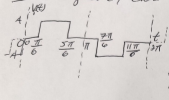 The
following periodic v(t) function will be used to answer:
a. Determine the period T
b. determine the frequency, f
c. determine the angular frequency, w
d. calculate A such that Vrms(t)= 120 Vrms
e. calculate ao, an, ab
f. calulate the values bn if nE [1 5]
g. determine the THD of v(t) using the first 5 harmonics
h. write the Fourieride approximation v(t)
The
following periodic v(t) function will be used to answer:
a. Determine the period T
b. determine the frequency, f
c. determine the angular frequency, w
d. calculate A such that Vrms(t)= 120 Vrms
e. calculate ao, an, ab
f. calulate the values bn if nE [1 5]
g. determine the THD of v(t) using the first 5 harmonics
h. write the Fourieride approximation v(t)
1 15 oints) Deterine if the following propositions are TRUE or FALSE. Note that p, q...
 1 15 oints) Deterine if the following propositions are TRUE or FALSE. Note that p, q r are propositi Px) and P(x.y) are predicates. RUE or FALSE.Note that p, q, r are propositions. (a).TNE 1f2小5or I + 1-3, then 10+2-3or 2 + 2-4. (b).TRvE+1 0 if and only if 2+ 2 5. (d). _ p v T Ξ T, where p is a proposition and T is tautology. V x Px) is equivalent to Vx - Px) (g). ㅡㅡㅡ, y...
3)Show that the truth function f(A, B, C) (A V B) C generates all truth functions. (Hint: Show that it generates two...
 3)Show that the truth function f(A, B, C) (A V B) C generates all truth functions. (Hint: Show that it generates two connectives that form adequate set.) an
3)Show that the truth function f(A, B, C) (A V B) C generates all truth functions. (Hint: Show that it generates two connectives that form adequate set.) an
3)Show that the truth function f(A, B, C) (A V B) C generates all truth functions. (Hint: Show that it generates two connectives that form adequate set.) an
------------------------------------------- Define the following propositions: c: I will return to college. j: I will get a...
------------------------------------------- Define the following propositions: c: I will return to college. j: I will get a job. Translate the following English sentences into logical expressions using the definitions above: (a) Not getting a job is a sufficient condition for me to return to college. (b) If I return to college, then I won't get a job. (c) I am not getting a job, but I am still not returning to college. (d) I will return to college only if I...
Determine the complex transfer function T(s) = V/V; for the circuit shown below. Specify it as...
 Determine the complex transfer function T(s) = V/V; for the circuit shown below. Specify it as a function of the complex frequency, s, and the symbols for the resistors and capacitor. On the attached graph, plot the magnitude of the complex transfer function T(jw) in decibels as a function of the frequency f of the source as f varies from 1 Hz to 1 MHz. Assume that the op amp is ideal. Use as the numerical values for the resistors...
Given that f (t) e-au(t to), where a 0, determine the Fourier transform F() of f(t)....
 Given that f (t) e-au(t to), where a 0, determine the Fourier transform F() of f(t). 7.1 (b) Given that where a > 0, determine the Fourier transform G (w) of g(0) by using the symmetry property and the result of part (a). Confirm the result of part (b) by calculating g) from G(w), using the inverse Fourier transform integral
Directions. Determine whether the following three arguments are valid using the truth table method. Use the...
Directions. Determine whether the following three arguments are valid using the truth table method. Use the Indirect Truth Table method as found in the link on Canvas. Indicate whether each is valid or not. Note that ‘//’ is used as the conclusion indicator and ‘/’ is used to separate the premises. [Note: Use only the following logical symbols: ‘&’ for conjunctions, ‘v’ for disjunctions, ‘->’ for conditionals, ‘<->’ for biconditionals, ‘~’ for negations.] Show your truth tables. 1. (S <->...
(1) Are the following propositions? (e) The sun is shining. (b) It rained in Austin, TX, on October 30, 1999. (c) Come to class! (d) Is it raining? (2) Write each sentence in symbols using P- It...
 (1) Are the following propositions? (e) The sun is shining. (b) It rained in Austin, TX, on October 30, 1999. (c) Come to class! (d) Is it raining? (2) Write each sentence in symbols using P- It is hot. and Q- It is sunny (a) It is sunny and hot. (b) It is not hot but it is sunny. (c) It is neither hot nor sunny (3) If P - Today it is raining, and Q-Today it is snowing. (a)...
 Determine the truth value of the statement (p V-) A [-(p Ar)] using the following conditions. a) p is false, 9 is false, and r is false. b) p is false, q is true, and r is true. a) If p is false, q is false, and ris false, what is the value of (p V-) A (-(PA r)]? O O False True b) If p is false, 9 is true, and r is true, what is the value of...
 Here is a truth table for three mystery compound propositions Pi, P2, and P3, each consisting of the propositional variables w, x, y, 2. 1 2 13 TTTFT TF TTFTTFT TTFFTFF TFF T TFF FTFTTT FT FF FF F FF TFTTF FFFTFFT FFFFTFT ts) a. Is (R Λ P ) → P a tautology? If so, explain. If not, give all counterexamples ts) b. Is P → (R v PJ ) a contradiction? If so, explain. If not, give all...
 The
following periodic v(t) function will be used to answer:
a. Determine the period T
b. determine the frequency, f
c. determine the angular frequency, w
d. calculate A such that Vrms(t)= 120 Vrms
e. calculate ao, an, ab
f. calulate the values bn if nE [1 5]
g. determine the THD of v(t) using the first 5 harmonics
h. write the Fourieride approximation v(t)
The
following periodic v(t) function will be used to answer:
a. Determine the period T
b. determine the frequency, f
c. determine the angular frequency, w
d. calculate A such that Vrms(t)= 120 Vrms
e. calculate ao, an, ab
f. calulate the values bn if nE [1 5]
g. determine the THD of v(t) using the first 5 harmonics
h. write the Fourieride approximation v(t)
 1 15 oints) Deterine if the following propositions are TRUE or FALSE. Note that p, q r are propositi Px) and P(x.y) are predicates. RUE or FALSE.Note that p, q, r are propositions. (a).TNE 1f2小5or I + 1-3, then 10+2-3or 2 + 2-4. (b).TRvE+1 0 if and only if 2+ 2 5. (d). _ p v T Ξ T, where p is a proposition and T is tautology. V x Px) is equivalent to Vx - Px) (g). ㅡㅡㅡ, y...
 3)Show that the truth function f(A, B, C) (A V B) C generates all truth functions. (Hint: Show that it generates two connectives that form adequate set.) an
3)Show that the truth function f(A, B, C) (A V B) C generates all truth functions. (Hint: Show that it generates two connectives that form adequate set.) an
3)Show that the truth function f(A, B, C) (A V B) C generates all truth functions. (Hint: Show that it generates two connectives that form adequate set.) an
 Determine the complex transfer function T(s) = V/V; for the circuit shown below. Specify it as a function of the complex frequency, s, and the symbols for the resistors and capacitor. On the attached graph, plot the magnitude of the complex transfer function T(jw) in decibels as a function of the frequency f of the source as f varies from 1 Hz to 1 MHz. Assume that the op amp is ideal. Use as the numerical values for the resistors...
 Given that f (t) e-au(t to), where a 0, determine the Fourier transform F() of f(t). 7.1 (b) Given that where a > 0, determine the Fourier transform G (w) of g(0) by using the symmetry property and the result of part (a). Confirm the result of part (b) by calculating g) from G(w), using the inverse Fourier transform integral
 (1) Are the following propositions? (e) The sun is shining. (b) It rained in Austin, TX, on October 30, 1999. (c) Come to class! (d) Is it raining? (2) Write each sentence in symbols using P- It is hot. and Q- It is sunny (a) It is sunny and hot. (b) It is not hot but it is sunny. (c) It is neither hot nor sunny (3) If P - Today it is raining, and Q-Today it is snowing. (a)...
Most questions answered within 3 hours.
-
Where is the error in this code sequence?
String s1 = "Hello";
String s2 = "ello";...
asked 10 months ago -
Financial data for Joel de Paris, Inc., for last year
follow:
Joel de Paris, Inc.
Balance...
asked 10 months ago -
Consider this reaction:
Al2(SO4)3 (aq)+ BaCl3
(aq) Al2Cl6 (aq)- +
3BaSO4(s) . What is the...
asked 10 months ago -
Suppose that Savneet is considering increasing her
recent random sample from 20 car rentals to 40...
asked 10 months ago -
Trucks arrive at an unloading terminal at an average rate of 120
per hour.
Trucks arrive...
asked 10 months ago -
Why are methanol and ethanol completely soluble in water while
octanol is not very little soluble....
asked 10 months ago -
A facilities manager at a university reads in a research report
that the mean amount of...
asked 10 months ago -
When the CuSO4 is rehydrated by adding water to the anhydrous
compound, is this an endothermic...
asked 10 months ago -
A ray of sunlight is passing from diamond into crown glass; the
angle of incidence is...
asked 10 months ago -
A block of mass 0.249 kg is placed on top of a light, vertical
spring of...
asked 10 months ago -
how do the kidneys compensate in the presences of acidosis
a) trigger hyperventilate
b) reserve acid...
asked 10 months ago -
Question 501 pts
The rental rate of capital to the firm increases. Which of the
following...
asked 10 months ago