
Homework Answers


Add Answer to:
Can you do just d and e?
1. Compute each of the following Galois groups. Which...
G. Shorter Questions Relating to Automorphisms and Galois Groups Let F be a field, and K a finite extension of F. Suppose a, b E K. Prove parts 1-3: 1 If an automorphism h of K fixes Fand a, then h f...
 G. Shorter Questions Relating to Automorphisms and Galois Groups Let F be a field, and K a finite extension of F. Suppose a, b E K. Prove parts 1-3: 1 If an automorphism h of K fixes Fand a, then h fixes F(a). 3 Aside from the identity function, there are no a-fixing automorphisms of a(). [HINT: Note that aV2 contains only real numbers.] 4 Explain why the conclusion of part 3 does not contradict Theorem 1.
G. Shorter Questions...
G. Shorter Questions Relating to Automorphisms and Galois Groups Let F be a field, and K a finite extension of F. Suppose a, b E K. Prove parts 1-3: 1 If an automorphism h of K fixes Fand a, then h fixes F(a). 3 Aside from the identity function, there are no a-fixing automorphisms of a(). [HINT: Note that aV2 contains only real numbers.] 4 Explain why the conclusion of part 3 does not contradict Theorem 1.
G. Shorter Questions...
3.2.6. Graph the 27 periodic extension of each of the following functions. Which extensions are continuous?...
 3.2.6. Graph the 27 periodic extension of each of the following functions. Which extensions are continuous? Differentiable? (A) 32, (b) (3? - ?), (c) e" (d) ell, (e) sinha, (f) 1+ cos²a; (g) sin jna, (h) (1) 1+22
Q(G), where ζ7 is a primitive 7th root of 1 . Then E is the splitting...
 Q(G), where ζ7 is a primitive 7th root of 1 . Then E is the splitting field of 2. Let E x7-1 over Q (equivalently, E is the splitting field of Ф7(x) over (2). (a) Find the Gauss sums for the subfields of Gal(E/Q). (b) Exhibit the Galois correspondence between Lat(E/Q) and Sub(G), where G Gal(Q(S7)/Q). (c) Identify the fixed subfields of each subgroup (using the Gauss sums earlier com- puted).
4. H ere are some True/False questions. If your answer is "TRUE", there is no need to justify you...
 4. H ere are some True/False questions. If your answer is "TRUE", there is no need to justify your answer. If your answer is "FALSE", then you should justity your answer with a counterexample or explanation. There are also some "short-answer" questions. . A. (True-False). Every simple field extension of K is a finite field extension. . B. (True-False). Let R⑥ F be a field extension. Suppose that F is a of u E F, and splitting field for the...
3. Consider the group Z45 (a) Give an example of a subnormal series which is not a composition se...
 just part c and d
3. Consider the group Z45 (a) Give an example of a subnormal series which is not a composition series. Explain why your example works. (b) Find a refinement of the series you gave above which is a composition series. That is, show how to extend your series into a composition series. (c) Find all other composition series and briefly explain how you know you have them all. (d) If p(x) is a polynomial whose splitting...
just part c and d
3. Consider the group Z45 (a) Give an example of a subnormal series which is not a composition series. Explain why your example works. (b) Find a refinement of the series you gave above which is a composition series. That is, show how to extend your series into a composition series. (c) Find all other composition series and briefly explain how you know you have them all. (d) If p(x) is a polynomial whose splitting...
1. Functinal Groups Name each of the functional groups indicated below: B A D N С...
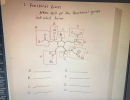 1. Functinal Groups Name each of the functional groups indicated below: B A D N С Br E 20 F 20 H NA G 9/20 A. ITI 27/20 SOVA 727/20 B. F G. C. H. indet 7/27/20 more eights each 7/27/20 INTDO D.
Consider the following two propositions: Problem 2: P (AV B)C Which of the following best describes...
 Consider the following two propositions: Problem 2: P (AV B)C Which of the following best describes the relationship between P and Q? Circle only one answer and are equivalent te 4. All of the above 5. None of the above Problem 1: Let B, C, D, E be the following sets 1. Which pair of these sets has the property that neither is contained in the other? 2. You are given that X is one of the sets B,C, D,...
Can u guys hlep me answer each of those questions please Thanks in advance. could you...
 Can u guys hlep me answer each of those questions please Thanks in
advance. could you guys do them step by step and explain which
rules u guys are used as you guys are doing the problems.
please.
(9) Find the derivative of each of the following: (a) y = 3,5-1 – VI + V2 (d) y = sin-(In x) (8) y = In V272422+3 In 2x – 1 x2 + 2x + 3 (j) y=7" + x1 (b) -...
Can u guys hlep me answer each of those questions please Thanks in
advance. could you guys do them step by step and explain which
rules u guys are used as you guys are doing the problems.
please.
(9) Find the derivative of each of the following: (a) y = 3,5-1 – VI + V2 (d) y = sin-(In x) (8) y = In V272422+3 In 2x – 1 x2 + 2x + 3 (j) y=7" + x1 (b) -...
I've figured out A-C, I'm just not sure how to start D and E Problem 5:...
 I've figured out A-C, I'm just not sure how to start D and E
Problem 5: A spherica charge Q-25 nC. The capacitance for this spherical capacitor is given by the equation C-4τε0R l capacitor consists of a single conducting sphere of radius R-12 cm that carries a positive Part (a) Write an equation for the energy stored in a spherical capacitor when a charge Q is placed on the capacitor. Write your equation in terms of R, Q, and...
I've figured out A-C, I'm just not sure how to start D and E
Problem 5: A spherica charge Q-25 nC. The capacitance for this spherical capacitor is given by the equation C-4τε0R l capacitor consists of a single conducting sphere of radius R-12 cm that carries a positive Part (a) Write an equation for the energy stored in a spherical capacitor when a charge Q is placed on the capacitor. Write your equation in terms of R, Q, and...
1. Given matrices (A), [B][C], [D], and [E] compute the following. You must show all the...
 1. Given matrices (A), [B][C], [D], and [E] compute the following. You must show all the steps in your solution to receive credit. (2 points each) -1 3 1] [-2 1 [-2 4 1 [A]*[B] [B]*[C] [D]*[A] [C*E] det[B] det[D] My of [D] M22 of [D] M21 of [D] Write the following system of equations in matrix form x-5y+32-6=0 3y +2x = -11 3x-7z+15= 0
 G. Shorter Questions Relating to Automorphisms and Galois Groups Let F be a field, and K a finite extension of F. Suppose a, b E K. Prove parts 1-3: 1 If an automorphism h of K fixes Fand a, then h fixes F(a). 3 Aside from the identity function, there are no a-fixing automorphisms of a(). [HINT: Note that aV2 contains only real numbers.] 4 Explain why the conclusion of part 3 does not contradict Theorem 1.
G. Shorter Questions...
G. Shorter Questions Relating to Automorphisms and Galois Groups Let F be a field, and K a finite extension of F. Suppose a, b E K. Prove parts 1-3: 1 If an automorphism h of K fixes Fand a, then h fixes F(a). 3 Aside from the identity function, there are no a-fixing automorphisms of a(). [HINT: Note that aV2 contains only real numbers.] 4 Explain why the conclusion of part 3 does not contradict Theorem 1.
G. Shorter Questions...
 3.2.6. Graph the 27 periodic extension of each of the following functions. Which extensions are continuous? Differentiable? (A) 32, (b) (3? - ?), (c) e" (d) ell, (e) sinha, (f) 1+ cos²a; (g) sin jna, (h) (1) 1+22
 Q(G), where ζ7 is a primitive 7th root of 1 . Then E is the splitting field of 2. Let E x7-1 over Q (equivalently, E is the splitting field of Ф7(x) over (2). (a) Find the Gauss sums for the subfields of Gal(E/Q). (b) Exhibit the Galois correspondence between Lat(E/Q) and Sub(G), where G Gal(Q(S7)/Q). (c) Identify the fixed subfields of each subgroup (using the Gauss sums earlier com- puted).
 4. H ere are some True/False questions. If your answer is "TRUE", there is no need to justify your answer. If your answer is "FALSE", then you should justity your answer with a counterexample or explanation. There are also some "short-answer" questions. . A. (True-False). Every simple field extension of K is a finite field extension. . B. (True-False). Let R⑥ F be a field extension. Suppose that F is a of u E F, and splitting field for the...
 just part c and d
3. Consider the group Z45 (a) Give an example of a subnormal series which is not a composition series. Explain why your example works. (b) Find a refinement of the series you gave above which is a composition series. That is, show how to extend your series into a composition series. (c) Find all other composition series and briefly explain how you know you have them all. (d) If p(x) is a polynomial whose splitting...
just part c and d
3. Consider the group Z45 (a) Give an example of a subnormal series which is not a composition series. Explain why your example works. (b) Find a refinement of the series you gave above which is a composition series. That is, show how to extend your series into a composition series. (c) Find all other composition series and briefly explain how you know you have them all. (d) If p(x) is a polynomial whose splitting...
 1. Functinal Groups Name each of the functional groups indicated below: B A D N С Br E 20 F 20 H NA G 9/20 A. ITI 27/20 SOVA 727/20 B. F G. C. H. indet 7/27/20 more eights each 7/27/20 INTDO D.
 Consider the following two propositions: Problem 2: P (AV B)C Which of the following best describes the relationship between P and Q? Circle only one answer and are equivalent te 4. All of the above 5. None of the above Problem 1: Let B, C, D, E be the following sets 1. Which pair of these sets has the property that neither is contained in the other? 2. You are given that X is one of the sets B,C, D,...
 Can u guys hlep me answer each of those questions please Thanks in
advance. could you guys do them step by step and explain which
rules u guys are used as you guys are doing the problems.
please.
(9) Find the derivative of each of the following: (a) y = 3,5-1 – VI + V2 (d) y = sin-(In x) (8) y = In V272422+3 In 2x – 1 x2 + 2x + 3 (j) y=7" + x1 (b) -...
Can u guys hlep me answer each of those questions please Thanks in
advance. could you guys do them step by step and explain which
rules u guys are used as you guys are doing the problems.
please.
(9) Find the derivative of each of the following: (a) y = 3,5-1 – VI + V2 (d) y = sin-(In x) (8) y = In V272422+3 In 2x – 1 x2 + 2x + 3 (j) y=7" + x1 (b) -...
 I've figured out A-C, I'm just not sure how to start D and E
Problem 5: A spherica charge Q-25 nC. The capacitance for this spherical capacitor is given by the equation C-4τε0R l capacitor consists of a single conducting sphere of radius R-12 cm that carries a positive Part (a) Write an equation for the energy stored in a spherical capacitor when a charge Q is placed on the capacitor. Write your equation in terms of R, Q, and...
I've figured out A-C, I'm just not sure how to start D and E
Problem 5: A spherica charge Q-25 nC. The capacitance for this spherical capacitor is given by the equation C-4τε0R l capacitor consists of a single conducting sphere of radius R-12 cm that carries a positive Part (a) Write an equation for the energy stored in a spherical capacitor when a charge Q is placed on the capacitor. Write your equation in terms of R, Q, and...
 1. Given matrices (A), [B][C], [D], and [E] compute the following. You must show all the steps in your solution to receive credit. (2 points each) -1 3 1] [-2 1 [-2 4 1 [A]*[B] [B]*[C] [D]*[A] [C*E] det[B] det[D] My of [D] M22 of [D] M21 of [D] Write the following system of equations in matrix form x-5y+32-6=0 3y +2x = -11 3x-7z+15= 0
Most questions answered within 3 hours.
-
Where is the error in this code sequence?
String s1 = "Hello";
String s2 = "ello";...
asked 10 months ago -
Financial data for Joel de Paris, Inc., for last year
follow:
Joel de Paris, Inc.
Balance...
asked 10 months ago -
Consider this reaction:
Al2(SO4)3 (aq)+ BaCl3
(aq) Al2Cl6 (aq)- +
3BaSO4(s) . What is the...
asked 10 months ago -
Suppose that Savneet is considering increasing her
recent random sample from 20 car rentals to 40...
asked 10 months ago -
Trucks arrive at an unloading terminal at an average rate of 120
per hour.
Trucks arrive...
asked 10 months ago -
Why are methanol and ethanol completely soluble in water while
octanol is not very little soluble....
asked 10 months ago -
A facilities manager at a university reads in a research report
that the mean amount of...
asked 10 months ago -
When the CuSO4 is rehydrated by adding water to the anhydrous
compound, is this an endothermic...
asked 10 months ago -
A ray of sunlight is passing from diamond into crown glass; the
angle of incidence is...
asked 10 months ago -
A block of mass 0.249 kg is placed on top of a light, vertical
spring of...
asked 10 months ago -
how do the kidneys compensate in the presences of acidosis
a) trigger hyperventilate
b) reserve acid...
asked 10 months ago -
Question 501 pts
The rental rate of capital to the firm increases. Which of the
following...
asked 10 months ago