Complex Analysis A and B plz
A)
 B)
B)
![Prove that all roots of z? – 523 + 12 = 0 lie between the circles [2] = 1 and |2| = 2](http://img.homeworklib.com/questions/1943d150-f7a5-11eb-a509-d389578b3e18.png?x-oss-process=image/resize,w_560)
Homework Answers


Add Answer to:
Complex Analysis A and B plz
A)
B)
= Use Rouche's Theorem to show that 24...
Using the complex-n-th roots theorem: 5. (a) Use Theorem 10.5.1: Complex n-th Roots Theorem (CNRT) to...
 Using the complex-n-th roots theorem:
5. (a) Use Theorem 10.5.1: Complex n-th Roots Theorem (CNRT) to com- pute all the 4-th roots of -1/4. (b) Factor the polynomial 4x4 + 1 in C[x]. (c) Factor the polynomial 4x4 +1 in R[x]. (d) Use Rational Roots Theorem to prove that the polynomial 4x4 + 1 has no rational roots. Deduce the factorization of 4x4 + 1 in Q[x].
Using the complex-n-th roots theorem:
5. (a) Use Theorem 10.5.1: Complex n-th Roots Theorem (CNRT) to com- pute all the 4-th roots of -1/4. (b) Factor the polynomial 4x4 + 1 in C[x]. (c) Factor the polynomial 4x4 +1 in R[x]. (d) Use Rational Roots Theorem to prove that the polynomial 4x4 + 1 has no rational roots. Deduce the factorization of 4x4 + 1 in Q[x].
5. Using Rouch´e theorem to show that the polynomial z5 + 3z2 + 6z + 1 has exactly one zero insid...
 5. Using Rouch´e theorem to show that the polynomial z5 + 3z2 +
6z + 1 has exactly one
zero inside the circle @(1).
COMPLEX ANALYSIS
5. Using Rouché theorem to show t zero inside the circle dA(1) that the polynomial +3 6z +1 has exactly one
5. Using Rouché theorem to show t zero inside the circle dA(1) that the polynomial +3 6z +1 has exactly one
5. Using Rouch´e theorem to show that the polynomial z5 + 3z2 +
6z + 1 has exactly one
zero inside the circle @(1).
COMPLEX ANALYSIS
5. Using Rouché theorem to show t zero inside the circle dA(1) that the polynomial +3 6z +1 has exactly one
5. Using Rouché theorem to show t zero inside the circle dA(1) that the polynomial +3 6z +1 has exactly one
Complex Analysis IVIatn 401: Homew ork Set # . 1. Apply the Cauchy-Goursat Theorem to show...
 Complex Analysis
IVIatn 401: Homew ork Set # . 1. Apply the Cauchy-Goursat Theorem to show that Je f(z) dz 0 when the contour C is the unit circle with counterclockwise orientation, and when tl) /(z) t e2)tan . z- 3 222z 2
Complex Analysis
IVIatn 401: Homew ork Set # . 1. Apply the Cauchy-Goursat Theorem to show that Je f(z) dz 0 when the contour C is the unit circle with counterclockwise orientation, and when tl) /(z) t e2)tan . z- 3 222z 2
Analysis 6. (a) State the Mean Value Theorem. Calo o- (b) Use your answer to (a)...
 Analysis
6. (a) State the Mean Value Theorem. Calo o- (b) Use your answer to (a) to prove that if f(x) is differentiable on [0,3), f(0)-5, and f(x) >3 for all z (0,3), then ()> 5+3r for all e [o,3].
Analysis
6. (a) State the Mean Value Theorem. Calo o- (b) Use your answer to (a) to prove that if f(x) is differentiable on [0,3), f(0)-5, and f(x) >3 for all z (0,3), then ()> 5+3r for all e [o,3].
all 4 roots lie in the annulus 1<|z|<2 by rouches theorem. maybe it is helpful. (5)...
 all
4 roots lie in the annulus 1<|z|<2 by rouches theorem. maybe
it is helpful.
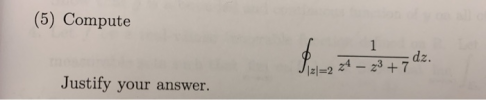
(5) Compute 1 dz. Iz=2 24 - 23 +7 Justify your answer.
all
4 roots lie in the annulus 1<|z|<2 by rouches theorem. maybe
it is helpful.
(5) Compute 1 dz. Iz=2 24 - 23 +7 Justify your answer.
Applied Complex Analysis Exercise. Show all work. PLEASE ANSWER IN A LEGIBLE MANNER. IF YOU HAVE...
 Applied Complex Analysis Exercise. Show all work. PLEASE ANSWER
IN A LEGIBLE MANNER. IF YOU HAVE BAD HANDWRITING, DO NOT
ANSWER.
Problem 2. Suppose that f is continuous in a closed bounded region R and it is analytic, non-constant and non-zero in the interior of R. Then prove that the minimum value of If(2) in R occurs somewhere on the boundary of R and never in the interior. Hint: Apply the Marimum Principle to the unction g(z)-1/f(z) (why can it...
Applied Complex Analysis Exercise. Show all work. PLEASE ANSWER
IN A LEGIBLE MANNER. IF YOU HAVE BAD HANDWRITING, DO NOT
ANSWER.
Problem 2. Suppose that f is continuous in a closed bounded region R and it is analytic, non-constant and non-zero in the interior of R. Then prove that the minimum value of If(2) in R occurs somewhere on the boundary of R and never in the interior. Hint: Apply the Marimum Principle to the unction g(z)-1/f(z) (why can it...
Problem A.5. Let D be a region in the complex plane. (a) State Green's theorem in...
 Problem A.5. Let D be a region in the complex plane. (a) State Green's theorem in terms of f(2)u(, y) + iv(x, y),z-+ iy, and (b) Prove the following case of Morera's theorem: If f is continuously differentiable 0 for every circle γ in D, then f is analytic in D. Hint: in D and J,f(z)dz Use part (a).
Complex Analysis Need it ASAP Suppose f is an entire function. Show that any of the...
 Complex Analysis
Need it ASAP
Suppose f is an entire function. Show that any of the two criteria below imply that f is a constant function. (a) Imf(z) #0 for all z EC and Ref(z) is an entire function. [10] (b) -1 < Ref (2) <1 for all z E C. [8]
Complex Analysis
Need it ASAP
Suppose f is an entire function. Show that any of the two criteria below imply that f is a constant function. (a) Imf(z) #0 for all z EC and Ref(z) is an entire function. [10] (b) -1 < Ref (2) <1 for all z E C. [8]
“not right but left half plane.” complex analysis CC be defined by or each real number...
 “not right but left half plane.” complex analysis
CC be defined by or each real number a, let fo : Prove that if a > 1, then fa has exactly one zero in the right half-plane E C:Ra)o and that this zero is a real number
“not right but left half plane.” complex analysis
CC be defined by or each real number a, let fo : Prove that if a > 1, then fa has exactly one zero in the right half-plane E C:Ra)o and that this zero is a real number
Hi, I really need help on both parts of this complex analysis question. Thanks! 1. Let...
 Hi, I really need help on both parts of this complex analysis
question. Thanks!
1. Let be a complex number and let 12=C 1.R>o be the complement in C to all real positive multiples of . (a) Show that the function 2 H 23 has a continuous inverse function, called 37, on N. (Hint: polar coordinates might help). Prove that there are exactly three different such continuous functions. Deduce that there is no continuous extension of 37 on all of...
Hi, I really need help on both parts of this complex analysis
question. Thanks!
1. Let be a complex number and let 12=C 1.R>o be the complement in C to all real positive multiples of . (a) Show that the function 2 H 23 has a continuous inverse function, called 37, on N. (Hint: polar coordinates might help). Prove that there are exactly three different such continuous functions. Deduce that there is no continuous extension of 37 on all of...
 Using the complex-n-th roots theorem:
5. (a) Use Theorem 10.5.1: Complex n-th Roots Theorem (CNRT) to com- pute all the 4-th roots of -1/4. (b) Factor the polynomial 4x4 + 1 in C[x]. (c) Factor the polynomial 4x4 +1 in R[x]. (d) Use Rational Roots Theorem to prove that the polynomial 4x4 + 1 has no rational roots. Deduce the factorization of 4x4 + 1 in Q[x].
Using the complex-n-th roots theorem:
5. (a) Use Theorem 10.5.1: Complex n-th Roots Theorem (CNRT) to com- pute all the 4-th roots of -1/4. (b) Factor the polynomial 4x4 + 1 in C[x]. (c) Factor the polynomial 4x4 +1 in R[x]. (d) Use Rational Roots Theorem to prove that the polynomial 4x4 + 1 has no rational roots. Deduce the factorization of 4x4 + 1 in Q[x].
 5. Using Rouch´e theorem to show that the polynomial z5 + 3z2 +
6z + 1 has exactly one
zero inside the circle @(1).
COMPLEX ANALYSIS
5. Using Rouché theorem to show t zero inside the circle dA(1) that the polynomial +3 6z +1 has exactly one
5. Using Rouché theorem to show t zero inside the circle dA(1) that the polynomial +3 6z +1 has exactly one
5. Using Rouch´e theorem to show that the polynomial z5 + 3z2 +
6z + 1 has exactly one
zero inside the circle @(1).
COMPLEX ANALYSIS
5. Using Rouché theorem to show t zero inside the circle dA(1) that the polynomial +3 6z +1 has exactly one
5. Using Rouché theorem to show t zero inside the circle dA(1) that the polynomial +3 6z +1 has exactly one
 Complex Analysis
IVIatn 401: Homew ork Set # . 1. Apply the Cauchy-Goursat Theorem to show that Je f(z) dz 0 when the contour C is the unit circle with counterclockwise orientation, and when tl) /(z) t e2)tan . z- 3 222z 2
Complex Analysis
IVIatn 401: Homew ork Set # . 1. Apply the Cauchy-Goursat Theorem to show that Je f(z) dz 0 when the contour C is the unit circle with counterclockwise orientation, and when tl) /(z) t e2)tan . z- 3 222z 2
 Analysis
6. (a) State the Mean Value Theorem. Calo o- (b) Use your answer to (a) to prove that if f(x) is differentiable on [0,3), f(0)-5, and f(x) >3 for all z (0,3), then ()> 5+3r for all e [o,3].
Analysis
6. (a) State the Mean Value Theorem. Calo o- (b) Use your answer to (a) to prove that if f(x) is differentiable on [0,3), f(0)-5, and f(x) >3 for all z (0,3), then ()> 5+3r for all e [o,3].
 all
4 roots lie in the annulus 1<|z|<2 by rouches theorem. maybe
it is helpful.
(5) Compute 1 dz. Iz=2 24 - 23 +7 Justify your answer.
all
4 roots lie in the annulus 1<|z|<2 by rouches theorem. maybe
it is helpful.
(5) Compute 1 dz. Iz=2 24 - 23 +7 Justify your answer.
 Applied Complex Analysis Exercise. Show all work. PLEASE ANSWER
IN A LEGIBLE MANNER. IF YOU HAVE BAD HANDWRITING, DO NOT
ANSWER.
Problem 2. Suppose that f is continuous in a closed bounded region R and it is analytic, non-constant and non-zero in the interior of R. Then prove that the minimum value of If(2) in R occurs somewhere on the boundary of R and never in the interior. Hint: Apply the Marimum Principle to the unction g(z)-1/f(z) (why can it...
Applied Complex Analysis Exercise. Show all work. PLEASE ANSWER
IN A LEGIBLE MANNER. IF YOU HAVE BAD HANDWRITING, DO NOT
ANSWER.
Problem 2. Suppose that f is continuous in a closed bounded region R and it is analytic, non-constant and non-zero in the interior of R. Then prove that the minimum value of If(2) in R occurs somewhere on the boundary of R and never in the interior. Hint: Apply the Marimum Principle to the unction g(z)-1/f(z) (why can it...
 Problem A.5. Let D be a region in the complex plane. (a) State Green's theorem in terms of f(2)u(, y) + iv(x, y),z-+ iy, and (b) Prove the following case of Morera's theorem: If f is continuously differentiable 0 for every circle γ in D, then f is analytic in D. Hint: in D and J,f(z)dz Use part (a).
 Complex Analysis
Need it ASAP
Suppose f is an entire function. Show that any of the two criteria below imply that f is a constant function. (a) Imf(z) #0 for all z EC and Ref(z) is an entire function. [10] (b) -1 < Ref (2) <1 for all z E C. [8]
Complex Analysis
Need it ASAP
Suppose f is an entire function. Show that any of the two criteria below imply that f is a constant function. (a) Imf(z) #0 for all z EC and Ref(z) is an entire function. [10] (b) -1 < Ref (2) <1 for all z E C. [8]
 “not right but left half plane.” complex analysis
CC be defined by or each real number a, let fo : Prove that if a > 1, then fa has exactly one zero in the right half-plane E C:Ra)o and that this zero is a real number
“not right but left half plane.” complex analysis
CC be defined by or each real number a, let fo : Prove that if a > 1, then fa has exactly one zero in the right half-plane E C:Ra)o and that this zero is a real number
 Hi, I really need help on both parts of this complex analysis
question. Thanks!
1. Let be a complex number and let 12=C 1.R>o be the complement in C to all real positive multiples of . (a) Show that the function 2 H 23 has a continuous inverse function, called 37, on N. (Hint: polar coordinates might help). Prove that there are exactly three different such continuous functions. Deduce that there is no continuous extension of 37 on all of...
Hi, I really need help on both parts of this complex analysis
question. Thanks!
1. Let be a complex number and let 12=C 1.R>o be the complement in C to all real positive multiples of . (a) Show that the function 2 H 23 has a continuous inverse function, called 37, on N. (Hint: polar coordinates might help). Prove that there are exactly three different such continuous functions. Deduce that there is no continuous extension of 37 on all of...
Most questions answered within 3 hours.
-
Where is the error in this code sequence?
String s1 = "Hello";
String s2 = "ello";...
asked 10 months ago -
Financial data for Joel de Paris, Inc., for last year
follow:
Joel de Paris, Inc.
Balance...
asked 10 months ago -
Consider this reaction:
Al2(SO4)3 (aq)+ BaCl3
(aq) Al2Cl6 (aq)- +
3BaSO4(s) . What is the...
asked 10 months ago -
Suppose that Savneet is considering increasing her
recent random sample from 20 car rentals to 40...
asked 10 months ago -
Trucks arrive at an unloading terminal at an average rate of 120
per hour.
Trucks arrive...
asked 10 months ago -
Why are methanol and ethanol completely soluble in water while
octanol is not very little soluble....
asked 10 months ago -
A facilities manager at a university reads in a research report
that the mean amount of...
asked 10 months ago -
When the CuSO4 is rehydrated by adding water to the anhydrous
compound, is this an endothermic...
asked 10 months ago -
A ray of sunlight is passing from diamond into crown glass; the
angle of incidence is...
asked 10 months ago -
A block of mass 0.249 kg is placed on top of a light, vertical
spring of...
asked 10 months ago -
how do the kidneys compensate in the presences of acidosis
a) trigger hyperventilate
b) reserve acid...
asked 10 months ago -
Question 501 pts
The rental rate of capital to the firm increases. Which of the
following...
asked 10 months ago