
Homework Answers
If you have any doubt and need any clarification please let me know. Kindly rate the answer accordingly. Thank you for your question on Chegg.
Add Answer to:
THE BOLZANO-WEIERSTRASS THEOREM
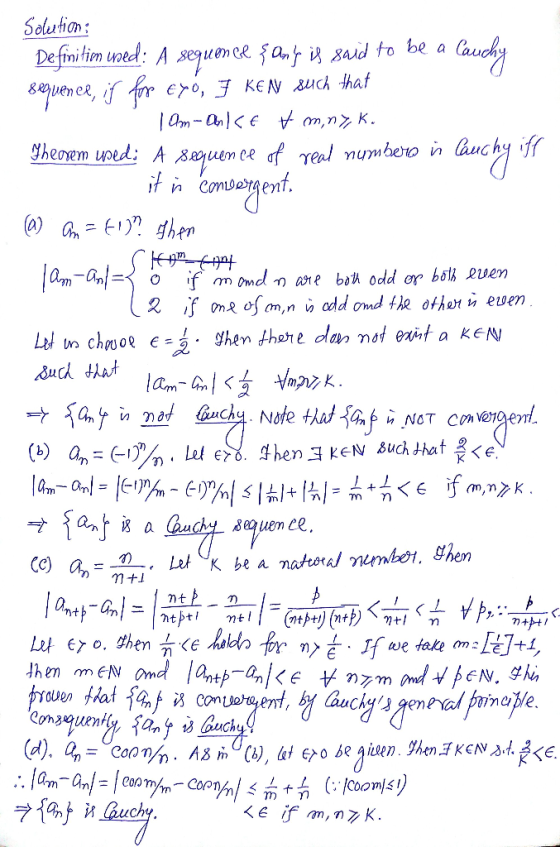
2.4.1 Determine which of the following are Cauchy sequences. (a) an = (-1)"...
A. Assume the Weierstrass Theorem is true for C0, 1, and then prove it is true...
 A. Assume the Weierstrass Theorem is true for C0, 1, and then prove it is true for C[a, b, for an arbitrary interval la, b HINT: For f E Cla, b), consider g(t)f(a+(b-a)t) in C0, 1
A. Assume the Weierstrass Theorem is true for C0, 1, and then prove it is true for C[a, b, for an arbitrary interval la, b HINT: For f E Cla, b), consider g(t)f(a+(b-a)t) in C0, 1
A. Assume the Weierstrass Theorem is true for C0, 1, and then prove it is true for C[a, b, for an arbitrary interval la, b HINT: For f E Cla, b), consider g(t)f(a+(b-a)t) in C0, 1
8. Prove that if two rational sequences (a)1 and (n)1 are equivalent, then (a) (an) is Cauchy if and only if (bn) is Ca...
 8. Prove that if two rational sequences (a)1 and (n)1 are equivalent, then (a) (an) is Cauchy if and only if (bn) is Cauchy. (b) (an) is bounded if and only if (%) is bounded.
8. Prove that if two rational sequences (a)1 and (n)1 are equivalent, then (a) (an) is Cauchy if and only if (bn) is Cauchy. (b) (an) is bounded if and only if (%) is bounded.
8. Prove that if two rational sequences (a)1 and (n)1 are equivalent, then (a) (an) is Cauchy if and only if (bn) is Cauchy. (b) (an) is bounded if and only if (%) is bounded.
8. Show that Theorem 3.1, the Nested intervals theorem, may be proved as a direct consequence...
 8. Show that Theorem 3.1, the Nested intervals theorem, may be proved as a direct consequence of the Cauchy criterion for convergence (Theorem 3.14). (Hint: Suppose I. = {x: 0, <x<bn} is a nested sequence. Then show that {an} and {b} are Cauchy sequences. Hence they each tend to a limit. Since b.-4, 0, the limits must be the same. Finally, the Sandwiching theorem shows that the limit is in every 1.] Definition. An infinite sequence {n} is called a...
5(a)(b) are asking what the Cauchy-Goursat Theorem and the general Cauchy Integral Theorem talks about. Please...
 5(a)(b) are asking what the
Cauchy-Goursat Theorem and the general Cauchy Integral Theorem
talks about. Please use these two theorems to solve the
problem.
(6) Let C denote the closed contour (3 – sint)et, 0 <t < 2n. Use 5(a)(b) above to aid in computing the following contour integrals. (a) So z?sin(2)dz (b) Jc E-P-5)² dz 24-iz
5(a)(b) are asking what the
Cauchy-Goursat Theorem and the general Cauchy Integral Theorem
talks about. Please use these two theorems to solve the
problem.
(6) Let C denote the closed contour (3 – sint)et, 0 <t < 2n. Use 5(a)(b) above to aid in computing the following contour integrals. (a) So z?sin(2)dz (b) Jc E-P-5)² dz 24-iz
(3) Let XXnX1,X2,⋯,Xn be iidiid random variables with Cauchy(0,1)Cauchy(0,1) distribution. That is, the density of X1...
(3) Let XXnX1,X2,⋯,Xn be iidiid random variables with Cauchy(0,1)Cauchy(0,1) distribution. That is, the density of X1 is 1/(π(1+x2)) for x∈ℜ. Prove that (X1+X2+⋯+Xn)/n is again distributed as Cauchy(0,1). The following ``answers'' have been proposed. Please read the choices very carefully and pick the most complete and accurate choice. (a) By the last exercise, the characteristic function of X1, is e−|t|e−|t|. Therefore by the fact that the Xi are iid, the characteristic function of their average is the product of n...
Determine whether the following sequences converge, and find the limit of those that converge a) (1+i)n...
Determine whether the following sequences converge, and find the limit of those that converge a) (1+i)n b) 1/n[(1+i)n)] c) 1/n![(1+i)n)] d) 1/(1+i)n e) n/(1+i)n f) n!/(1+i)n
Which of the following statements is true regarding homology and homologous sequences. a)If two sequences are...
Which of the following statements is true regarding homology and homologous sequences. a)If two sequences are homologs then they are also paralogs b)If two sequences are homologs then they are also orthologs c)If two sequences can be aligned via a sequence alingment then they are homologs. d)Suppose tha there are n differences between two sequences ,and that the probability of this ocurring at random is less than 0.05.Then the sequences are homologs. e)All of the above f)None of the above
Which of the following statements is true regarding homology and homologous sequences. a)If two sequences are...
Which of the following statements is true regarding homology and homologous sequences. a)If two sequences are homologs then they are also paralogs b)If two sequences are homologs then they are also orthologs c)If two sequences can be aligned via a sequence alingment then they are homologs. d)Suppose tha there are n differences between two sequences ,and that the probability of this ocurring at random is less than 0.05.Then the sequences are homologs. e)All of the above f)None of the above
2.4.1. Suppose (t is as shown 3-2 1 3 4 (a) Determine the fundamental period To,...
 2.4.1. Suppose (t is as shown 3-2 1 3 4 (a) Determine the fundamental period To, the fundamental frequency fo, and the funda- mental cycle x(t). Express a(t) as a function involving a rect(.) (b) Determine X(f), the Fourier transform of the fundamental cycle a(t) (c) Determine the Fourier series coefficients xk for ï(t) (d) DetermiX(f), the Fourier transform of (t) (e) Determine the power P (f) Determine the percentage of power in DC and the percentage of power in...
1. For each of the following sequences, determine whether it converges. If so, find the limit....
 1. For each of the following sequences, determine whether it converges. If so, find the limit. 2n+1 5n-2 a. b. 4. =(-1)"." 2n 2"-1 c. n
 A. Assume the Weierstrass Theorem is true for C0, 1, and then prove it is true for C[a, b, for an arbitrary interval la, b HINT: For f E Cla, b), consider g(t)f(a+(b-a)t) in C0, 1
A. Assume the Weierstrass Theorem is true for C0, 1, and then prove it is true for C[a, b, for an arbitrary interval la, b HINT: For f E Cla, b), consider g(t)f(a+(b-a)t) in C0, 1
A. Assume the Weierstrass Theorem is true for C0, 1, and then prove it is true for C[a, b, for an arbitrary interval la, b HINT: For f E Cla, b), consider g(t)f(a+(b-a)t) in C0, 1
 8. Prove that if two rational sequences (a)1 and (n)1 are equivalent, then (a) (an) is Cauchy if and only if (bn) is Cauchy. (b) (an) is bounded if and only if (%) is bounded.
8. Prove that if two rational sequences (a)1 and (n)1 are equivalent, then (a) (an) is Cauchy if and only if (bn) is Cauchy. (b) (an) is bounded if and only if (%) is bounded.
8. Prove that if two rational sequences (a)1 and (n)1 are equivalent, then (a) (an) is Cauchy if and only if (bn) is Cauchy. (b) (an) is bounded if and only if (%) is bounded.
 8. Show that Theorem 3.1, the Nested intervals theorem, may be proved as a direct consequence of the Cauchy criterion for convergence (Theorem 3.14). (Hint: Suppose I. = {x: 0, <x<bn} is a nested sequence. Then show that {an} and {b} are Cauchy sequences. Hence they each tend to a limit. Since b.-4, 0, the limits must be the same. Finally, the Sandwiching theorem shows that the limit is in every 1.] Definition. An infinite sequence {n} is called a...
 5(a)(b) are asking what the
Cauchy-Goursat Theorem and the general Cauchy Integral Theorem
talks about. Please use these two theorems to solve the
problem.
(6) Let C denote the closed contour (3 – sint)et, 0 <t < 2n. Use 5(a)(b) above to aid in computing the following contour integrals. (a) So z?sin(2)dz (b) Jc E-P-5)² dz 24-iz
5(a)(b) are asking what the
Cauchy-Goursat Theorem and the general Cauchy Integral Theorem
talks about. Please use these two theorems to solve the
problem.
(6) Let C denote the closed contour (3 – sint)et, 0 <t < 2n. Use 5(a)(b) above to aid in computing the following contour integrals. (a) So z?sin(2)dz (b) Jc E-P-5)² dz 24-iz
 2.4.1. Suppose (t is as shown 3-2 1 3 4 (a) Determine the fundamental period To, the fundamental frequency fo, and the funda- mental cycle x(t). Express a(t) as a function involving a rect(.) (b) Determine X(f), the Fourier transform of the fundamental cycle a(t) (c) Determine the Fourier series coefficients xk for ï(t) (d) DetermiX(f), the Fourier transform of (t) (e) Determine the power P (f) Determine the percentage of power in DC and the percentage of power in...
 1. For each of the following sequences, determine whether it converges. If so, find the limit. 2n+1 5n-2 a. b. 4. =(-1)"." 2n 2"-1 c. n
Most questions answered within 3 hours.
-
Where is the error in this code sequence?
String s1 = "Hello";
String s2 = "ello";...
asked 10 months ago -
Financial data for Joel de Paris, Inc., for last year
follow:
Joel de Paris, Inc.
Balance...
asked 10 months ago -
Consider this reaction:
Al2(SO4)3 (aq)+ BaCl3
(aq) Al2Cl6 (aq)- +
3BaSO4(s) . What is the...
asked 10 months ago -
Suppose that Savneet is considering increasing her
recent random sample from 20 car rentals to 40...
asked 10 months ago -
Trucks arrive at an unloading terminal at an average rate of 120
per hour.
Trucks arrive...
asked 10 months ago -
Why are methanol and ethanol completely soluble in water while
octanol is not very little soluble....
asked 10 months ago -
A facilities manager at a university reads in a research report
that the mean amount of...
asked 10 months ago -
When the CuSO4 is rehydrated by adding water to the anhydrous
compound, is this an endothermic...
asked 10 months ago -
A ray of sunlight is passing from diamond into crown glass; the
angle of incidence is...
asked 10 months ago -
A block of mass 0.249 kg is placed on top of a light, vertical
spring of...
asked 10 months ago -
how do the kidneys compensate in the presences of acidosis
a) trigger hyperventilate
b) reserve acid...
asked 10 months ago -
Question 501 pts
The rental rate of capital to the firm increases. Which of the
following...
asked 10 months ago