
Homework Answers

Add Answer to:
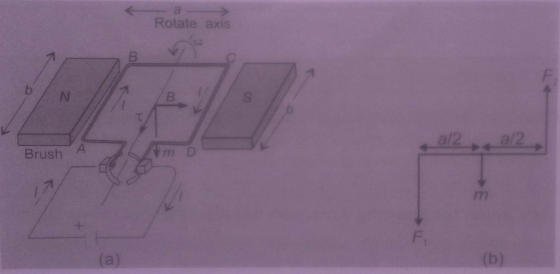
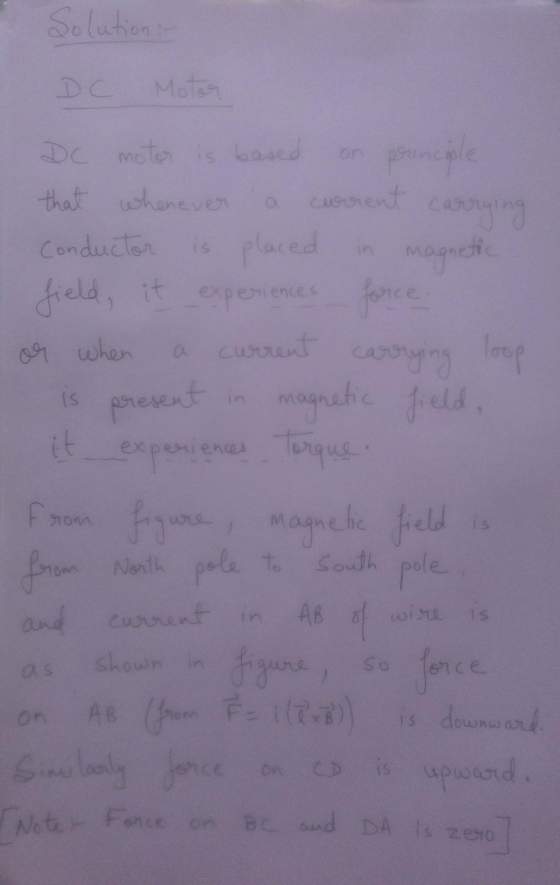
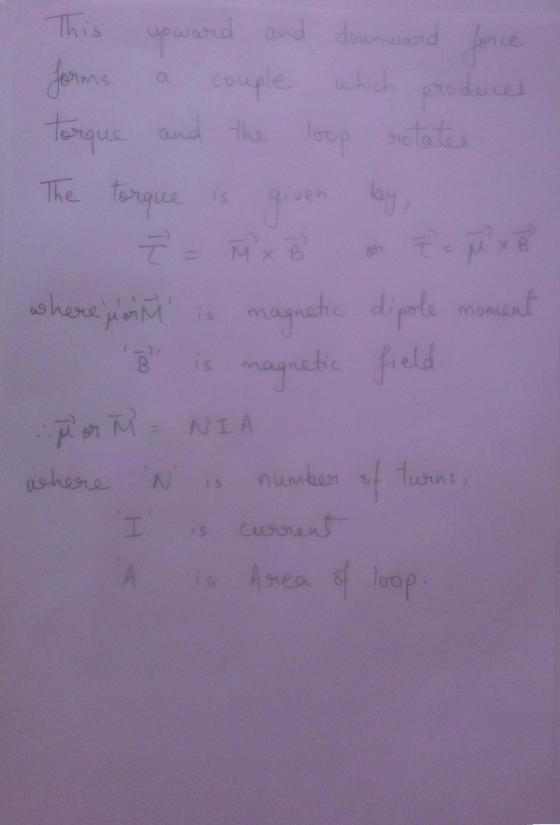
3. Describe the working principle of DC motor. Draw the figure and explain? Problem-3: Calculate magnetic...
Problem 2 A separately excited DC motor is characterized by the followng intormation Armature res...
 Problem 2 A separately excited DC motor is characterized by the followng intormation Armature resistance Ra-5 2 armature inductance La . very large, Field resistance RS200 Ω, ted voltage Vt 200 V, and an inertia constant J-12 kg m Neglecting friction losses and assuming no-saturation in the machine magnetic core system, answer the folowing questions: Part 1: (6 marks) he motor a as shown in figure 2a. The motor drives a constant power load of vaue 1 40375 hp (ie...
Please answer clearly Problem 3 a) Find the magnetic field H at the center of a...
 Please answer clearly
Problem 3 a) Find the magnetic field H at the center of a square loop carrying a current I. The side of the square loop is b meters long. b) A circular loop that has a radius a and that carries a current I produces the same magnetic field strength at its center as that at the center of a square loop that has side b and that carries the same current I. Determine the ratio of...
Please answer clearly
Problem 3 a) Find the magnetic field H at the center of a square loop carrying a current I. The side of the square loop is b meters long. b) A circular loop that has a radius a and that carries a current I produces the same magnetic field strength at its center as that at the center of a square loop that has side b and that carries the same current I. Determine the ratio of...
Need some help with a physics problem - Find the magnetic flux through a square loop...
Need some help with a physics problem - Find the magnetic flux through a square loop of wire of side length 10 cm which is a distance 5 cm from a current carrying wire where I(t) = 15sin(100t) and t is in seconds. Determine the emf induced in the square loop of wire if the loop is at rest.
Problem 4: A very very small square loop of side a and curent "i" is located a distance r from a ...
 Problem 4: A very very small square loop of side a and curent "i" is located a distance r from a wire carrying a curent I The magnetic field from the wire is as given in the figure below. Calculate the dipole moment of the small loop and its energy, torque and force in the magnetic field.
Problem 4: A very very small square loop of side a and curent "i" is located a distance r from a wire carrying...
Problem 4: A very very small square loop of side a and curent "i" is located a distance r from a wire carrying a curent I The magnetic field from the wire is as given in the figure below. Calculate the dipole moment of the small loop and its energy, torque and force in the magnetic field.
Problem 4: A very very small square loop of side a and curent "i" is located a distance r from a wire carrying...
A simple DC motor consists of a single coil of 100 loops, rotating in a magnetic...
A simple DC motor consists of a single coil of 100 loops, rotating in a magnetic field with flux density B = 170 mT. The area of the coil is 3.50 × 10⁻⁴ m2. When the angle between the plane of the coil and the magnetic field increases from 15.0° to 45.0° the torque on the coil decreases by 5.39 × 10⁻³ N m. Calculate the current flowing through the coil.
DQuestion 21 1 pts 53.13 2 Figure F3 Current-carrying square coil in magnetic field A square...
 DQuestion 21 1 pts 53.13 2 Figure F3 Current-carrying square coil in magnetic field A square coil has N-40 turns of copper wire, each of side a-5.0 cm. The current in the coil is 1-4.0 A. The coil is placed in a uniform magnetic field B-16 T as shown in Figure F3. The plane of the coil makes an angle of 53.13 with the magnetic field. The coil is free to rotate about the y axis. Calculate the area of...
Please solve and explain how its done. You know that the net magnetic force on the...
 Please solve and explain how its done.
You know that the net magnetic force on the (closed) current loop in the uniform magnetic field is zero. As shown in the figure below, the rectangular thin wire loop running current 12=6.37 A is, however, in the non-uniform magnetic field produced by a long straight wire carrying current 11=17.72 A. The rectangular loop and the source wire are in the same (xy)-plane with the geometrical dimensions illustrated in the figure and equal...
Please solve and explain how its done.
You know that the net magnetic force on the (closed) current loop in the uniform magnetic field is zero. As shown in the figure below, the rectangular thin wire loop running current 12=6.37 A is, however, in the non-uniform magnetic field produced by a long straight wire carrying current 11=17.72 A. The rectangular loop and the source wire are in the same (xy)-plane with the geometrical dimensions illustrated in the figure and equal...
3. The loop (h=7.6 cm square) in the figure to the right has an induced current...
 3. The loop (h=7.6 cm square) in the figure to the right has an induced current of 250 mA as shown. The loop has a resistance of 1.5 12. The x's indicate the direction of the magnetic field. a. Is the magnetic field strength increasing or decreasing? Explain. b. What is the rate of change of the magnetic field, AB/At?
A non-uniform magnetic field points out of the page as shown below in the figure. The...
 A non-uniform magnetic field points out of the page as shown
below in the figure. The field increases at a constant rate of 2.0
mT as you move to the right. A square wire loop of 15 cm on a side
lies on a plane perpendicular to the field, and a 2.5 A current
circles the loop in the counter-clockwise direction. Calculate the
magnitude and direction of the net magnetic force on the loop
out 15 cm .
A non-uniform magnetic field points out of the page as shown
below in the figure. The field increases at a constant rate of 2.0
mT as you move to the right. A square wire loop of 15 cm on a side
lies on a plane perpendicular to the field, and a 2.5 A current
circles the loop in the counter-clockwise direction. Calculate the
magnitude and direction of the net magnetic force on the loop
out 15 cm .
4.) For the slidewire generator below, the magnetic field is a constant 2.0 T into the...
 4.) For the slidewire generator below, the magnetic field is a constant 2.0 T into the page, the length L is 0.50 m and the conducting slidewire moves at 5.5 m/s. The total resistance of the circuit is R=1.5 Ω. a.) Find the induced current (7 pts). b.) How much power is dissipated? (6 pts) c.) In what direction does the induced current flow? (3 pts) A current carrying circular loop with N-50 turns rotates in a 2.0 T magnetic...
 Problem 2 A separately excited DC motor is characterized by the followng intormation Armature resistance Ra-5 2 armature inductance La . very large, Field resistance RS200 Ω, ted voltage Vt 200 V, and an inertia constant J-12 kg m Neglecting friction losses and assuming no-saturation in the machine magnetic core system, answer the folowing questions: Part 1: (6 marks) he motor a as shown in figure 2a. The motor drives a constant power load of vaue 1 40375 hp (ie...
 Please answer clearly
Problem 3 a) Find the magnetic field H at the center of a square loop carrying a current I. The side of the square loop is b meters long. b) A circular loop that has a radius a and that carries a current I produces the same magnetic field strength at its center as that at the center of a square loop that has side b and that carries the same current I. Determine the ratio of...
Please answer clearly
Problem 3 a) Find the magnetic field H at the center of a square loop carrying a current I. The side of the square loop is b meters long. b) A circular loop that has a radius a and that carries a current I produces the same magnetic field strength at its center as that at the center of a square loop that has side b and that carries the same current I. Determine the ratio of...
 Problem 4: A very very small square loop of side a and curent "i" is located a distance r from a wire carrying a curent I The magnetic field from the wire is as given in the figure below. Calculate the dipole moment of the small loop and its energy, torque and force in the magnetic field.
Problem 4: A very very small square loop of side a and curent "i" is located a distance r from a wire carrying...
Problem 4: A very very small square loop of side a and curent "i" is located a distance r from a wire carrying a curent I The magnetic field from the wire is as given in the figure below. Calculate the dipole moment of the small loop and its energy, torque and force in the magnetic field.
Problem 4: A very very small square loop of side a and curent "i" is located a distance r from a wire carrying...
 DQuestion 21 1 pts 53.13 2 Figure F3 Current-carrying square coil in magnetic field A square coil has N-40 turns of copper wire, each of side a-5.0 cm. The current in the coil is 1-4.0 A. The coil is placed in a uniform magnetic field B-16 T as shown in Figure F3. The plane of the coil makes an angle of 53.13 with the magnetic field. The coil is free to rotate about the y axis. Calculate the area of...
 Please solve and explain how its done.
You know that the net magnetic force on the (closed) current loop in the uniform magnetic field is zero. As shown in the figure below, the rectangular thin wire loop running current 12=6.37 A is, however, in the non-uniform magnetic field produced by a long straight wire carrying current 11=17.72 A. The rectangular loop and the source wire are in the same (xy)-plane with the geometrical dimensions illustrated in the figure and equal...
Please solve and explain how its done.
You know that the net magnetic force on the (closed) current loop in the uniform magnetic field is zero. As shown in the figure below, the rectangular thin wire loop running current 12=6.37 A is, however, in the non-uniform magnetic field produced by a long straight wire carrying current 11=17.72 A. The rectangular loop and the source wire are in the same (xy)-plane with the geometrical dimensions illustrated in the figure and equal...
 3. The loop (h=7.6 cm square) in the figure to the right has an induced current of 250 mA as shown. The loop has a resistance of 1.5 12. The x's indicate the direction of the magnetic field. a. Is the magnetic field strength increasing or decreasing? Explain. b. What is the rate of change of the magnetic field, AB/At?
 A non-uniform magnetic field points out of the page as shown
below in the figure. The field increases at a constant rate of 2.0
mT as you move to the right. A square wire loop of 15 cm on a side
lies on a plane perpendicular to the field, and a 2.5 A current
circles the loop in the counter-clockwise direction. Calculate the
magnitude and direction of the net magnetic force on the loop
out 15 cm .
A non-uniform magnetic field points out of the page as shown
below in the figure. The field increases at a constant rate of 2.0
mT as you move to the right. A square wire loop of 15 cm on a side
lies on a plane perpendicular to the field, and a 2.5 A current
circles the loop in the counter-clockwise direction. Calculate the
magnitude and direction of the net magnetic force on the loop
out 15 cm .
 4.) For the slidewire generator below, the magnetic field is a constant 2.0 T into the page, the length L is 0.50 m and the conducting slidewire moves at 5.5 m/s. The total resistance of the circuit is R=1.5 Ω. a.) Find the induced current (7 pts). b.) How much power is dissipated? (6 pts) c.) In what direction does the induced current flow? (3 pts) A current carrying circular loop with N-50 turns rotates in a 2.0 T magnetic...
Most questions answered within 3 hours.
-
Where is the error in this code sequence?
String s1 = "Hello";
String s2 = "ello";...
asked 11 months ago -
Financial data for Joel de Paris, Inc., for last year
follow:
Joel de Paris, Inc.
Balance...
asked 11 months ago -
Consider this reaction:
Al2(SO4)3 (aq)+ BaCl3
(aq) Al2Cl6 (aq)- +
3BaSO4(s) . What is the...
asked 11 months ago -
Suppose that Savneet is considering increasing her
recent random sample from 20 car rentals to 40...
asked 11 months ago -
Trucks arrive at an unloading terminal at an average rate of 120
per hour.
Trucks arrive...
asked 11 months ago -
Why are methanol and ethanol completely soluble in water while
octanol is not very little soluble....
asked 11 months ago -
A facilities manager at a university reads in a research report
that the mean amount of...
asked 11 months ago -
When the CuSO4 is rehydrated by adding water to the anhydrous
compound, is this an endothermic...
asked 11 months ago -
A ray of sunlight is passing from diamond into crown glass; the
angle of incidence is...
asked 11 months ago -
A block of mass 0.249 kg is placed on top of a light, vertical
spring of...
asked 11 months ago -
how do the kidneys compensate in the presences of acidosis
a) trigger hyperventilate
b) reserve acid...
asked 11 months ago -
Question 501 pts
The rental rate of capital to the firm increases. Which of the
following...
asked 11 months ago