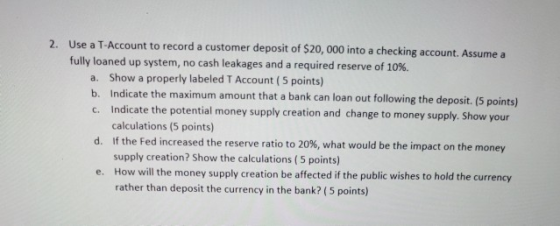
answer all of questions on number 2, and answer can't be cursive.
Homework Answers
1.
Required reserve = $20,000 x 10% = $2,000
Excess reserve = Loan = $20,000 - $2,000 = $18,000
| Assets | $ | Liabilities & Net worth | $ |
| Required reserves | 2,000 | Checkable deposits | 20,000 |
| Loans | 18,000 |
2.
Maximum lending by the bank = Excess reserve = $18,000
3.
An increase in deposit will increase money supply.
Maximum Increase in money supply = New deposit / Reserve ratio = $2,000 / 0.1 = $20,000
4.
When reserve ratio (rr) = 10%, Money supply (MS) = $20,000 / 0.1 = $200,000
When rr = 20%, MS = $20,000 / 0.2 = $100,000
Therefore, money supply will decrease by $(200,000 - 100,000) = $100,000.
5.
Let currency-deposit ratio be cr.
Money multiplier (MM) = (1 + cr) / (cr + rr)
Increase in MS = Increase in deposit x MM
Therefore, the higher the value of cr, the lower the value of MM and the lower the increase in money supply.
Add Answer to:
answer all of questions on number 2, and answer can't
be cursive.
2. Use a T-Account...
Assume that Elliott deposits $1,000 in coins he collected into his checking account. The required reserve...
Assume that Elliott deposits $1,000 in coins he collected into his checking account. The required reserve ratio for the banking system is 10% and Elliott’s bank was fully loaned up prior to his deposit. Explain the immediate effect of his deposit on the M1 measure of the money supply. Calculate the following: the maximum amount the bank will loan out the maximum increase in the money supply as a result of this transaction Now assume that the Federal Reserve purchases...
Assume the Fed sells a $10m T-bill to First National Bank. a. Show the T-accounts of...
 Assume the Fed sells a $10m T-bill to First National Bank. a. Show the T-accounts of the Fed and First National Bank. b. By how much will the monetary base change? c. If the reserve-deposit ratio is 15% and the currency-deposit ratio is 25%, calculate the eventual change in the money supply.
1. Suppose you withdraw $500 from your checking account at your bank, which has a required...
1. Suppose you withdraw $500 from your checking account at your bank, which has a required reserve ratio of 30%. Initially, as a result of your this transaction, the size of M1 will.... (Increase/decrease/remain unchanged) . Before any further actions by your bank, the reserves in your bank..... Increase/decrease/remain unchanged) by... while the excess reserves of your bank ..... (Increase/decrease/remain unchanged) by .... 2. Suppose that the general public decided to decrease its holdings of currency and increase its checking...
Answer the following questions: a) If a bank depositor deposits $1,000 of currency to his checking...
 Answer the following questions: a) If a bank depositor deposits $1,000 of currency to his checking account, what happens to reserves, checkable deposits, and the monetary base? b) If the Fed buys bonds worth $2 million from the First National Bank, what happens to reserves and the monetary base? Use T-accounts to explain your answer c) If the Fed sells $2 million of bonds to Irving the Investor, who pays for the bonds with a check, what happens to reserves...
The Fed decides to buy $50 million in bonds. A. Show the initial T-account at the...
The Fed decides to buy $50 million in bonds. A. Show the initial T-account at the bank when this gets deposited. B. If the Reserve Requirement is 25%, show the T-account after the first loan is made. C. What is the maximum amount the money supply could expand by from this purchase. Show the T-account if the maximum number of loans and deposits is made. D. Show the affect of the change in the Money Market (your numbers don’t have...
The Fed decides to buy $50 million in bonds. A. Show the initial T-account at the bank when this gets deposited. B. If the Reserve Requirement is 25%, show the T-account after the first loan is made....
The Fed decides to buy $50 million in bonds. A. Show the initial T-account at the bank when this gets deposited. B. If the Reserve Requirement is 25%, show the T-account after the first loan is made. C. What is the maximum amount the money supply could expand by from this purchase. Show the T-account if the maximum number of loans and deposits is made. D. Show the affect of the change in the Money Market (your numbers don’t have...
need an answer to question 5 textbook is macroeconomics 9th edition to keep the money supply...
 need an answer to question 5
textbook is macroeconomics 9th edition
to keep the money supply at its original level, does it culate, in dollars, how much the central bank . Explain how banks create money 5. What are the various ways in which the Federal 6. As a Case Study in the chapter discusses, the Reserve can influence the money supply? money supply fell from 1929 to 1933 because Why might a banking crisis lead to a fall in...
need an answer to question 5
textbook is macroeconomics 9th edition
to keep the money supply at its original level, does it culate, in dollars, how much the central bank . Explain how banks create money 5. What are the various ways in which the Federal 6. As a Case Study in the chapter discusses, the Reserve can influence the money supply? money supply fell from 1929 to 1933 because Why might a banking crisis lead to a fall in...
a) A customer deposits $10,000 check into her checking account. Use a T-account to show how...
 a) A customer deposits $10,000 check into her checking account. Use a T-account to show how her bank will reflect this transaction. b) Using a T-account, show how the bank will reflect the transaction once the funds become available. c) Assuming the bank has a 10% required reserve requirement, show on a T-account the required and excess reserves. d) Assume that this bank decides to make a car loan using the excess reserves from our customer's deposit. Show this transaction...
Suppose that the public wishes to hold $0.35 in pocket money (currency and coin) and $0.25...
Suppose that the public wishes to hold $0.35 in pocket money (currency and coin) and $0.25 in time and savings deposits. Suppose that banks wish to hold $0.20 for each new dollar of transaction money received. Suppose that $0.05 finds its way outside of the domestic banking system. Suppose the reserve requirement on transaction deposits is 3 percent and that on time and savings deposits is 4%. (20 points) a. What is the size of the transaction deposit multiplier? Make...
Ml equals currency + demand deposits + A)nothing else B)othere checkable deposits. C)traveler's checks + other checkable deposits. D)traveler's checks + other checkable deposits -+ savings de...
 Ml equals currency + demand deposits + A)nothing else B)othere checkable deposits. C)traveler's checks + other checkable deposits. D)traveler's checks + other checkable deposits -+ savings deposits 2. If you deposit $100 of currency into a demand deposit at a bank, this action by itself A)does not change the money supply. B)increases the money supply. C)decreases the money supply. D)has an indeterminate effect on the money supply. 3. The manager of the bank where you work tells you that your...
 Assume the Fed sells a $10m T-bill to First National Bank. a. Show the T-accounts of the Fed and First National Bank. b. By how much will the monetary base change? c. If the reserve-deposit ratio is 15% and the currency-deposit ratio is 25%, calculate the eventual change in the money supply.
 Answer the following questions: a) If a bank depositor deposits $1,000 of currency to his checking account, what happens to reserves, checkable deposits, and the monetary base? b) If the Fed buys bonds worth $2 million from the First National Bank, what happens to reserves and the monetary base? Use T-accounts to explain your answer c) If the Fed sells $2 million of bonds to Irving the Investor, who pays for the bonds with a check, what happens to reserves...
 need an answer to question 5
textbook is macroeconomics 9th edition
to keep the money supply at its original level, does it culate, in dollars, how much the central bank . Explain how banks create money 5. What are the various ways in which the Federal 6. As a Case Study in the chapter discusses, the Reserve can influence the money supply? money supply fell from 1929 to 1933 because Why might a banking crisis lead to a fall in...
need an answer to question 5
textbook is macroeconomics 9th edition
to keep the money supply at its original level, does it culate, in dollars, how much the central bank . Explain how banks create money 5. What are the various ways in which the Federal 6. As a Case Study in the chapter discusses, the Reserve can influence the money supply? money supply fell from 1929 to 1933 because Why might a banking crisis lead to a fall in...
 a) A customer deposits $10,000 check into her checking account. Use a T-account to show how her bank will reflect this transaction. b) Using a T-account, show how the bank will reflect the transaction once the funds become available. c) Assuming the bank has a 10% required reserve requirement, show on a T-account the required and excess reserves. d) Assume that this bank decides to make a car loan using the excess reserves from our customer's deposit. Show this transaction...
 Ml equals currency + demand deposits + A)nothing else B)othere checkable deposits. C)traveler's checks + other checkable deposits. D)traveler's checks + other checkable deposits -+ savings deposits 2. If you deposit $100 of currency into a demand deposit at a bank, this action by itself A)does not change the money supply. B)increases the money supply. C)decreases the money supply. D)has an indeterminate effect on the money supply. 3. The manager of the bank where you work tells you that your...
Most questions answered within 3 hours.
-
Where is the error in this code sequence?
String s1 = "Hello";
String s2 = "ello";...
asked 10 months ago -
Financial data for Joel de Paris, Inc., for last year
follow:
Joel de Paris, Inc.
Balance...
asked 10 months ago -
Consider this reaction:
Al2(SO4)3 (aq)+ BaCl3
(aq) Al2Cl6 (aq)- +
3BaSO4(s) . What is the...
asked 10 months ago -
Suppose that Savneet is considering increasing her
recent random sample from 20 car rentals to 40...
asked 10 months ago -
Trucks arrive at an unloading terminal at an average rate of 120
per hour.
Trucks arrive...
asked 10 months ago -
Why are methanol and ethanol completely soluble in water while
octanol is not very little soluble....
asked 10 months ago -
A facilities manager at a university reads in a research report
that the mean amount of...
asked 10 months ago -
When the CuSO4 is rehydrated by adding water to the anhydrous
compound, is this an endothermic...
asked 10 months ago -
A ray of sunlight is passing from diamond into crown glass; the
angle of incidence is...
asked 10 months ago -
A block of mass 0.249 kg is placed on top of a light, vertical
spring of...
asked 10 months ago -
how do the kidneys compensate in the presences of acidosis
a) trigger hyperventilate
b) reserve acid...
asked 10 months ago -
Question 501 pts
The rental rate of capital to the firm increases. Which of the
following...
asked 10 months ago