
Homework Answers
Add Answer to:
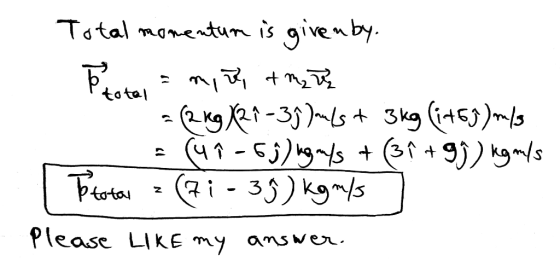
7. (5 points) A 2 kg particle has a velocity (21-3 ) m/s, and a 3...
A 1.96-kg particle has a velocity (2.08 î − 3.07 ĵ) m/s, and a 3.05-kg particle...
A 1.96-kg particle has a velocity (2.08 î − 3.07 ĵ) m/s, and a 3.05-kg particle has a velocity (1.08 î + 5.96 ĵ) m/s. (a) Find the velocity of the center of mass. (b) Find the total momentum of the system.
A 1.92-kg particle has a velocity (2.03 İ-2.90 ) m/s, and a 2.99-kg particle has a...
 A 1.92-kg particle has a velocity (2.03 İ-2.90 ) m/s, and a 2.99-kg particle has a velocity (0.98 İ + 5.99 ) m/s. (a) Find the velocity of the center of mass. j) m/s (b) Find the total momentum of the system. j) kg m/s 10 9 A OP 035 M A 5.10-kg steel ball strikes a wall with a speed of 11.0 m/s at an angle of θ 60.0° with the surface. It bounces off with the same speed...
3. A 5 kg particle moves in the +x direction with a velocity of 6 m/s...
 3. A 5 kg particle moves in the +x direction with a velocity of 6 m/s shown in the figure below. You are told that it makes an elastic collision with a 2kg particle that is initially at rest. After the collision, the 2 kg particle moves with a speed of 5 m/s in the direction 30° above the x-axis. (a) What are the x and y components of the 5 kg particle after the collision? (20 points) (b) Were...
4) A ball with a mass of 0.15 kg has a velocity of 5 m/s. It...
 4) A ball with a mass of 0.15 kg has a velocity of 5 m/s. It strikes a wall perpendicularly and bounces off straight back with a velocity of 2 m/s. The ball underwent a change in momentum equal to (There is only one answer) (2p) A) 0.20 kg. m/s B) 1.20 kg. m/s C) 1.05 kg. m/s D) 6 kg. m/s E) 8.5 kg. m/s 5) A 2-kg mass moving with a velocity of 6 m/s collides elastically with...
010:- A2 kg particle has a velocity of 3t + 4j (m/s). Find the magnitude of...
 010:- A2 kg particle has a velocity of 3t + 4j (m/s). Find the magnitude of its totai momentum (A) 15kgms (B) 20 kgms-1 (C)25kgms1 (D)skgms (E) 10kgms1
1. A 30.00 kg mass moving with the velocity of 10 m/s. The momentum of the...
 1. A 30.00 kg mass moving with the velocity of 10 m/s. The momentum of the body will be A. 144.2 kg m/s. B. 187.8 kg m/s. C. 320.0 kg m/s. D. 442.4 kg m/s. E. None of the above 2. Out of the following which one is not a vector quantity? A. Force B. Impulse C. Mass D. velocity 3. Impulse is the product of which two quantities? A. Mass and Time B. Mass and Momentum C. Force and...
12. The angular position of the particle is (t)= 2 + 3t+ t(rad), its angular velocity...
 12. The angular position of the particle is (t)= 2 + 3t+ t(rad), its angular velocity at t = 3s is: * 5 (8 Points) none of them 22 1/s 16 1/s 25 1/5 9 1/3 13.A 2.50-kg particle moves in the xy plane with a velocity of v = 3 i +5k (m/s). Determine the angular momentum of the particle in Js, when its position vector is r = 7 i (m): * (7 points) 87,5j 21j none of...
Block 1,0,5 kg) travels with an initial velocity of 60) +[ 60 ) m/s and then...
 Block 1,0,5 kg) travels with an initial velocity of 60) +[ 60 ) m/s and then com es block 2 (0.5 kg) tra eling th an tal velo ity of . -60 After the colision, block 1 has a final momentum o -10+ toj1kg*m/s. Assume that no external forces are present and therefore the momervtum for the system of blocks is conserved. What is the Initial momentum of block 17 What is the initial momentum of block 27 kg m/s...
Block 1 (0.5 kg) travels with an Initial velocity of [ 40/1 601 m/s and then...
 Block 1 (0.5 kg) travels with an Initial velocity of [ 40/1 601 m/s and then collides with block 2 (0.5 kg) travelling with an Inltial velocity of t-4011+I-401 1 m/s After the collision, block 1 has a final momentum of [ 51] + [ Qİ kg·m/s. Assume that no external forces are present and therefore the momentum for the system of blocks is conserved. What Is the Initial momentum of block 1? 1 + kg*m/s Setmit Ansee Tries 0/3...
2.5 m/s2.5 m/s Initial Velocity Initial Velocity 0 1 m/s 0 3 m/s Mass: 1 kg...
 2.5 m/s2.5 m/s Initial Velocity Initial Velocity 0 1 m/s 0 3 m/s Mass: 1 kg Mass: 3 kg Inelastic Case 2: Blue Cart Moving Slower than the Red Cart Set the initial blue cart velocity to less than the red cart velocity. Position the blue cart in the middle of the track. Use different mass values. Run the simulation and record the mass and velocity values. Before Collision After Collision m/s m/s m/s mRed kg m Blue kg Table...
 A 1.92-kg particle has a velocity (2.03 İ-2.90 ) m/s, and a 2.99-kg particle has a velocity (0.98 İ + 5.99 ) m/s. (a) Find the velocity of the center of mass. j) m/s (b) Find the total momentum of the system. j) kg m/s 10 9 A OP 035 M A 5.10-kg steel ball strikes a wall with a speed of 11.0 m/s at an angle of θ 60.0° with the surface. It bounces off with the same speed...
 3. A 5 kg particle moves in the +x direction with a velocity of 6 m/s shown in the figure below. You are told that it makes an elastic collision with a 2kg particle that is initially at rest. After the collision, the 2 kg particle moves with a speed of 5 m/s in the direction 30° above the x-axis. (a) What are the x and y components of the 5 kg particle after the collision? (20 points) (b) Were...
 4) A ball with a mass of 0.15 kg has a velocity of 5 m/s. It strikes a wall perpendicularly and bounces off straight back with a velocity of 2 m/s. The ball underwent a change in momentum equal to (There is only one answer) (2p) A) 0.20 kg. m/s B) 1.20 kg. m/s C) 1.05 kg. m/s D) 6 kg. m/s E) 8.5 kg. m/s 5) A 2-kg mass moving with a velocity of 6 m/s collides elastically with...
 010:- A2 kg particle has a velocity of 3t + 4j (m/s). Find the magnitude of its totai momentum (A) 15kgms (B) 20 kgms-1 (C)25kgms1 (D)skgms (E) 10kgms1
 1. A 30.00 kg mass moving with the velocity of 10 m/s. The momentum of the body will be A. 144.2 kg m/s. B. 187.8 kg m/s. C. 320.0 kg m/s. D. 442.4 kg m/s. E. None of the above 2. Out of the following which one is not a vector quantity? A. Force B. Impulse C. Mass D. velocity 3. Impulse is the product of which two quantities? A. Mass and Time B. Mass and Momentum C. Force and...
 12. The angular position of the particle is (t)= 2 + 3t+ t(rad), its angular velocity at t = 3s is: * 5 (8 Points) none of them 22 1/s 16 1/s 25 1/5 9 1/3 13.A 2.50-kg particle moves in the xy plane with a velocity of v = 3 i +5k (m/s). Determine the angular momentum of the particle in Js, when its position vector is r = 7 i (m): * (7 points) 87,5j 21j none of...
 Block 1,0,5 kg) travels with an initial velocity of 60) +[ 60 ) m/s and then com es block 2 (0.5 kg) tra eling th an tal velo ity of . -60 After the colision, block 1 has a final momentum o -10+ toj1kg*m/s. Assume that no external forces are present and therefore the momervtum for the system of blocks is conserved. What is the Initial momentum of block 17 What is the initial momentum of block 27 kg m/s...
 Block 1 (0.5 kg) travels with an Initial velocity of [ 40/1 601 m/s and then collides with block 2 (0.5 kg) travelling with an Inltial velocity of t-4011+I-401 1 m/s After the collision, block 1 has a final momentum of [ 51] + [ Qİ kg·m/s. Assume that no external forces are present and therefore the momentum for the system of blocks is conserved. What Is the Initial momentum of block 1? 1 + kg*m/s Setmit Ansee Tries 0/3...
 2.5 m/s2.5 m/s Initial Velocity Initial Velocity 0 1 m/s 0 3 m/s Mass: 1 kg Mass: 3 kg Inelastic Case 2: Blue Cart Moving Slower than the Red Cart Set the initial blue cart velocity to less than the red cart velocity. Position the blue cart in the middle of the track. Use different mass values. Run the simulation and record the mass and velocity values. Before Collision After Collision m/s m/s m/s mRed kg m Blue kg Table...
Most questions answered within 3 hours.
-
Where is the error in this code sequence?
String s1 = "Hello";
String s2 = "ello";...
asked 11 months ago -
Financial data for Joel de Paris, Inc., for last year
follow:
Joel de Paris, Inc.
Balance...
asked 11 months ago -
Consider this reaction:
Al2(SO4)3 (aq)+ BaCl3
(aq) Al2Cl6 (aq)- +
3BaSO4(s) . What is the...
asked 11 months ago -
Suppose that Savneet is considering increasing her
recent random sample from 20 car rentals to 40...
asked 11 months ago -
Trucks arrive at an unloading terminal at an average rate of 120
per hour.
Trucks arrive...
asked 11 months ago -
Why are methanol and ethanol completely soluble in water while
octanol is not very little soluble....
asked 11 months ago -
A facilities manager at a university reads in a research report
that the mean amount of...
asked 11 months ago -
When the CuSO4 is rehydrated by adding water to the anhydrous
compound, is this an endothermic...
asked 11 months ago -
A ray of sunlight is passing from diamond into crown glass; the
angle of incidence is...
asked 11 months ago -
A block of mass 0.249 kg is placed on top of a light, vertical
spring of...
asked 11 months ago -
how do the kidneys compensate in the presences of acidosis
a) trigger hyperventilate
b) reserve acid...
asked 11 months ago -
Question 501 pts
The rental rate of capital to the firm increases. Which of the
following...
asked 11 months ago