
Homework Answers
Add Answer to:
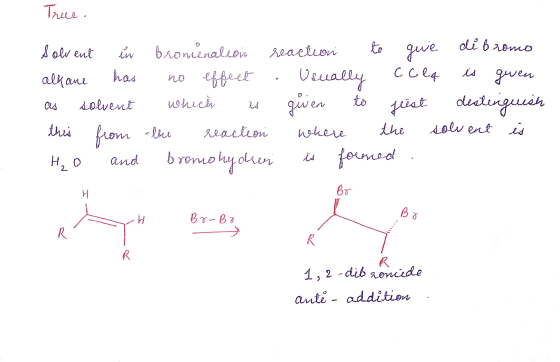
The bromination of alkenes depend more on the reagent than the solvent, that product in any...
Bromination of Alkenes - treatment of alkenes with molecular bromine leads to the anti addition of...
 Bromination of Alkenes - treatment of alkenes with molecular bromine leads to the anti addition of the two bromine atoms across the double bond. Br2 CH2CH2 Mechanism Major Product The hinders one face of the molecule forcing the second bromine to add from the opposite face resulting _of the bromine atoms. Halohydrin formation - treatment of alkenes with bromine or chlorine (X) in the presence of water as a solvent leads to addition of OH and X across the double...
Explantion: In a radical allylic bromination of alkenes with NBS reaction, why does allylic bromination occur...
Explantion: In a radical allylic bromination of alkenes with NBS reaction, why does allylic bromination occur instead of alkene bromination? Secondly, why does the more substituted alkene predominate if more than one alkene can form from such a reaction?
Reactions of Alkenes For the reactions below, provide the missing product, reactant or reagent(s). Show the...
 Reactions of Alkenes
For the reactions below, provide the missing product, reactant
or reagent(s). Show the stereochemistry where appropriate.
2) Reactions of Alkenes For the reactions below, provide the missing product, reactant or reagent(s). Show the stereochemistry where appropriate. HINT: Use this as preparation for the Final Exam! Solve as many as you can WITHOUT referring to resources. After writing your answers, then go check them. 2.5 points each NOTE: we will take extra points off for incorrectly drawn structures....
Reactions of Alkenes
For the reactions below, provide the missing product, reactant
or reagent(s). Show the stereochemistry where appropriate.
2) Reactions of Alkenes For the reactions below, provide the missing product, reactant or reagent(s). Show the stereochemistry where appropriate. HINT: Use this as preparation for the Final Exam! Solve as many as you can WITHOUT referring to resources. After writing your answers, then go check them. 2.5 points each NOTE: we will take extra points off for incorrectly drawn structures....
Reactions of Alkenes For the reactions below, provide the missing product, reactant or reagent(s). Show the...
 Reactions of Alkenes
For the reactions below, provide the missing product, reactant
or reagent(s). Show the stereochemistry where appropriate.
OH (racemic) Br2 CH2Cl2 (solvent) H2 Pd/C ОН cold, dilute KMnO4
Reactions of Alkenes
For the reactions below, provide the missing product, reactant
or reagent(s). Show the stereochemistry where appropriate.
OH (racemic) Br2 CH2Cl2 (solvent) H2 Pd/C ОН cold, dilute KMnO4
Identify the reactant, reagent, and solvent to synthesize the following Grignard reagent. Note: If one or more items a...
 Identify the reactant, reagent,
and solvent to synthesize the following Grignard reagent. Note: If
one or more items are incorrectly placed, a single red X will
appear on the top left.
Identify the reactant, reagent,
and solvent to synthesize the following Grignard reagent. Note: If
one or more items are incorrectly placed, a single red X will
appear on the top left.
For questions 4 and 5, more than one letter may apply: The concentration of which reagent...
 For questions 4 and 5, more than one letter may apply: The concentration of which reagent should be increased to accelerate the rate of reaction? Nal он AgBr A Br (solvent) NO, I- NaBr AgNO, (solvent)
please answer all parts, thanks! 1. More substituted alkenes are more stable than less substituted alkenes....
 please answer all parts, thanks!
1. More substituted alkenes are more stable than less substituted alkenes. Show the orbital overlap that helps to explain this observation. 2. Why is the heat of hydrogenation for an alkene exothermic? Analyze the bonds that are changing. AH = -30 kcal/mol Explain: + H2 3. Treating alkene "A" below with HBr can lead to a number of products. "A" SM + H-Br A bunch of products. For real, hella products. 3.A. Label the stereocenters...
please answer all parts, thanks!
1. More substituted alkenes are more stable than less substituted alkenes. Show the orbital overlap that helps to explain this observation. 2. Why is the heat of hydrogenation for an alkene exothermic? Analyze the bonds that are changing. AH = -30 kcal/mol Explain: + H2 3. Treating alkene "A" below with HBr can lead to a number of products. "A" SM + H-Br A bunch of products. For real, hella products. 3.A. Label the stereocenters...
Give the names of the reagent(s) and conditions (solvent, heat/no heat) that are expected to give...
 Give the names of the reagent(s) and conditions (solvent,
heat/no heat) that are expected to give the best yield in the
synthetic transformation below. More than one reaction is needed.
List the reagents and conditions separated by numbers for each
separate reaction
Give the names of the reagent(s) and conditions (solvent, heat/no heat) that are expected to give the best yield in the synthetic transformation below. More than one reaction is needed. List the reagents and conditions separated by numbers...
Give the names of the reagent(s) and conditions (solvent,
heat/no heat) that are expected to give the best yield in the
synthetic transformation below. More than one reaction is needed.
List the reagents and conditions separated by numbers for each
separate reaction
Give the names of the reagent(s) and conditions (solvent, heat/no heat) that are expected to give the best yield in the synthetic transformation below. More than one reaction is needed. List the reagents and conditions separated by numbers...
For questions 4 and 5, more than one letter may apply: The concentration of which reagent...
 For questions 4 and 5, more than one letter may apply: The concentration of which reagent should be increased to accelerate the rate of reaction? - 4. - в - - Nal - AgBr - OH (solvent) - - - - NO3 - I- // NaBr - AgNO3 11 - (solvent) - 11
a. Alkenes with electron withdrawing groups are good dienophiles-True/False b. Wolfkishner reaction is helpful to convert an ester to alkane. True false c. Tertiary alcohol will be formed by the r...
 a. Alkenes with electron withdrawing groups are good dienophiles-True/False b. Wolfkishner reaction is helpful to convert an ester to alkane. True false c. Tertiary alcohol will be formed by the reaction between a ketone and Grignard reagent True/ false d. A cyclic conjugated compound with 6 pi electron is aromatic- True/ False e. Addition of CO; to Methyl magnesium bromide is a nucleophilic addition Truel false f A good protecting group should be cleaved during the progress of the reaction-True...
 Bromination of Alkenes - treatment of alkenes with molecular bromine leads to the anti addition of the two bromine atoms across the double bond. Br2 CH2CH2 Mechanism Major Product The hinders one face of the molecule forcing the second bromine to add from the opposite face resulting _of the bromine atoms. Halohydrin formation - treatment of alkenes with bromine or chlorine (X) in the presence of water as a solvent leads to addition of OH and X across the double...
 Reactions of Alkenes
For the reactions below, provide the missing product, reactant
or reagent(s). Show the stereochemistry where appropriate.
2) Reactions of Alkenes For the reactions below, provide the missing product, reactant or reagent(s). Show the stereochemistry where appropriate. HINT: Use this as preparation for the Final Exam! Solve as many as you can WITHOUT referring to resources. After writing your answers, then go check them. 2.5 points each NOTE: we will take extra points off for incorrectly drawn structures....
Reactions of Alkenes
For the reactions below, provide the missing product, reactant
or reagent(s). Show the stereochemistry where appropriate.
2) Reactions of Alkenes For the reactions below, provide the missing product, reactant or reagent(s). Show the stereochemistry where appropriate. HINT: Use this as preparation for the Final Exam! Solve as many as you can WITHOUT referring to resources. After writing your answers, then go check them. 2.5 points each NOTE: we will take extra points off for incorrectly drawn structures....
 Reactions of Alkenes
For the reactions below, provide the missing product, reactant
or reagent(s). Show the stereochemistry where appropriate.
OH (racemic) Br2 CH2Cl2 (solvent) H2 Pd/C ОН cold, dilute KMnO4
Reactions of Alkenes
For the reactions below, provide the missing product, reactant
or reagent(s). Show the stereochemistry where appropriate.
OH (racemic) Br2 CH2Cl2 (solvent) H2 Pd/C ОН cold, dilute KMnO4
 Identify the reactant, reagent,
and solvent to synthesize the following Grignard reagent. Note: If
one or more items are incorrectly placed, a single red X will
appear on the top left.
Identify the reactant, reagent,
and solvent to synthesize the following Grignard reagent. Note: If
one or more items are incorrectly placed, a single red X will
appear on the top left.
 For questions 4 and 5, more than one letter may apply: The concentration of which reagent should be increased to accelerate the rate of reaction? Nal он AgBr A Br (solvent) NO, I- NaBr AgNO, (solvent)
 please answer all parts, thanks!
1. More substituted alkenes are more stable than less substituted alkenes. Show the orbital overlap that helps to explain this observation. 2. Why is the heat of hydrogenation for an alkene exothermic? Analyze the bonds that are changing. AH = -30 kcal/mol Explain: + H2 3. Treating alkene "A" below with HBr can lead to a number of products. "A" SM + H-Br A bunch of products. For real, hella products. 3.A. Label the stereocenters...
please answer all parts, thanks!
1. More substituted alkenes are more stable than less substituted alkenes. Show the orbital overlap that helps to explain this observation. 2. Why is the heat of hydrogenation for an alkene exothermic? Analyze the bonds that are changing. AH = -30 kcal/mol Explain: + H2 3. Treating alkene "A" below with HBr can lead to a number of products. "A" SM + H-Br A bunch of products. For real, hella products. 3.A. Label the stereocenters...
 Give the names of the reagent(s) and conditions (solvent,
heat/no heat) that are expected to give the best yield in the
synthetic transformation below. More than one reaction is needed.
List the reagents and conditions separated by numbers for each
separate reaction
Give the names of the reagent(s) and conditions (solvent, heat/no heat) that are expected to give the best yield in the synthetic transformation below. More than one reaction is needed. List the reagents and conditions separated by numbers...
Give the names of the reagent(s) and conditions (solvent,
heat/no heat) that are expected to give the best yield in the
synthetic transformation below. More than one reaction is needed.
List the reagents and conditions separated by numbers for each
separate reaction
Give the names of the reagent(s) and conditions (solvent, heat/no heat) that are expected to give the best yield in the synthetic transformation below. More than one reaction is needed. List the reagents and conditions separated by numbers...
 For questions 4 and 5, more than one letter may apply: The concentration of which reagent should be increased to accelerate the rate of reaction? - 4. - в - - Nal - AgBr - OH (solvent) - - - - NO3 - I- // NaBr - AgNO3 11 - (solvent) - 11
 a. Alkenes with electron withdrawing groups are good dienophiles-True/False b. Wolfkishner reaction is helpful to convert an ester to alkane. True false c. Tertiary alcohol will be formed by the reaction between a ketone and Grignard reagent True/ false d. A cyclic conjugated compound with 6 pi electron is aromatic- True/ False e. Addition of CO; to Methyl magnesium bromide is a nucleophilic addition Truel false f A good protecting group should be cleaved during the progress of the reaction-True...
Most questions answered within 3 hours.
-
Where is the error in this code sequence?
String s1 = "Hello";
String s2 = "ello";...
asked 11 months ago -
Financial data for Joel de Paris, Inc., for last year
follow:
Joel de Paris, Inc.
Balance...
asked 11 months ago -
Consider this reaction:
Al2(SO4)3 (aq)+ BaCl3
(aq) Al2Cl6 (aq)- +
3BaSO4(s) . What is the...
asked 11 months ago -
Suppose that Savneet is considering increasing her
recent random sample from 20 car rentals to 40...
asked 11 months ago -
Trucks arrive at an unloading terminal at an average rate of 120
per hour.
Trucks arrive...
asked 11 months ago -
Why are methanol and ethanol completely soluble in water while
octanol is not very little soluble....
asked 11 months ago -
A facilities manager at a university reads in a research report
that the mean amount of...
asked 11 months ago -
When the CuSO4 is rehydrated by adding water to the anhydrous
compound, is this an endothermic...
asked 11 months ago -
A ray of sunlight is passing from diamond into crown glass; the
angle of incidence is...
asked 11 months ago -
A block of mass 0.249 kg is placed on top of a light, vertical
spring of...
asked 11 months ago -
how do the kidneys compensate in the presences of acidosis
a) trigger hyperventilate
b) reserve acid...
asked 11 months ago -
Question 501 pts
The rental rate of capital to the firm increases. Which of the
following...
asked 11 months ago