
Homework Answers
Add Answer to:
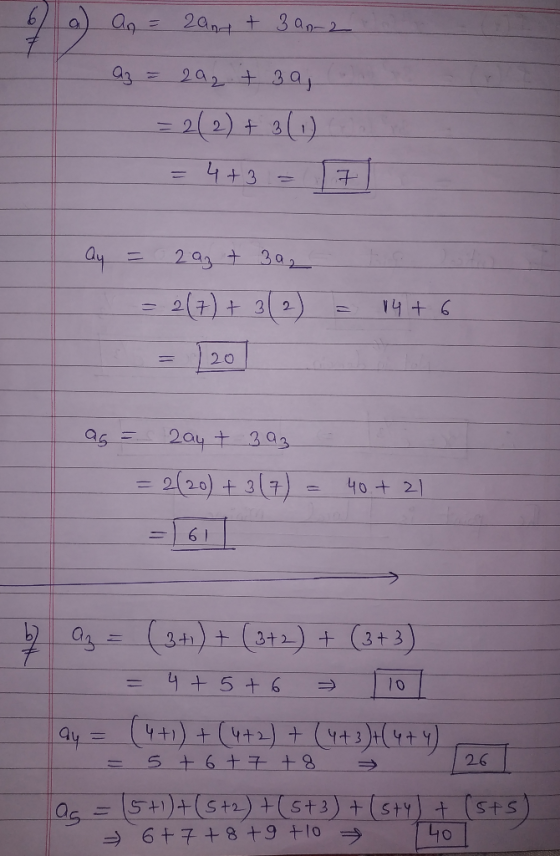
(12 points) Find az, a4, and as of the sequences. (6) a. q = 1, 02...
1. Let az, az, az, a4 are vectors in R3. Suppose that az 3a1 – 2a3...
 1. Let az, az, az, a4 are vectors in R3. Suppose that az 3a1 – 2a3 + 84. (a) Are aj, aj, az, a4 linearly independent? (b) Suppose that ai, az, a4 are linearly independent. What is the dimension of the span{a1, az, az, a4}? (c) Is the set of vectors aj, az, az, a4 form a basis of R3? Explain your reasoning. (d) Form a basis of R3 using a subset of ai, a2, a3, 24.
1. For each of the following sequences, determine whether it converges. If so, find the limit....
 1. For each of the following sequences, determine whether it converges. If so, find the limit. 2n+1 5n-2 a. b. 4. =(-1)"." 2n 2"-1 c. n
(10 points) Determine whether the sequences are increasing, decreasing, or not monotonic. If increasing, enter 1...
 (10 points) Determine whether the sequences are increasing, decreasing, or not monotonic. If increasing, enter 1 as your answer. If decreasing, enter -1 as your answer. If not monotonic, enter 0 as your answer n + 3. an +2 2n +8 Note: In order to get credit for this problem all answers must be correct You have attempted this problem 0 times. You have unlimited attempts remaining. 12 F1O F9 F8 F6 F5
(10 points) Determine whether the sequences are...
(10 points) Determine whether the sequences are increasing, decreasing, or not monotonic. If increasing, enter 1 as your answer. If decreasing, enter -1 as your answer. If not monotonic, enter 0 as your answer n + 3. an +2 2n +8 Note: In order to get credit for this problem all answers must be correct You have attempted this problem 0 times. You have unlimited attempts remaining. 12 F1O F9 F8 F6 F5
(10 points) Determine whether the sequences are...
answers provided 1. Are the following sequences well ordered as € +0? If not, arrange them...
 answers provided
1. Are the following sequences well ordered as € +0? If not, arrange them so that they are. (a) Mn = (sinh(6/2)]2n for n = 0,1,2,3,... (b) $i = e$e-8/6, p=e, pos = eln(e), pa=e", $s = = sin(eº), po = inte (c) $1 = {€ – 1 – €, 02 = {€ – 1, $3 = e, $4 = {€ – 1 (d) An = e-1/e" for n = 0,1, 2, 3, ... (a) yes (b) no...
answers provided
1. Are the following sequences well ordered as € +0? If not, arrange them so that they are. (a) Mn = (sinh(6/2)]2n for n = 0,1,2,3,... (b) $i = e$e-8/6, p=e, pos = eln(e), pa=e", $s = = sin(eº), po = inte (c) $1 = {€ – 1 – €, 02 = {€ – 1, $3 = e, $4 = {€ – 1 (d) An = e-1/e" for n = 0,1, 2, 3, ... (a) yes (b) no...
number 4 1. Find the limit of the following sequences (find lim an) n n a.)...
 number 4
1. Find the limit of the following sequences (find lim an) n n a.) an = n +3 b.) an = V35n n- 2. Determine whether the following series converge or diverge. -3 (n + 2)n + 5 b.) tan-'(n) n2 + 1 a.) 5 nel 3. Determine the radius of convergence and the interval of convergence of the series 2" (x – 3)" n n=1 n=0 (-1)", 2n 4. Using the power series cos(x) (2n)! (-« <...
number 4
1. Find the limit of the following sequences (find lim an) n n a.) an = n +3 b.) an = V35n n- 2. Determine whether the following series converge or diverge. -3 (n + 2)n + 5 b.) tan-'(n) n2 + 1 a.) 5 nel 3. Determine the radius of convergence and the interval of convergence of the series 2" (x – 3)" n n=1 n=0 (-1)", 2n 4. Using the power series cos(x) (2n)! (-« <...
number 4 as clearly as possible 1. Find the limit of the following sequences (find lim...
 number 4 as clearly as possible
1. Find the limit of the following sequences (find lim an) n n a.) an = n +3 b.) an = V35n n- 2. Determine whether the following series converge or diverge. -3 (n + 2)n + 5 b.) tan-'(n) n2 + 1 a.) 5 nel 3. Determine the radius of convergence and the interval of convergence of the series 2" (x – 3)" n n=1 n=0 (-1)", 2n 4. Using the power series...
number 4 as clearly as possible
1. Find the limit of the following sequences (find lim an) n n a.) an = n +3 b.) an = V35n n- 2. Determine whether the following series converge or diverge. -3 (n + 2)n + 5 b.) tan-'(n) n2 + 1 a.) 5 nel 3. Determine the radius of convergence and the interval of convergence of the series 2" (x – 3)" n n=1 n=0 (-1)", 2n 4. Using the power series...
10. Let p(x) +1. Let E be the splitting field for p(x) over Q. a. Find the resolvent cubic R(z). ...
 Part D,E,F,G
10. Let p(x) +1. Let E be the splitting field for p(x) over Q. a. Find the resolvent cubic R(z). b. Prove that R(x) is irreducible over Q. c. Prove that (E:Q) 12 or 24. d. Prove: Gal(E/Q) A4 or S4 e. If p(x) (2+ az+ b)(a2 + cr + d), verify the calculations on page 100 which show that a2 is a root of the cubic polynomial r(x)3-4. 1. f. Prove: r(x) -4z 1 is irreducible in...
Part D,E,F,G
10. Let p(x) +1. Let E be the splitting field for p(x) over Q. a. Find the resolvent cubic R(z). b. Prove that R(x) is irreducible over Q. c. Prove that (E:Q) 12 or 24. d. Prove: Gal(E/Q) A4 or S4 e. If p(x) (2+ az+ b)(a2 + cr + d), verify the calculations on page 100 which show that a2 is a root of the cubic polynomial r(x)3-4. 1. f. Prove: r(x) -4z 1 is irreducible in...
6. ... / 6 points) Determine if the following sequences converge or diverge. If they converge,...
 6. ... / 6 points) Determine if the following sequences converge or diverge. If they converge, give the limit. (a) an = (-1)" n+1 n (b) an = n In(n)
DSP 4. (12 points) (a) (4 points) Let x[n] = {1,2, 1, 2} and h[n] =...
 DSP
4. (12 points) (a) (4 points) Let x[n] = {1,2, 1, 2} and h[n] = {1,-1,1, -1} be two length-4 sequences defined for 0 <n<3. Determine the circular convolution of length-4 y[n] = x[n] 4 hin). (b) (6 points) Find the 4-point discrete Fourier transform (DFT) X[k], H[k], and Y[k]. (c) (2 points) Find the 4-point inverse DFT (IDFT) of Z[k] = {X[k]H[k].
DSP
4. (12 points) (a) (4 points) Let x[n] = {1,2, 1, 2} and h[n] = {1,-1,1, -1} be two length-4 sequences defined for 0 <n<3. Determine the circular convolution of length-4 y[n] = x[n] 4 hin). (b) (6 points) Find the 4-point discrete Fourier transform (DFT) X[k], H[k], and Y[k]. (c) (2 points) Find the 4-point inverse DFT (IDFT) of Z[k] = {X[k]H[k].
2 Determine whether the following the following sequences converge or diverge. If it converges, find the...
 2 Determine whether the following the following sequences converge or diverge. If it converges, find the limit. (a) an = cos () 2n (b) a = In 2n + 1 3 (a) Does Î- (-)" converge or diverge? If it converges, find its sum. n=1 (b) Show how > 41-13-" can be written in the form of a geometric series. Does it converge or diverge? If it converges, find its sum. n=1
 1. Let az, az, az, a4 are vectors in R3. Suppose that az 3a1 – 2a3 + 84. (a) Are aj, aj, az, a4 linearly independent? (b) Suppose that ai, az, a4 are linearly independent. What is the dimension of the span{a1, az, az, a4}? (c) Is the set of vectors aj, az, az, a4 form a basis of R3? Explain your reasoning. (d) Form a basis of R3 using a subset of ai, a2, a3, 24.
 1. For each of the following sequences, determine whether it converges. If so, find the limit. 2n+1 5n-2 a. b. 4. =(-1)"." 2n 2"-1 c. n
 (10 points) Determine whether the sequences are increasing, decreasing, or not monotonic. If increasing, enter 1 as your answer. If decreasing, enter -1 as your answer. If not monotonic, enter 0 as your answer n + 3. an +2 2n +8 Note: In order to get credit for this problem all answers must be correct You have attempted this problem 0 times. You have unlimited attempts remaining. 12 F1O F9 F8 F6 F5
(10 points) Determine whether the sequences are...
(10 points) Determine whether the sequences are increasing, decreasing, or not monotonic. If increasing, enter 1 as your answer. If decreasing, enter -1 as your answer. If not monotonic, enter 0 as your answer n + 3. an +2 2n +8 Note: In order to get credit for this problem all answers must be correct You have attempted this problem 0 times. You have unlimited attempts remaining. 12 F1O F9 F8 F6 F5
(10 points) Determine whether the sequences are...
 answers provided
1. Are the following sequences well ordered as € +0? If not, arrange them so that they are. (a) Mn = (sinh(6/2)]2n for n = 0,1,2,3,... (b) $i = e$e-8/6, p=e, pos = eln(e), pa=e", $s = = sin(eº), po = inte (c) $1 = {€ – 1 – €, 02 = {€ – 1, $3 = e, $4 = {€ – 1 (d) An = e-1/e" for n = 0,1, 2, 3, ... (a) yes (b) no...
answers provided
1. Are the following sequences well ordered as € +0? If not, arrange them so that they are. (a) Mn = (sinh(6/2)]2n for n = 0,1,2,3,... (b) $i = e$e-8/6, p=e, pos = eln(e), pa=e", $s = = sin(eº), po = inte (c) $1 = {€ – 1 – €, 02 = {€ – 1, $3 = e, $4 = {€ – 1 (d) An = e-1/e" for n = 0,1, 2, 3, ... (a) yes (b) no...
 number 4
1. Find the limit of the following sequences (find lim an) n n a.) an = n +3 b.) an = V35n n- 2. Determine whether the following series converge or diverge. -3 (n + 2)n + 5 b.) tan-'(n) n2 + 1 a.) 5 nel 3. Determine the radius of convergence and the interval of convergence of the series 2" (x – 3)" n n=1 n=0 (-1)", 2n 4. Using the power series cos(x) (2n)! (-« <...
number 4
1. Find the limit of the following sequences (find lim an) n n a.) an = n +3 b.) an = V35n n- 2. Determine whether the following series converge or diverge. -3 (n + 2)n + 5 b.) tan-'(n) n2 + 1 a.) 5 nel 3. Determine the radius of convergence and the interval of convergence of the series 2" (x – 3)" n n=1 n=0 (-1)", 2n 4. Using the power series cos(x) (2n)! (-« <...
 number 4 as clearly as possible
1. Find the limit of the following sequences (find lim an) n n a.) an = n +3 b.) an = V35n n- 2. Determine whether the following series converge or diverge. -3 (n + 2)n + 5 b.) tan-'(n) n2 + 1 a.) 5 nel 3. Determine the radius of convergence and the interval of convergence of the series 2" (x – 3)" n n=1 n=0 (-1)", 2n 4. Using the power series...
number 4 as clearly as possible
1. Find the limit of the following sequences (find lim an) n n a.) an = n +3 b.) an = V35n n- 2. Determine whether the following series converge or diverge. -3 (n + 2)n + 5 b.) tan-'(n) n2 + 1 a.) 5 nel 3. Determine the radius of convergence and the interval of convergence of the series 2" (x – 3)" n n=1 n=0 (-1)", 2n 4. Using the power series...
 Part D,E,F,G
10. Let p(x) +1. Let E be the splitting field for p(x) over Q. a. Find the resolvent cubic R(z). b. Prove that R(x) is irreducible over Q. c. Prove that (E:Q) 12 or 24. d. Prove: Gal(E/Q) A4 or S4 e. If p(x) (2+ az+ b)(a2 + cr + d), verify the calculations on page 100 which show that a2 is a root of the cubic polynomial r(x)3-4. 1. f. Prove: r(x) -4z 1 is irreducible in...
Part D,E,F,G
10. Let p(x) +1. Let E be the splitting field for p(x) over Q. a. Find the resolvent cubic R(z). b. Prove that R(x) is irreducible over Q. c. Prove that (E:Q) 12 or 24. d. Prove: Gal(E/Q) A4 or S4 e. If p(x) (2+ az+ b)(a2 + cr + d), verify the calculations on page 100 which show that a2 is a root of the cubic polynomial r(x)3-4. 1. f. Prove: r(x) -4z 1 is irreducible in...
 6. ... / 6 points) Determine if the following sequences converge or diverge. If they converge, give the limit. (a) an = (-1)" n+1 n (b) an = n In(n)
 DSP
4. (12 points) (a) (4 points) Let x[n] = {1,2, 1, 2} and h[n] = {1,-1,1, -1} be two length-4 sequences defined for 0 <n<3. Determine the circular convolution of length-4 y[n] = x[n] 4 hin). (b) (6 points) Find the 4-point discrete Fourier transform (DFT) X[k], H[k], and Y[k]. (c) (2 points) Find the 4-point inverse DFT (IDFT) of Z[k] = {X[k]H[k].
DSP
4. (12 points) (a) (4 points) Let x[n] = {1,2, 1, 2} and h[n] = {1,-1,1, -1} be two length-4 sequences defined for 0 <n<3. Determine the circular convolution of length-4 y[n] = x[n] 4 hin). (b) (6 points) Find the 4-point discrete Fourier transform (DFT) X[k], H[k], and Y[k]. (c) (2 points) Find the 4-point inverse DFT (IDFT) of Z[k] = {X[k]H[k].
 2 Determine whether the following the following sequences converge or diverge. If it converges, find the limit. (a) an = cos () 2n (b) a = In 2n + 1 3 (a) Does Î- (-)" converge or diverge? If it converges, find its sum. n=1 (b) Show how > 41-13-" can be written in the form of a geometric series. Does it converge or diverge? If it converges, find its sum. n=1
Most questions answered within 3 hours.
-
Where is the error in this code sequence?
String s1 = "Hello";
String s2 = "ello";...
asked 11 months ago -
Financial data for Joel de Paris, Inc., for last year
follow:
Joel de Paris, Inc.
Balance...
asked 11 months ago -
Consider this reaction:
Al2(SO4)3 (aq)+ BaCl3
(aq) Al2Cl6 (aq)- +
3BaSO4(s) . What is the...
asked 11 months ago -
Suppose that Savneet is considering increasing her
recent random sample from 20 car rentals to 40...
asked 11 months ago -
Trucks arrive at an unloading terminal at an average rate of 120
per hour.
Trucks arrive...
asked 11 months ago -
Why are methanol and ethanol completely soluble in water while
octanol is not very little soluble....
asked 11 months ago -
A facilities manager at a university reads in a research report
that the mean amount of...
asked 11 months ago -
When the CuSO4 is rehydrated by adding water to the anhydrous
compound, is this an endothermic...
asked 11 months ago -
A ray of sunlight is passing from diamond into crown glass; the
angle of incidence is...
asked 11 months ago -
A block of mass 0.249 kg is placed on top of a light, vertical
spring of...
asked 11 months ago -
how do the kidneys compensate in the presences of acidosis
a) trigger hyperventilate
b) reserve acid...
asked 11 months ago -
Question 501 pts
The rental rate of capital to the firm increases. Which of the
following...
asked 11 months ago