
Homework Answers
Add Answer to:
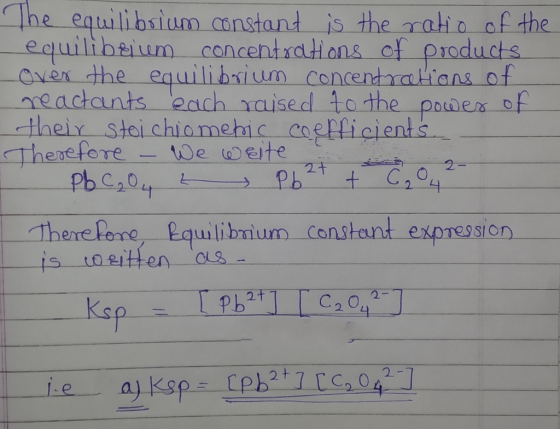
a. C. 3. What is the equilibrium constant expression for the dissolution of solid lead oxalate,...
Write the equilibrium-constant expression for the reaction shown in terms of [NO], [0, 1, and [NO,...
 Write the equilibrium-constant expression for the reaction shown in terms of [NO], [0, 1, and [NO, J. 2 NO(g) + O2(g) = 2 NO, (g) Ke, which is sometimes symbolized as Kor Key, denotes that the equilibrium constant is expressed using molar concentrations. For this question, Kmeans the same thing as K and Ke. K. = [C] [D]2 [4][B] At 25 °C, only 0.0670 mol of the generic salt AB, is soluble in 1.00 L of water. What is the...
Consider the dissolution equation of lead(II) chloride. PbCl2 (s) Pb2+ (aq) + 2 C1- (aq) Suppose...
 Consider the dissolution equation of lead(II) chloride. PbCl2 (s) Pb2+ (aq) + 2 C1- (aq) Suppose you add 0.2331 g of PbCl2(s) to 50.0 mL of water. In the resulting saturated solution, you find that the concentration of Pb2+ (aq) is 0.0159 M and the concentration of Cl - (aq) is 0.0318 M. What is the value of the equilibrium constant, Ksp, for the dissolution of PbCl2? Answer:
The solubility of lead(II) iodide in water is 0.62 grams per 1.0 L of solution. What is the solubility product cons...
 The solubility of lead(II) iodide in water is 0.62 grams per 1.0 L of solution. What is the solubility product constant, Ksp. for the dissolution? Pb/z(s) ++ Pb2+ (aq) + 2/"(aq) O 4.0x10⁻³ O 9.7x10⁻⁹ 2.4x10⁻⁹ O 1.8x10⁻⁶
a) Write the chemical equation for solid lead(II) bromide in equilibrium with its ions. b) Write...
 a) Write the chemical equation for solid lead(II) bromide in equilibrium with its ions. b) Write the corresponding equilibrium constant expression. c) What specific name is given to the equilibrium constant expression for relatively insoluble salts? d) Explain why the solid lead(II) bromide is not used in this equilibrium constant expression. When an ionic compound dissolves in water, the individual ions first leave the crystal lattice and then each ion becomes surrounded by a cluster of polar water molecules. What...
What is the correct expression of the solubility product constant (Ksp) for the following equilibrium? PbC14...
 What is the correct expression of the solubility product constant (Ksp) for the following equilibrium? PbC14 (s) = P64+ (aq) + 4Cl- (s) P64+ K 8p [c1"]" Кsp [Pb2+] [c1-14 [PbC14] [Ps+]4x [C] K sp = (PbC14) O Køp = [P64+] [C1-14
What is the correct expression of the solubility product constant (Ksp) for the following equilibrium? PbCl4...
 What is the correct expression of the solubility product constant (Ksp) for the following equilibrium? PbCl4 (s) = P64+ (aq) + 4C1- (s) K SP [P0++] [C1-]4 4 [PB+][c1] sp [PbCl4] [Pb++]ax [cr] Ksp = [PbC14] OK sp = [Pb1+] [C1-14
6) Given the following thermodynamic data, calculate the equilibrium constant for the dissolution of galena, PbS,...
 6) Given the following thermodynamic data, calculate the equilibrium constant for the dissolution of galena, PbS, at 298 K and 1 bar according to the reaction PbS(solid) + H-Pb(aq) + HS. From this, can you calculate the solubility of PbS at pH-2? (Hint: assume [Pb2] [HS] and note that PbSl-1 for pure galena; at pH-2, [H+] 0.01) AHf, lbar (kJ/mol) 97.7 (kJ/mol-K) 0.091 (cm3/mole) 31.5 Galena (PbS, solid H+ (aqueous ion,1 molal Pb2+ (aq. ion, 1 molal HS-(aq. ion, 1...
Write the chemical equation for the solubility equilibrium and the Ksp expression for each compound please...
 Write the chemical equation for the
solubility equilibrium and the Ksp expression for each
compound please help and explain steps
AgI First, write the solubility equilibrium for Agi. Include physical states in your answer: ? Edit Next, write the solubility product constant for Agi: OK = [Ag+][I-12 sp sp Ksp = ([Ag+][1-)) / [AgI] Okn = [Agl] / [[Ag+][1-1) Ksp = [Ag+][1-) AuCl3 First, write the solubility equilibrium for AuCl3. Include physical states in your answer: |? Edit Next, write...
Write the chemical equation for the
solubility equilibrium and the Ksp expression for each
compound please help and explain steps
AgI First, write the solubility equilibrium for Agi. Include physical states in your answer: ? Edit Next, write the solubility product constant for Agi: OK = [Ag+][I-12 sp sp Ksp = ([Ag+][1-)) / [AgI] Okn = [Agl] / [[Ag+][1-1) Ksp = [Ag+][1-) AuCl3 First, write the solubility equilibrium for AuCl3. Include physical states in your answer: |? Edit Next, write...
Model I: The Dissolution of Magnesium Hydroxide in Water When solid Mg(OH)2 dissolves in water, the...
Model I: The Dissolution of Magnesium Hydroxide in Water When solid Mg(OH)2 dissolves in water, the chemical reaction is: Mg(OH)2(s) Mg2+(aq) + 2OH-(aq) (1) Table I. These are the results after equilibrium has been established for the addition of solid Mg(OH)2(s) to water yielding a final volume of 10.0 L of solution. Total amount of Mg(OH)2 added Mg2+ concentration in the resulting solution at eq OH- concentration in the resulting solution at eq Mass of Mg(OH)2 that does not dissolve...
Learning Goal: To learn how to calculate the solubility from Kspand vice versa. Consider the following equilibrium be...
Learning Goal: To learn how to calculate the solubility from Kspand vice versa. Consider the following equilibrium between a solid salt and its dissolved form (ions) in a saturated solution: CaF2(s)⇌Ca2+(aq)+2F−(aq) At equilibrium, the ion concentrations remain constant because the rate of dissolution of solid CaF2 equals the rate of the ion crystallization. The equilibrium constant for the dissolution reaction is Ksp=[Ca2+][F−]2 Ksp is called the solubility product and can be determined experimentally by measuring thesolubility, which is the amount...
 Write the equilibrium-constant expression for the reaction shown in terms of [NO], [0, 1, and [NO, J. 2 NO(g) + O2(g) = 2 NO, (g) Ke, which is sometimes symbolized as Kor Key, denotes that the equilibrium constant is expressed using molar concentrations. For this question, Kmeans the same thing as K and Ke. K. = [C] [D]2 [4][B] At 25 °C, only 0.0670 mol of the generic salt AB, is soluble in 1.00 L of water. What is the...
 Consider the dissolution equation of lead(II) chloride. PbCl2 (s) Pb2+ (aq) + 2 C1- (aq) Suppose you add 0.2331 g of PbCl2(s) to 50.0 mL of water. In the resulting saturated solution, you find that the concentration of Pb2+ (aq) is 0.0159 M and the concentration of Cl - (aq) is 0.0318 M. What is the value of the equilibrium constant, Ksp, for the dissolution of PbCl2? Answer:
 The solubility of lead(II) iodide in water is 0.62 grams per 1.0 L of solution. What is the solubility product constant, Ksp. for the dissolution? Pb/z(s) ++ Pb2+ (aq) + 2/"(aq) O 4.0x10⁻³ O 9.7x10⁻⁹ 2.4x10⁻⁹ O 1.8x10⁻⁶
 a) Write the chemical equation for solid lead(II) bromide in equilibrium with its ions. b) Write the corresponding equilibrium constant expression. c) What specific name is given to the equilibrium constant expression for relatively insoluble salts? d) Explain why the solid lead(II) bromide is not used in this equilibrium constant expression. When an ionic compound dissolves in water, the individual ions first leave the crystal lattice and then each ion becomes surrounded by a cluster of polar water molecules. What...
 What is the correct expression of the solubility product constant (Ksp) for the following equilibrium? PbC14 (s) = P64+ (aq) + 4Cl- (s) P64+ K 8p [c1"]" Кsp [Pb2+] [c1-14 [PbC14] [Ps+]4x [C] K sp = (PbC14) O Køp = [P64+] [C1-14
 What is the correct expression of the solubility product constant (Ksp) for the following equilibrium? PbCl4 (s) = P64+ (aq) + 4C1- (s) K SP [P0++] [C1-]4 4 [PB+][c1] sp [PbCl4] [Pb++]ax [cr] Ksp = [PbC14] OK sp = [Pb1+] [C1-14
 6) Given the following thermodynamic data, calculate the equilibrium constant for the dissolution of galena, PbS, at 298 K and 1 bar according to the reaction PbS(solid) + H-Pb(aq) + HS. From this, can you calculate the solubility of PbS at pH-2? (Hint: assume [Pb2] [HS] and note that PbSl-1 for pure galena; at pH-2, [H+] 0.01) AHf, lbar (kJ/mol) 97.7 (kJ/mol-K) 0.091 (cm3/mole) 31.5 Galena (PbS, solid H+ (aqueous ion,1 molal Pb2+ (aq. ion, 1 molal HS-(aq. ion, 1...
 Write the chemical equation for the
solubility equilibrium and the Ksp expression for each
compound please help and explain steps
AgI First, write the solubility equilibrium for Agi. Include physical states in your answer: ? Edit Next, write the solubility product constant for Agi: OK = [Ag+][I-12 sp sp Ksp = ([Ag+][1-)) / [AgI] Okn = [Agl] / [[Ag+][1-1) Ksp = [Ag+][1-) AuCl3 First, write the solubility equilibrium for AuCl3. Include physical states in your answer: |? Edit Next, write...
Write the chemical equation for the
solubility equilibrium and the Ksp expression for each
compound please help and explain steps
AgI First, write the solubility equilibrium for Agi. Include physical states in your answer: ? Edit Next, write the solubility product constant for Agi: OK = [Ag+][I-12 sp sp Ksp = ([Ag+][1-)) / [AgI] Okn = [Agl] / [[Ag+][1-1) Ksp = [Ag+][1-) AuCl3 First, write the solubility equilibrium for AuCl3. Include physical states in your answer: |? Edit Next, write...
Most questions answered within 3 hours.
-
Where is the error in this code sequence?
String s1 = "Hello";
String s2 = "ello";...
asked 10 months ago -
Financial data for Joel de Paris, Inc., for last year
follow:
Joel de Paris, Inc.
Balance...
asked 10 months ago -
Consider this reaction:
Al2(SO4)3 (aq)+ BaCl3
(aq) Al2Cl6 (aq)- +
3BaSO4(s) . What is the...
asked 10 months ago -
Suppose that Savneet is considering increasing her
recent random sample from 20 car rentals to 40...
asked 10 months ago -
Trucks arrive at an unloading terminal at an average rate of 120
per hour.
Trucks arrive...
asked 10 months ago -
Why are methanol and ethanol completely soluble in water while
octanol is not very little soluble....
asked 10 months ago -
A facilities manager at a university reads in a research report
that the mean amount of...
asked 10 months ago -
When the CuSO4 is rehydrated by adding water to the anhydrous
compound, is this an endothermic...
asked 10 months ago -
A ray of sunlight is passing from diamond into crown glass; the
angle of incidence is...
asked 10 months ago -
A block of mass 0.249 kg is placed on top of a light, vertical
spring of...
asked 10 months ago -
how do the kidneys compensate in the presences of acidosis
a) trigger hyperventilate
b) reserve acid...
asked 10 months ago -
Question 501 pts
The rental rate of capital to the firm increases. Which of the
following...
asked 10 months ago