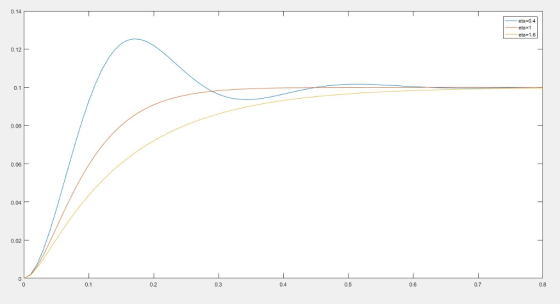
![2. Consider a spring-mass-damper system with oh-20 rad/s and K-1k = 0.010 mN that is initially at rest [y(0) = dydt(0)-0]. This systern is subjected to a step load F-10 N at t-0·Plot displacement y(t) for range 0StS0.8 for 3 different damping ratios(-0.40,1.00, 1.60) on a single graph (see Eq. 3.15). Use a software package to plot (Excel, MathCad, Matlab, etc.)-do not plot by hand. (12 points)](http://img.homeworklib.com/questions/29e6d270-f8b8-11eb-8097-f91630983215.png?x-oss-process=image/resize,w_560)
Homework Answers
clc
clear all
eta=input('eta=');
syms y(t)
Dy = diff(y);
ode = diff(y,t,2)+(40*eta)*diff(y,t,1)+400*y == 40;%differential
equation%
cond1 = y(0) == 0;%initial conditions%
cond2 = Dy(0) == 0;
conds = [cond1 cond2];
y(t) = dsolve(ode,conds);
t=0:0.01:0.8;
y1=y(t);
plot(t,y1)
hold on


Add Answer to:
2. Consider a spring-mass-damper system with oh-20 rad/s and K-1k = 0.010 mN that is initially...
Problem Set A Problem 6. (20%) A ordinary differential equation for a mass-damper-spring system is following....
 Problem Set A Problem 6. (20%) A ordinary differential equation for a mass-damper-spring system is following. The mass m 1, damping coetfic e initial position y(o) O, and the initial velocity i constant k 3 and force 10, all are in appropriate units. Th 1, spring zero, within the time range of O to 20 unit of time, use Matlab find the solution of function y(t)? Hint: you need to convert the 2nd order ODE into two 1st order ODEs....
a can be skipped Consider the following second-order ODE representing a spring-mass-damper system for zero initial...
 a can be skipped
Consider the following second-order ODE representing a spring-mass-damper system for zero initial conditions (forced response): 2x + 2x + x=u, x(0) = 0, *(0) = 0 where u is the Unit Step Function (of magnitude 1). a. Use MATLAB to obtain an analytical solution x(t) for the differential equation, using the Laplace Transforms approach (do not use DSOLVE). Obtain the analytical expression for x(t). Also obtain a plot of .x(t) (for a simulation of 14 seconds)...
a can be skipped
Consider the following second-order ODE representing a spring-mass-damper system for zero initial conditions (forced response): 2x + 2x + x=u, x(0) = 0, *(0) = 0 where u is the Unit Step Function (of magnitude 1). a. Use MATLAB to obtain an analytical solution x(t) for the differential equation, using the Laplace Transforms approach (do not use DSOLVE). Obtain the analytical expression for x(t). Also obtain a plot of .x(t) (for a simulation of 14 seconds)...
Consider the spring-mass-damper system shown. Assume M-1kg. B - 20 N-s/m, K-25 N/m and f(t) =...
 Consider the spring-mass-damper system shown. Assume M-1kg. B - 20 N-s/m, K-25 N/m and f(t) = ON (zero-input case). The initial conditions are: x(O) = 1 m, x(0) = 0 m/s Select the correct plot of "x vs. t" for this zero-input case. They M B 0 0 O O o
(20pts) Consider the vertical spring-mass-damper system shown below, where m 2 kg, b 4 N-s/m, and...
 (20pts) Consider the vertical spring-mass-damper system shown below, where m 2 kg, b 4 N-s/m, and k 20N/m. Assume that x(0) 0.1 m and (0) 0. The displacement is measured form the equilibrium position. Derive a mathematical model of the system (i.e. an ODE). Then find x(t) as a function of time t.
x(t) y(d) Consider the spring-mass-damper system above travelling along a bumpy surface with a height change....
 x(t) y(d) Consider the spring-mass-damper system above travelling along a bumpy surface with a height change. The damping ratio is =0.2, the natural frequency is 3 rad/s, and the mass, m=200 kg. The wheel does not lose contact with the road and the road has the shape, y(d)4sin 0H(d 10) where d is distance in meters, and y(d) is the height in centimeters 1. Write the ordinary differential equation for v-1 m/s and v-5 m/s. 2. The solution of x(t)...
2. The energy of the mass-spring system is given by the sum of the kinetic energy and the potenti...
 using matlab help to answer #2 please show steps in creating code
2. The energy of the mass-spring system is given by the sum of the kinetic energy and the potential energy. In the absence of damping, the energy is conserved (a) Add commands to LAB05ex1 to compute and plot the quantity E-m k2 as a function of time. What do you observe? (pay close attention to the y-axis scale and, if necessary, use ylim to get a better graph)....
using matlab help to answer #2 please show steps in creating code
2. The energy of the mass-spring system is given by the sum of the kinetic energy and the potential energy. In the absence of damping, the energy is conserved (a) Add commands to LAB05ex1 to compute and plot the quantity E-m k2 as a function of time. What do you observe? (pay close attention to the y-axis scale and, if necessary, use ylim to get a better graph)....
 Problem Set A Problem 6. (20%) A ordinary differential equation for a mass-damper-spring system is following. The mass m 1, damping coetfic e initial position y(o) O, and the initial velocity i constant k 3 and force 10, all are in appropriate units. Th 1, spring zero, within the time range of O to 20 unit of time, use Matlab find the solution of function y(t)? Hint: you need to convert the 2nd order ODE into two 1st order ODEs....
 a can be skipped
Consider the following second-order ODE representing a spring-mass-damper system for zero initial conditions (forced response): 2x + 2x + x=u, x(0) = 0, *(0) = 0 where u is the Unit Step Function (of magnitude 1). a. Use MATLAB to obtain an analytical solution x(t) for the differential equation, using the Laplace Transforms approach (do not use DSOLVE). Obtain the analytical expression for x(t). Also obtain a plot of .x(t) (for a simulation of 14 seconds)...
a can be skipped
Consider the following second-order ODE representing a spring-mass-damper system for zero initial conditions (forced response): 2x + 2x + x=u, x(0) = 0, *(0) = 0 where u is the Unit Step Function (of magnitude 1). a. Use MATLAB to obtain an analytical solution x(t) for the differential equation, using the Laplace Transforms approach (do not use DSOLVE). Obtain the analytical expression for x(t). Also obtain a plot of .x(t) (for a simulation of 14 seconds)...
 Consider the spring-mass-damper system shown. Assume M-1kg. B - 20 N-s/m, K-25 N/m and f(t) = ON (zero-input case). The initial conditions are: x(O) = 1 m, x(0) = 0 m/s Select the correct plot of "x vs. t" for this zero-input case. They M B 0 0 O O o
 (20pts) Consider the vertical spring-mass-damper system shown below, where m 2 kg, b 4 N-s/m, and k 20N/m. Assume that x(0) 0.1 m and (0) 0. The displacement is measured form the equilibrium position. Derive a mathematical model of the system (i.e. an ODE). Then find x(t) as a function of time t.
 x(t) y(d) Consider the spring-mass-damper system above travelling along a bumpy surface with a height change. The damping ratio is =0.2, the natural frequency is 3 rad/s, and the mass, m=200 kg. The wheel does not lose contact with the road and the road has the shape, y(d)4sin 0H(d 10) where d is distance in meters, and y(d) is the height in centimeters 1. Write the ordinary differential equation for v-1 m/s and v-5 m/s. 2. The solution of x(t)...
 using matlab help to answer #2 please show steps in creating code
2. The energy of the mass-spring system is given by the sum of the kinetic energy and the potential energy. In the absence of damping, the energy is conserved (a) Add commands to LAB05ex1 to compute and plot the quantity E-m k2 as a function of time. What do you observe? (pay close attention to the y-axis scale and, if necessary, use ylim to get a better graph)....
using matlab help to answer #2 please show steps in creating code
2. The energy of the mass-spring system is given by the sum of the kinetic energy and the potential energy. In the absence of damping, the energy is conserved (a) Add commands to LAB05ex1 to compute and plot the quantity E-m k2 as a function of time. What do you observe? (pay close attention to the y-axis scale and, if necessary, use ylim to get a better graph)....
Most questions answered within 3 hours.
-
Where is the error in this code sequence?
String s1 = "Hello";
String s2 = "ello";...
asked 10 months ago -
Financial data for Joel de Paris, Inc., for last year
follow:
Joel de Paris, Inc.
Balance...
asked 10 months ago -
Consider this reaction:
Al2(SO4)3 (aq)+ BaCl3
(aq) Al2Cl6 (aq)- +
3BaSO4(s) . What is the...
asked 10 months ago -
Suppose that Savneet is considering increasing her
recent random sample from 20 car rentals to 40...
asked 10 months ago -
Trucks arrive at an unloading terminal at an average rate of 120
per hour.
Trucks arrive...
asked 10 months ago -
Why are methanol and ethanol completely soluble in water while
octanol is not very little soluble....
asked 10 months ago -
A facilities manager at a university reads in a research report
that the mean amount of...
asked 10 months ago -
When the CuSO4 is rehydrated by adding water to the anhydrous
compound, is this an endothermic...
asked 10 months ago -
A ray of sunlight is passing from diamond into crown glass; the
angle of incidence is...
asked 10 months ago -
A block of mass 0.249 kg is placed on top of a light, vertical
spring of...
asked 10 months ago -
how do the kidneys compensate in the presences of acidosis
a) trigger hyperventilate
b) reserve acid...
asked 10 months ago -
Question 501 pts
The rental rate of capital to the firm increases. Which of the
following...
asked 10 months ago