
Homework Answers

Add Answer to:
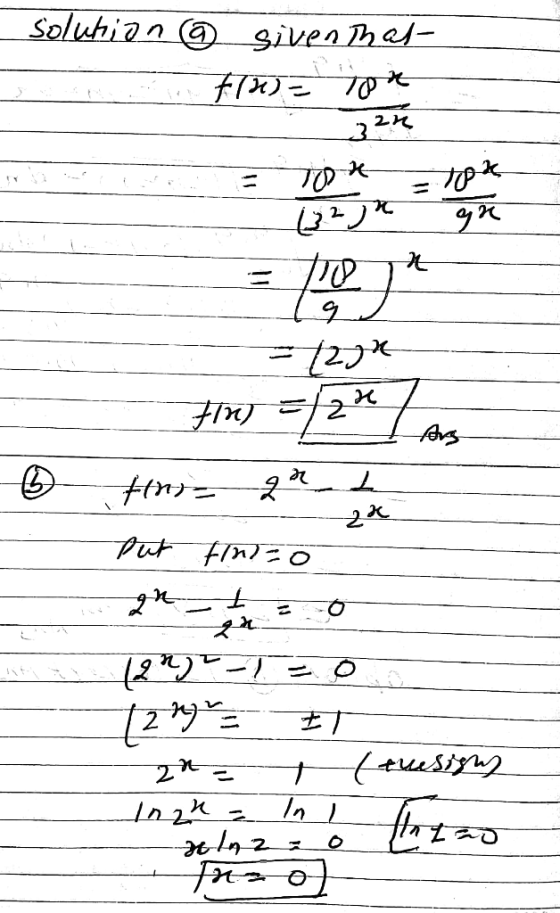
(15 pts) 1. Solve the following problems. (a) Write the function f(r) as the form of...
a ) write a function in the form f(x) =aln(x+b), for the tranformed logarithm using graph...
 a ) write a function in the form f(x) =aln(x+b), for the
tranformed logarithm using graph below
b)
-10 Suppose log)(x) = 2, log (y) = 5, and log (2) = 3. Find the value of logo- #3 2/ | ܣ ܩ |. ܂ ܂܂
a ) write a function in the form f(x) =aln(x+b), for the
tranformed logarithm using graph below
b)
-10 Suppose log)(x) = 2, log (y) = 5, and log (2) = 3. Find the value of logo- #3 2/ | ܣ ܩ |. ܂ ܂܂
7. (15 pts) Numerical Integration. Given a continuous function f (x) on the interval [a, b],...
 7. (15 pts) Numerical Integration. Given a continuous function f (x) on the interval [a, b], write the Lagrange form of the quadratic polynomial interpolating f(a), (a b)), f(b). Instead of calculating the integral I(f) Jaf(x)dx we could approximate it via Q(f) = | q(x)dx. Find an expression for this quadrature rule, the so-called Simpson's rule.
Solve the following problems. Show your work clearly. Question 1 (25 points): Let f(x) = x5:...
 Solve the following problems. Show your work clearly. Question 1 (25 points): Let f(x) = x5: (A)Determine whether fis one-to-one by using a geometric method. (B)“The inverse function of f(x) = xs is equal to the inverse function of f(x) = x5 +6" Is this statement true or false? Justify your solution steps. (C) Solve the equation ex®+6 = 7. Determine whether the solution changes or not when ex* = 7. Compare your solution steps by using the properties of...
14. For each statement, write an equivalent statement in logarithmic form. a) 63 = 216 b)...
 14. For each statement, write an equivalent statement in logarithmic form. a) 63 = 216 b) 3-4 = 1 c) a =C 15. For each statement, write an equivalent statement in exponential form. a) log: 32 = -5 b) log2 V8 = c) log, sut 16. Find the value of each expression without using a calculator. a) log3 729 b) log 100,000 d) log 16 e) log32 2 g) logs 16 h) log1632 j) In e k) In e c)...
15 all parts please! 15. Use Laws of Logarithms to solve the following equations. a) Write...
 15 all parts please!
15. Use Laws of Logarithms to solve the following equations. a) Write the expression as a sum, difference or product of logs. P9 V 7 10g6 pa b) Write the expression as a single log. (loga p-loga 9) + 2 logar c) Solve the equation and give the answer to four decimal places. 31-2x = 4* d) Solve the log equation and give the answer to four decimal places. log.(9x) = 2 - log. (x +...
15 all parts please!
15. Use Laws of Logarithms to solve the following equations. a) Write the expression as a sum, difference or product of logs. P9 V 7 10g6 pa b) Write the expression as a single log. (loga p-loga 9) + 2 logar c) Solve the equation and give the answer to four decimal places. 31-2x = 4* d) Solve the log equation and give the answer to four decimal places. log.(9x) = 2 - log. (x +...
15) Use the compound interest formulas A-P and 15) Find the accumulated value of an investment...
 15) Use the compound interest formulas A-P and 15) Find the accumulated value of an investment of $3000 at 8% compounded annually for 9 years. A) $5552.79 B) $5160,00 C)$5997.01 D) $4920.00 Rewrite the equation in terms of base e. Express the answer in terms of a natural logarithm, and then round to three decimal places. 16) y - 2.2(0.9) 16) A)y=220.9% y=222718-0.105x B) y=22eXIn09 y=2.2 -0.105x C)y-09ex In22 y-0.90788 D) y-In 22)ex In 69 y-0788e-0.105 Graph the function 17)...
Write the equation in exponential form. 1 log =-2 100 The equation in exponential form is...
 Write the equation in exponential form. 1 log =-2 100 The equation in exponential form is Write the equation in logarithmic form. 10º = 1,000,000,000 The equation in logarithmic form is Simplify the expression. log 0.0001 = Write the logarithm as a sum or difference of logarithms. Simplify each term as much as possibl Assume that the variables represent positive real numbers. Vab In Write the logarithm as a sum or difference of logarithms. Simplify each term as much as...
Write out the power series of the function f(x) = In(1+ x) centered at r =...
 Write out the power series of the function f(x) = In(1+ x) centered at r = 0. Determine the interval and radius of convergence. Use the power series and properties of the natural logarithm to approximate n to the nearest hundredths, and show the approximation is within 0.01. Please show your work
Show all steps. SHOW ALL WORK Section Number rsStudent Number In| Expand the given logarithm and...
 Show all steps.
SHOW ALL WORK Section Number rsStudent Number In| Expand the given logarithm and simplify: I. ry 2. Using the properties of logarithms, write the following expression as a single logarithm: 2log,(x)log,)+log,() 3. Solve the following equations analytically: a. 52-125 35x+1-171-r b.
Show all steps.
SHOW ALL WORK Section Number rsStudent Number In| Expand the given logarithm and simplify: I. ry 2. Using the properties of logarithms, write the following expression as a single logarithm: 2log,(x)log,)+log,() 3. Solve the following equations analytically: a. 52-125 35x+1-171-r b.
4. (25 pts) Given a function f with three continious derivatives, and three equally spaced points...
 Parts b and c please
4. (25 pts) Given a function f with three continious derivatives, and three equally spaced points zi z, = zi+h, エ3年エ1 + 21, we would like to approxinate f'(z), Let p(z) be the quadratic polynomial interpolating ()) (a) Write p in the Lagrange form. (b) Show the forward difference formula (c) Prove that this expression is a second order approximation off,(r), that is, show that where C depends on the third derivative of f.
4....
Parts b and c please
4. (25 pts) Given a function f with three continious derivatives, and three equally spaced points zi z, = zi+h, エ3年エ1 + 21, we would like to approxinate f'(z), Let p(z) be the quadratic polynomial interpolating ()) (a) Write p in the Lagrange form. (b) Show the forward difference formula (c) Prove that this expression is a second order approximation off,(r), that is, show that where C depends on the third derivative of f.
4....
 a ) write a function in the form f(x) =aln(x+b), for the
tranformed logarithm using graph below
b)
-10 Suppose log)(x) = 2, log (y) = 5, and log (2) = 3. Find the value of logo- #3 2/ | ܣ ܩ |. ܂ ܂܂
a ) write a function in the form f(x) =aln(x+b), for the
tranformed logarithm using graph below
b)
-10 Suppose log)(x) = 2, log (y) = 5, and log (2) = 3. Find the value of logo- #3 2/ | ܣ ܩ |. ܂ ܂܂
 7. (15 pts) Numerical Integration. Given a continuous function f (x) on the interval [a, b], write the Lagrange form of the quadratic polynomial interpolating f(a), (a b)), f(b). Instead of calculating the integral I(f) Jaf(x)dx we could approximate it via Q(f) = | q(x)dx. Find an expression for this quadrature rule, the so-called Simpson's rule.
 Solve the following problems. Show your work clearly. Question 1 (25 points): Let f(x) = x5: (A)Determine whether fis one-to-one by using a geometric method. (B)“The inverse function of f(x) = xs is equal to the inverse function of f(x) = x5 +6" Is this statement true or false? Justify your solution steps. (C) Solve the equation ex®+6 = 7. Determine whether the solution changes or not when ex* = 7. Compare your solution steps by using the properties of...
 14. For each statement, write an equivalent statement in logarithmic form. a) 63 = 216 b) 3-4 = 1 c) a =C 15. For each statement, write an equivalent statement in exponential form. a) log: 32 = -5 b) log2 V8 = c) log, sut 16. Find the value of each expression without using a calculator. a) log3 729 b) log 100,000 d) log 16 e) log32 2 g) logs 16 h) log1632 j) In e k) In e c)...
 15 all parts please!
15. Use Laws of Logarithms to solve the following equations. a) Write the expression as a sum, difference or product of logs. P9 V 7 10g6 pa b) Write the expression as a single log. (loga p-loga 9) + 2 logar c) Solve the equation and give the answer to four decimal places. 31-2x = 4* d) Solve the log equation and give the answer to four decimal places. log.(9x) = 2 - log. (x +...
15 all parts please!
15. Use Laws of Logarithms to solve the following equations. a) Write the expression as a sum, difference or product of logs. P9 V 7 10g6 pa b) Write the expression as a single log. (loga p-loga 9) + 2 logar c) Solve the equation and give the answer to four decimal places. 31-2x = 4* d) Solve the log equation and give the answer to four decimal places. log.(9x) = 2 - log. (x +...
 15) Use the compound interest formulas A-P and 15) Find the accumulated value of an investment of $3000 at 8% compounded annually for 9 years. A) $5552.79 B) $5160,00 C)$5997.01 D) $4920.00 Rewrite the equation in terms of base e. Express the answer in terms of a natural logarithm, and then round to three decimal places. 16) y - 2.2(0.9) 16) A)y=220.9% y=222718-0.105x B) y=22eXIn09 y=2.2 -0.105x C)y-09ex In22 y-0.90788 D) y-In 22)ex In 69 y-0788e-0.105 Graph the function 17)...
 Write the equation in exponential form. 1 log =-2 100 The equation in exponential form is Write the equation in logarithmic form. 10º = 1,000,000,000 The equation in logarithmic form is Simplify the expression. log 0.0001 = Write the logarithm as a sum or difference of logarithms. Simplify each term as much as possibl Assume that the variables represent positive real numbers. Vab In Write the logarithm as a sum or difference of logarithms. Simplify each term as much as...
 Write out the power series of the function f(x) = In(1+ x) centered at r = 0. Determine the interval and radius of convergence. Use the power series and properties of the natural logarithm to approximate n to the nearest hundredths, and show the approximation is within 0.01. Please show your work
 Show all steps.
SHOW ALL WORK Section Number rsStudent Number In| Expand the given logarithm and simplify: I. ry 2. Using the properties of logarithms, write the following expression as a single logarithm: 2log,(x)log,)+log,() 3. Solve the following equations analytically: a. 52-125 35x+1-171-r b.
Show all steps.
SHOW ALL WORK Section Number rsStudent Number In| Expand the given logarithm and simplify: I. ry 2. Using the properties of logarithms, write the following expression as a single logarithm: 2log,(x)log,)+log,() 3. Solve the following equations analytically: a. 52-125 35x+1-171-r b.
 Parts b and c please
4. (25 pts) Given a function f with three continious derivatives, and three equally spaced points zi z, = zi+h, エ3年エ1 + 21, we would like to approxinate f'(z), Let p(z) be the quadratic polynomial interpolating ()) (a) Write p in the Lagrange form. (b) Show the forward difference formula (c) Prove that this expression is a second order approximation off,(r), that is, show that where C depends on the third derivative of f.
4....
Parts b and c please
4. (25 pts) Given a function f with three continious derivatives, and three equally spaced points zi z, = zi+h, エ3年エ1 + 21, we would like to approxinate f'(z), Let p(z) be the quadratic polynomial interpolating ()) (a) Write p in the Lagrange form. (b) Show the forward difference formula (c) Prove that this expression is a second order approximation off,(r), that is, show that where C depends on the third derivative of f.
4....
Most questions answered within 3 hours.
-
Where is the error in this code sequence?
String s1 = "Hello";
String s2 = "ello";...
asked 10 months ago -
Financial data for Joel de Paris, Inc., for last year
follow:
Joel de Paris, Inc.
Balance...
asked 10 months ago -
Consider this reaction:
Al2(SO4)3 (aq)+ BaCl3
(aq) Al2Cl6 (aq)- +
3BaSO4(s) . What is the...
asked 10 months ago -
Suppose that Savneet is considering increasing her
recent random sample from 20 car rentals to 40...
asked 10 months ago -
Trucks arrive at an unloading terminal at an average rate of 120
per hour.
Trucks arrive...
asked 10 months ago -
Why are methanol and ethanol completely soluble in water while
octanol is not very little soluble....
asked 10 months ago -
A facilities manager at a university reads in a research report
that the mean amount of...
asked 10 months ago -
When the CuSO4 is rehydrated by adding water to the anhydrous
compound, is this an endothermic...
asked 10 months ago -
A ray of sunlight is passing from diamond into crown glass; the
angle of incidence is...
asked 10 months ago -
A block of mass 0.249 kg is placed on top of a light, vertical
spring of...
asked 10 months ago -
how do the kidneys compensate in the presences of acidosis
a) trigger hyperventilate
b) reserve acid...
asked 10 months ago -
Question 501 pts
The rental rate of capital to the firm increases. Which of the
following...
asked 10 months ago