

Homework Answers
Add Answer to:
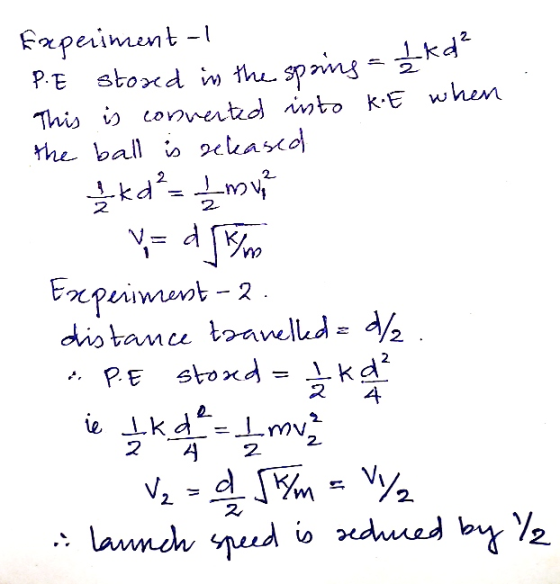
Experiment 1: You push a ball against a single-spring platform, compressing the spring by d. Then,...
You push a 3.2 kg block against a horizontal spring, compressing the spring by 27 cm....
You push a 3.2 kg block against a horizontal spring, compressing the spring by 27 cm. Then you release the block, and the spring sends it sliding across a frictionless tabletop. If the spring constant is 540 N/m, what is the speed of the block? *The answer should be 3.5 m/s, but I don't know how to get it*
You push a 0.18 kg block at point 1 to point 0, compressing a spring (k...
 You push a 0.18 kg block at point 1 to point 0, compressing a
spring (k = 240 N/m) a distance of 0.20 m. You release the block,
and it travels along the track, goes around the first loop (rA=
0.42 m) and then the second loop (rB= 0.89 m)
a) What is the velocity of the block at point 1
after it is released?
b) What is the velocity of the block at point A?
c) What is the...
You push a 0.18 kg block at point 1 to point 0, compressing a
spring (k = 240 N/m) a distance of 0.20 m. You release the block,
and it travels along the track, goes around the first loop (rA=
0.42 m) and then the second loop (rB= 0.89 m)
a) What is the velocity of the block at point 1
after it is released?
b) What is the velocity of the block at point A?
c) What is the...
A small, spring-loaded cannon launches a golf ball from level ground with an initial speed vi...
A small, spring-loaded cannon launches a golf ball from level ground with an initial speed vi at an angle θi with the horizontal. The golf ball lands a horizontal distance R from its launch point. The highest point the golf ball reaches during its flight is a distance R/12 above the ground. In terms of R and g, find the following. (You may ignore air resistance.) (a) the time interval during which the golf ball is in motion t =...
THE EXPERIMENT The speed "." of a ball as it leaves the spring gun will be...
 THE EXPERIMENT The speed "." of a ball as it leaves the spring gun will be measured by projecting the ball horizontally (0-0) from a table top at a distance H above the floor. The gun is then elevated at a known angle 8. The position of the target is calculated using the measured value of v. calculated time of flight, and the equations of motion. A successful prediction with the projectile hitting the target means that the following concepts...
1) a)You are asked to find the initial velocity of a steel ball from a spring...
1) a)You are asked to find the initial velocity of a steel ball from a spring loaded launcher. You place the launcher on the edge of a table 1.0 meter above the floor and launch the projectile several times horizontally. If you find that the average distance the ball travels is 1.3 meters, what is the initial velocity of the ball? To solve a problem like this, use equations for the y-motion to find the time and then the x-motion...
Experimental technique 5. [1pt] Which of the following statements are true for this experiment? E.g., enter...
 Experimental technique
5. [1pt]
Which of the following statements are true for this experiment?
E.g., enter AB. If none are true, enter N. You have 4
tries.
Everyone must wear safety glasses.
For each launch angle, the projectile range is measured for one
speed setting.
Never look into the barrel of the launcher when it is
loaded.
The launch angle θ measured using the plumb line is the angle of
the launcher with respect to the vertical.
The projectile is...
Experimental technique
5. [1pt]
Which of the following statements are true for this experiment?
E.g., enter AB. If none are true, enter N. You have 4
tries.
Everyone must wear safety glasses.
For each launch angle, the projectile range is measured for one
speed setting.
Never look into the barrel of the launcher when it is
loaded.
The launch angle θ measured using the plumb line is the angle of
the launcher with respect to the vertical.
The projectile is...
TRIAL 1 600 2.610 9.91 o.2 0.39 2.62 43 Average Result: The average speed of the given ball is ve...
 TRIAL 1 600 2.610 9.91 o.2 0.39 2.62 43 Average Result: The average speed of the given ball is velas hralels 1) Pull the penduum to the side, insert the ball into the gun, and compress and latch the gun spring Release the pendulum so that it hangs vertically 2) Fire the gun. The pendulum will latch near the highest point of its swing. Measure ne height ha·the vertical distance from the pendulum platform to the center of the ball...
he goal of this problem is to engineer a roller-coaster (see Figure 1). Imagine you work,...
 he goal of this problem is to engineer a roller-coaster (see Figure 1). Imagine you work, for an amusement park and your boss asks you to buy a spring that could launch a 2,000kg roller-coaster train on the track. In this problem we consider the acceleration of gravity to be g -9.8m/s. art 1: Frictionless track. We first consider a frictionless track. The train is first compressing a spring of constant k and is suddenly released. The compression A. 4m....
I need help on the second picture. they did not give us a air drag coeffient
 i need help on the second picture.
they did not give us a air drag coeffient
Physics 220 by David Michaels Lab 8 Instructor's Initials Activity 8.1 Score Potential to Work to Reach Great Heights Part I In this activity you are to use the same spring launcher or Nerfo gun you used in Lab 4 (check your Lab 4.1 for which one you used) to analyze energy conservation in various forms Let's assume the launching mechanism of the Nerfo...
i need help on the second picture.
they did not give us a air drag coeffient
Physics 220 by David Michaels Lab 8 Instructor's Initials Activity 8.1 Score Potential to Work to Reach Great Heights Part I In this activity you are to use the same spring launcher or Nerfo gun you used in Lab 4 (check your Lab 4.1 for which one you used) to analyze energy conservation in various forms Let's assume the launching mechanism of the Nerfo...
Experiment I: Malus' Law Questions The orientation of these polarizing filters can't be measured with great...
 Experiment I: Malus' Law Questions The orientation of these polarizing filters can't be measured with great accuracy because they re not marked off in small increments. Estimate the maximum uncertainty in measuring @ in this experiment. Justify your estimate. 1 with theory. Let's assume your 21 From your data table, choose the trial in poorest agre 1/1 measurement was accurate, but that the angle was not accurate. Calculate the angle that would theoretically yield this value of 1/1 measured angle....
 You push a 0.18 kg block at point 1 to point 0, compressing a
spring (k = 240 N/m) a distance of 0.20 m. You release the block,
and it travels along the track, goes around the first loop (rA=
0.42 m) and then the second loop (rB= 0.89 m)
a) What is the velocity of the block at point 1
after it is released?
b) What is the velocity of the block at point A?
c) What is the...
You push a 0.18 kg block at point 1 to point 0, compressing a
spring (k = 240 N/m) a distance of 0.20 m. You release the block,
and it travels along the track, goes around the first loop (rA=
0.42 m) and then the second loop (rB= 0.89 m)
a) What is the velocity of the block at point 1
after it is released?
b) What is the velocity of the block at point A?
c) What is the...
 THE EXPERIMENT The speed "." of a ball as it leaves the spring gun will be measured by projecting the ball horizontally (0-0) from a table top at a distance H above the floor. The gun is then elevated at a known angle 8. The position of the target is calculated using the measured value of v. calculated time of flight, and the equations of motion. A successful prediction with the projectile hitting the target means that the following concepts...
 Experimental technique
5. [1pt]
Which of the following statements are true for this experiment?
E.g., enter AB. If none are true, enter N. You have 4
tries.
Everyone must wear safety glasses.
For each launch angle, the projectile range is measured for one
speed setting.
Never look into the barrel of the launcher when it is
loaded.
The launch angle θ measured using the plumb line is the angle of
the launcher with respect to the vertical.
The projectile is...
Experimental technique
5. [1pt]
Which of the following statements are true for this experiment?
E.g., enter AB. If none are true, enter N. You have 4
tries.
Everyone must wear safety glasses.
For each launch angle, the projectile range is measured for one
speed setting.
Never look into the barrel of the launcher when it is
loaded.
The launch angle θ measured using the plumb line is the angle of
the launcher with respect to the vertical.
The projectile is...
 TRIAL 1 600 2.610 9.91 o.2 0.39 2.62 43 Average Result: The average speed of the given ball is velas hralels 1) Pull the penduum to the side, insert the ball into the gun, and compress and latch the gun spring Release the pendulum so that it hangs vertically 2) Fire the gun. The pendulum will latch near the highest point of its swing. Measure ne height ha·the vertical distance from the pendulum platform to the center of the ball...
 he goal of this problem is to engineer a roller-coaster (see Figure 1). Imagine you work, for an amusement park and your boss asks you to buy a spring that could launch a 2,000kg roller-coaster train on the track. In this problem we consider the acceleration of gravity to be g -9.8m/s. art 1: Frictionless track. We first consider a frictionless track. The train is first compressing a spring of constant k and is suddenly released. The compression A. 4m....
 i need help on the second picture.
they did not give us a air drag coeffient
Physics 220 by David Michaels Lab 8 Instructor's Initials Activity 8.1 Score Potential to Work to Reach Great Heights Part I In this activity you are to use the same spring launcher or Nerfo gun you used in Lab 4 (check your Lab 4.1 for which one you used) to analyze energy conservation in various forms Let's assume the launching mechanism of the Nerfo...
i need help on the second picture.
they did not give us a air drag coeffient
Physics 220 by David Michaels Lab 8 Instructor's Initials Activity 8.1 Score Potential to Work to Reach Great Heights Part I In this activity you are to use the same spring launcher or Nerfo gun you used in Lab 4 (check your Lab 4.1 for which one you used) to analyze energy conservation in various forms Let's assume the launching mechanism of the Nerfo...
 Experiment I: Malus' Law Questions The orientation of these polarizing filters can't be measured with great accuracy because they re not marked off in small increments. Estimate the maximum uncertainty in measuring @ in this experiment. Justify your estimate. 1 with theory. Let's assume your 21 From your data table, choose the trial in poorest agre 1/1 measurement was accurate, but that the angle was not accurate. Calculate the angle that would theoretically yield this value of 1/1 measured angle....
Most questions answered within 3 hours.
-
Where is the error in this code sequence?
String s1 = "Hello";
String s2 = "ello";...
asked 10 months ago -
Financial data for Joel de Paris, Inc., for last year
follow:
Joel de Paris, Inc.
Balance...
asked 10 months ago -
Consider this reaction:
Al2(SO4)3 (aq)+ BaCl3
(aq) Al2Cl6 (aq)- +
3BaSO4(s) . What is the...
asked 10 months ago -
Suppose that Savneet is considering increasing her
recent random sample from 20 car rentals to 40...
asked 10 months ago -
Trucks arrive at an unloading terminal at an average rate of 120
per hour.
Trucks arrive...
asked 10 months ago -
Why are methanol and ethanol completely soluble in water while
octanol is not very little soluble....
asked 10 months ago -
A facilities manager at a university reads in a research report
that the mean amount of...
asked 10 months ago -
When the CuSO4 is rehydrated by adding water to the anhydrous
compound, is this an endothermic...
asked 10 months ago -
A ray of sunlight is passing from diamond into crown glass; the
angle of incidence is...
asked 10 months ago -
A block of mass 0.249 kg is placed on top of a light, vertical
spring of...
asked 10 months ago -
how do the kidneys compensate in the presences of acidosis
a) trigger hyperventilate
b) reserve acid...
asked 10 months ago -
Question 501 pts
The rental rate of capital to the firm increases. Which of the
following...
asked 10 months ago