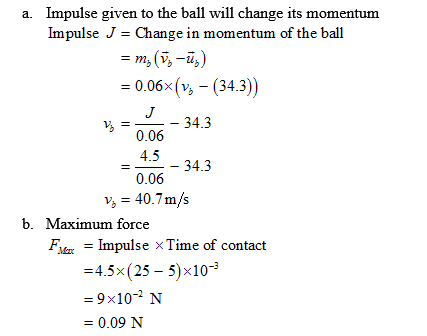
a tennis ball was hit with a tennis racquet. The ball was hit in the same direction from which it approached the raquet ( the opposite of the direction it was going), so it was s essentially a one- dimensional collision. The 60.0 gram tennis ball approached the racquet with a speed of 34.3 m/s. The tennis racquet gave the ball an impulse of 4.5 newton-seconds. a) Find the velocity of the ball after the collision.

Homework Answers
Add Answer to:
a tennis ball was hit with a tennis racquet. The ball was hit in
the same...
My Notes A tennis player receives a shot with the ball (0.060 0 kg) traveling horizontally...
My Notes A tennis player receives a shot with the ball (0.060 0 kg) traveling horizontally at 55.0 m/s and returns the shot with the ball traveling horizontally at 39.5 m/s in the opposite direction. (Assume the initial direction of the ball is in the −x direction.) (a) What is the impulse delivered to the ball by the tennis racquet?___________________ î N · s (b) What work does the racquet do on the ball?______________________ J My Notes An estimated force–time...
A tennis ball has mass 0.055kg and is hit at a speed of 120km/h by the...
 A tennis ball has mass 0.055kg and is hit at a speed of 120km/h by the server. The opposing player hits the ball exactly back along the line of its trajectory giving the ball a new speed of 110km/h. If the contact time between the racquet and the ball is 0.015s what is the average force on the tennis ball imparted by the opposing player. 234N 843N 10.2N 36.7N 122N
The mass of a regulation tennis ball is 57 g (although it can vary slightly), and...
The mass of a regulation tennis ball is 57 g (although it can vary slightly), and tests have shown that the ball is in contact with the tennis racket for 30 ms. (This number can also vary, depending on the racket and swing.) We shall assume a 30.0 ms contact time. One of the fastest-known served tennis balls was served by “Big Bill” Tilden in 1931, and its speed was measured to be 73 m/s. Suppose that the positive direction...
Golf Ball Impulse Due in 38 minutes A golf ball (mass 0.045 kg) is hit with...
 Golf Ball Impulse Due in 38 minutes A golf ball (mass 0.045 kg) is hit with a club from a tee. The plot shows the force on the ball as a function of time in milliseconds. One millisecond is 10-3 seconds. What is its speed right after the hit? Submit Answer Tries 0/7 Force [N] 0 2 4 6 14 16 18 20 8 10 12 Time [ms] Post Discussion Send Feedback
7. AS kg ball is initially at rest on a horizontal frictionless surface as shown to...
 7. AS kg ball is initially at rest on a horizontal frictionless surface as shown to the right. A hard plastic cube of mass 0.5 kg slides across the surface at a speed of 26 ms and strikes the ball The figure below shows a graph of the force exerted on the ball by the cube as a function of time. Oslo Force (x10'N) 10 2.0 10.0 4.0 6.0 8.0 Time (x10's) A) Determine the total impulse given to the...
Please answer all four Re - Part A The mass of a regulation tennis ball is...
 Please answer all four
Re - Part A The mass of a regulation tennis ball is 57 g (although it can vary slightly), and tests have shown that the ball is in contact with the tennis racket for 30 m. (This number can also vary, depending on the racket and swing.) We shall assume a 30.0-ius contact time. The fastest- known served tennis ball was served by "Big Bill' Tilden in 1931, and its speed was measured to be 73...
Please answer all four
Re - Part A The mass of a regulation tennis ball is 57 g (although it can vary slightly), and tests have shown that the ball is in contact with the tennis racket for 30 m. (This number can also vary, depending on the racket and swing.) We shall assume a 30.0-ius contact time. The fastest- known served tennis ball was served by "Big Bill' Tilden in 1931, and its speed was measured to be 73...
The following function gives the height h meters, of a batted baseball as a function of the time, t seconds, since the ball was hit.
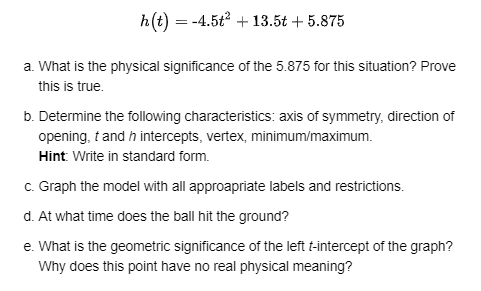 The following function gives the height h meters, of a batted baseball as a function of the time, t seconds, since the ball was hit. h(t)=-4.5^2+13.5t+5.875 or https://i.gyazo.com/a83bb3b851c332dadc76e2462313605f.png A. What is the physical significance of the 5.875 for this situation? Prove this is true.B. Determine the following characteristics: axis of symmetry, direction of opening, t and h intercepts, vertex, minimum/maximum.Hint: Write in standard form.C. Graph the model with all approapriate labels and restrictions. D. At what time does the ball hit the ground? E. What is the...
A steel ball is dropped onto a hard floor from a height of 1.95 m and rebounds to a height of 1.89m
 A steel ball is dropped onto a hard floor from a height of 1.95 m and rebounds to a height of 1.89m. (Assume that the positive direction is upward.) (a) Calculate its velocity (in m/s) just before it strikes the floor (b) Calculate its velocity (in m/s) just after it leaves the floor on its way back up(c) Calculate its acceleration (in m/s) during contact with the floor if that contact lasts 0.0800 ms (d) How much (in ) did the ball compress...
please help! The figure below shows a metal ball with a mass of 2.84 kg bouncing...
 please help!
The figure below shows a metal ball with a mass of 2.84 kg bouncing off a wall. The ball has the same speed just before and just after the impact (v - 10.0 ms, and the angle its path makes with the wall is 8 - 60.0° as shown. (Because we are analyzing the motion of the ball over a very short time just before and after Impact, you may safely ignore the effect of gravity on the...
please help!
The figure below shows a metal ball with a mass of 2.84 kg bouncing off a wall. The ball has the same speed just before and just after the impact (v - 10.0 ms, and the angle its path makes with the wall is 8 - 60.0° as shown. (Because we are analyzing the motion of the ball over a very short time just before and after Impact, you may safely ignore the effect of gravity on the...
 A tennis ball has mass 0.055kg and is hit at a speed of 120km/h by the server. The opposing player hits the ball exactly back along the line of its trajectory giving the ball a new speed of 110km/h. If the contact time between the racquet and the ball is 0.015s what is the average force on the tennis ball imparted by the opposing player. 234N 843N 10.2N 36.7N 122N
 Golf Ball Impulse Due in 38 minutes A golf ball (mass 0.045 kg) is hit with a club from a tee. The plot shows the force on the ball as a function of time in milliseconds. One millisecond is 10-3 seconds. What is its speed right after the hit? Submit Answer Tries 0/7 Force [N] 0 2 4 6 14 16 18 20 8 10 12 Time [ms] Post Discussion Send Feedback
 7. AS kg ball is initially at rest on a horizontal frictionless surface as shown to the right. A hard plastic cube of mass 0.5 kg slides across the surface at a speed of 26 ms and strikes the ball The figure below shows a graph of the force exerted on the ball by the cube as a function of time. Oslo Force (x10'N) 10 2.0 10.0 4.0 6.0 8.0 Time (x10's) A) Determine the total impulse given to the...
 Please answer all four
Re - Part A The mass of a regulation tennis ball is 57 g (although it can vary slightly), and tests have shown that the ball is in contact with the tennis racket for 30 m. (This number can also vary, depending on the racket and swing.) We shall assume a 30.0-ius contact time. The fastest- known served tennis ball was served by "Big Bill' Tilden in 1931, and its speed was measured to be 73...
Please answer all four
Re - Part A The mass of a regulation tennis ball is 57 g (although it can vary slightly), and tests have shown that the ball is in contact with the tennis racket for 30 m. (This number can also vary, depending on the racket and swing.) We shall assume a 30.0-ius contact time. The fastest- known served tennis ball was served by "Big Bill' Tilden in 1931, and its speed was measured to be 73...
 please help!
The figure below shows a metal ball with a mass of 2.84 kg bouncing off a wall. The ball has the same speed just before and just after the impact (v - 10.0 ms, and the angle its path makes with the wall is 8 - 60.0° as shown. (Because we are analyzing the motion of the ball over a very short time just before and after Impact, you may safely ignore the effect of gravity on the...
please help!
The figure below shows a metal ball with a mass of 2.84 kg bouncing off a wall. The ball has the same speed just before and just after the impact (v - 10.0 ms, and the angle its path makes with the wall is 8 - 60.0° as shown. (Because we are analyzing the motion of the ball over a very short time just before and after Impact, you may safely ignore the effect of gravity on the...
Most questions answered within 3 hours.
-
Where is the error in this code sequence?
String s1 = "Hello";
String s2 = "ello";...
asked 11 months ago -
Financial data for Joel de Paris, Inc., for last year
follow:
Joel de Paris, Inc.
Balance...
asked 11 months ago -
Consider this reaction:
Al2(SO4)3 (aq)+ BaCl3
(aq) Al2Cl6 (aq)- +
3BaSO4(s) . What is the...
asked 11 months ago -
Suppose that Savneet is considering increasing her
recent random sample from 20 car rentals to 40...
asked 11 months ago -
Trucks arrive at an unloading terminal at an average rate of 120
per hour.
Trucks arrive...
asked 11 months ago -
Why are methanol and ethanol completely soluble in water while
octanol is not very little soluble....
asked 11 months ago -
A facilities manager at a university reads in a research report
that the mean amount of...
asked 11 months ago -
When the CuSO4 is rehydrated by adding water to the anhydrous
compound, is this an endothermic...
asked 11 months ago -
A ray of sunlight is passing from diamond into crown glass; the
angle of incidence is...
asked 11 months ago -
A block of mass 0.249 kg is placed on top of a light, vertical
spring of...
asked 11 months ago -
how do the kidneys compensate in the presences of acidosis
a) trigger hyperventilate
b) reserve acid...
asked 11 months ago -
Question 501 pts
The rental rate of capital to the firm increases. Which of the
following...
asked 11 months ago