
Homework Answers

Add Answer to:
(20 points) Use phasor techniques, solve for the current in the circuit. 3Q 3Hi 1/3 F
(3) Using phasor techniques, solve for the equivalent impedance and the current I(t) in the circuit...
 (3) Using phasor techniques, solve for the equivalent impedance and the current I(t) in the circuit shown in Figure 3. Given: Vs(t)-0.4cos(100t-1.309) V 1.2 μF Vs(t) 100 mH Figure 3
3.(20) Given the circuit shown, solve for the phasor It. Ito A) 12 Loov Zikr -...
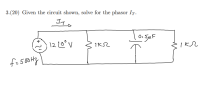 3.(20) Given the circuit shown, solve for the phasor It. Ito A) 12 Loov Zikr - Zikr |- san f = 500Hz L
Problem 5. Use phasor techniques to analyze the circuit shown below and answer the following questions....
 Problem 5. Use phasor techniques to analyze the circuit shown below and answer the following questions. a. Draw the frequency domain circuit b. Find the equivalent impedance C. Find the current iſt) flowing from left to right through the 30 ohm resistor d. Find the steady-state voltage v.(t) (Hint: answer is v.(t) = 17.14 cos(2000) V) 3022 5022 W 50 uF 60 sin 2001 V 0.1 H 3.0)
Phasor-Domain Analysis Techniques (7-9) 7.4 The circuit of Figure 7.5 operates at 1 kHz. Determine the...
 Phasor-Domain Analysis Techniques (7-9) 7.4 The circuit of Figure 7.5 operates at 1 kHz. Determine the node voltages VA and VB Use these component values: 3.3 k2 and R3 = 2.2 k 4.7 k, R2 Ri C1 0.047 Fand C2 0.1 F Vi 9/0° V and V2 = 3/ - 90° V VA VB R3 R2 R1 ww :C2 = C1 V2 V1
Problem 24: (18 points) 1. (6 points) Figure 2 shows an RC circuit with input f(t)...
 Problem 24: (18 points) 1. (6 points) Figure 2 shows an RC circuit with input f(t) and output y(t) Function Generator R, v, (r) y1) Figure 2: RC circuit. (a) (1 point) Sketch the circuit in the phasor domain by replacing the capacitor with its impedance represen- (b) (3 points) Using circuit analysis techniques, show that the frequency response function is Specify the DC gain, K, and the time constant, T, in terms of the parameters R, R, and C...
Example #3 a) Use phasor diagrams to calculate the impedence of a parallel RLC circuit. b) How does the current depend...
 Example #3 a) Use phasor diagrams to calculate the impedence of a parallel RLC circuit. b) How does the current depend on frequency? c) What is the phase angle between the voltage and the current? d) How does the power dissipated depend frequency? on
Example #3 a) Use phasor diagrams to calculate the impedence of a parallel RLC circuit. b) How does the current depend on frequency? c) What is the phase angle between the voltage and the current? d)...
Example #3 a) Use phasor diagrams to calculate the impedence of a parallel RLC circuit. b) How does the current depend on frequency? c) What is the phase angle between the voltage and the current? d) How does the power dissipated depend frequency? on
Example #3 a) Use phasor diagrams to calculate the impedence of a parallel RLC circuit. b) How does the current depend on frequency? c) What is the phase angle between the voltage and the current? d)...
4.15. Use phasor techniques in the following. (a) Find 2 cos(100t - 459) – 3 cos...
 4.15. Use phasor techniques in the following. (a) Find 2 cos(100t - 459) – 3 cos (100t + 60°) (b) Find 50 sin(100t) + (d/dt) cos (100t - 30). Hint: Do not take the derivative in the time domain; replace it by jo in the frequency domain. (c) Use phasor techniques to evaluate the derivative the formula in the time domain and transform of i(t) = 20 sin(500t) at t = 2 ms. Hint: Write into the frequency domain, using...
You have the following circuit in sinusoidal steady-state. Use phasor circuit analysis to find the time...
 You have the following circuit in sinusoidal
steady-state.
Use phasor circuit analysis to find the time domain expression
for the steady-state current, i(t), and steady-state voltages,
VR(t), VC(t) and VL(t).
Vs(t) = 50 cos(1000t) Volts.
Problem 1 (20 points) You have the following circuit in sinusoidal steady-state. Use phasor circuit analysis to find the time domain expression for the steady-state current, i(t), and steady- state voltages, Vr(t), Vc(t) and Vl(t). Vs(t) = 50 cos(1000t) Volts. i(t) 100 12 25 mH...
You have the following circuit in sinusoidal
steady-state.
Use phasor circuit analysis to find the time domain expression
for the steady-state current, i(t), and steady-state voltages,
VR(t), VC(t) and VL(t).
Vs(t) = 50 cos(1000t) Volts.
Problem 1 (20 points) You have the following circuit in sinusoidal steady-state. Use phasor circuit analysis to find the time domain expression for the steady-state current, i(t), and steady- state voltages, Vr(t), Vc(t) and Vl(t). Vs(t) = 50 cos(1000t) Volts. i(t) 100 12 25 mH...
6. (20) Transform the circuit below to phasor domain. Sketch and completely label the transformed circuit....
 6. (20) Transform the circuit below to phasor domain. Sketch and completely label the transformed circuit. Find the steady state value of i(t). (Hint: Find the current (I) in the phasor domain then convert it back to the time domain to find i(t).) 15 F 375mH 30 cos (377t-15°) V
Circuit help. tem 5 Part A Use the mesh-current method to find the phasor current 19...
 Circuit help.
tem 5 Part A Use the mesh-current method to find the phasor current 19 in the circuit in Figure 1). Suppose that R-11 ? Express your answer in complex form using three significant figures Figure 1 of 1 > Submit Previous Answers Request Ans Previous Answers Request Answer X Incorrect: Try Again; 3 attempts remaining Provide Feedback j412 1 20902 y
Circuit help.
tem 5 Part A Use the mesh-current method to find the phasor current 19 in the circuit in Figure 1). Suppose that R-11 ? Express your answer in complex form using three significant figures Figure 1 of 1 > Submit Previous Answers Request Ans Previous Answers Request Answer X Incorrect: Try Again; 3 attempts remaining Provide Feedback j412 1 20902 y
 (3) Using phasor techniques, solve for the equivalent impedance and the current I(t) in the circuit shown in Figure 3. Given: Vs(t)-0.4cos(100t-1.309) V 1.2 μF Vs(t) 100 mH Figure 3
 3.(20) Given the circuit shown, solve for the phasor It. Ito A) 12 Loov Zikr - Zikr |- san f = 500Hz L
 Problem 5. Use phasor techniques to analyze the circuit shown below and answer the following questions. a. Draw the frequency domain circuit b. Find the equivalent impedance C. Find the current iſt) flowing from left to right through the 30 ohm resistor d. Find the steady-state voltage v.(t) (Hint: answer is v.(t) = 17.14 cos(2000) V) 3022 5022 W 50 uF 60 sin 2001 V 0.1 H 3.0)
 Phasor-Domain Analysis Techniques (7-9) 7.4 The circuit of Figure 7.5 operates at 1 kHz. Determine the node voltages VA and VB Use these component values: 3.3 k2 and R3 = 2.2 k 4.7 k, R2 Ri C1 0.047 Fand C2 0.1 F Vi 9/0° V and V2 = 3/ - 90° V VA VB R3 R2 R1 ww :C2 = C1 V2 V1
 Problem 24: (18 points) 1. (6 points) Figure 2 shows an RC circuit with input f(t) and output y(t) Function Generator R, v, (r) y1) Figure 2: RC circuit. (a) (1 point) Sketch the circuit in the phasor domain by replacing the capacitor with its impedance represen- (b) (3 points) Using circuit analysis techniques, show that the frequency response function is Specify the DC gain, K, and the time constant, T, in terms of the parameters R, R, and C...
 Example #3 a) Use phasor diagrams to calculate the impedence of a parallel RLC circuit. b) How does the current depend on frequency? c) What is the phase angle between the voltage and the current? d) How does the power dissipated depend frequency? on
Example #3 a) Use phasor diagrams to calculate the impedence of a parallel RLC circuit. b) How does the current depend on frequency? c) What is the phase angle between the voltage and the current? d)...
Example #3 a) Use phasor diagrams to calculate the impedence of a parallel RLC circuit. b) How does the current depend on frequency? c) What is the phase angle between the voltage and the current? d) How does the power dissipated depend frequency? on
Example #3 a) Use phasor diagrams to calculate the impedence of a parallel RLC circuit. b) How does the current depend on frequency? c) What is the phase angle between the voltage and the current? d)...
 4.15. Use phasor techniques in the following. (a) Find 2 cos(100t - 459) – 3 cos (100t + 60°) (b) Find 50 sin(100t) + (d/dt) cos (100t - 30). Hint: Do not take the derivative in the time domain; replace it by jo in the frequency domain. (c) Use phasor techniques to evaluate the derivative the formula in the time domain and transform of i(t) = 20 sin(500t) at t = 2 ms. Hint: Write into the frequency domain, using...
 You have the following circuit in sinusoidal
steady-state.
Use phasor circuit analysis to find the time domain expression
for the steady-state current, i(t), and steady-state voltages,
VR(t), VC(t) and VL(t).
Vs(t) = 50 cos(1000t) Volts.
Problem 1 (20 points) You have the following circuit in sinusoidal steady-state. Use phasor circuit analysis to find the time domain expression for the steady-state current, i(t), and steady- state voltages, Vr(t), Vc(t) and Vl(t). Vs(t) = 50 cos(1000t) Volts. i(t) 100 12 25 mH...
You have the following circuit in sinusoidal
steady-state.
Use phasor circuit analysis to find the time domain expression
for the steady-state current, i(t), and steady-state voltages,
VR(t), VC(t) and VL(t).
Vs(t) = 50 cos(1000t) Volts.
Problem 1 (20 points) You have the following circuit in sinusoidal steady-state. Use phasor circuit analysis to find the time domain expression for the steady-state current, i(t), and steady- state voltages, Vr(t), Vc(t) and Vl(t). Vs(t) = 50 cos(1000t) Volts. i(t) 100 12 25 mH...
 6. (20) Transform the circuit below to phasor domain. Sketch and completely label the transformed circuit. Find the steady state value of i(t). (Hint: Find the current (I) in the phasor domain then convert it back to the time domain to find i(t).) 15 F 375mH 30 cos (377t-15°) V
 Circuit help.
tem 5 Part A Use the mesh-current method to find the phasor current 19 in the circuit in Figure 1). Suppose that R-11 ? Express your answer in complex form using three significant figures Figure 1 of 1 > Submit Previous Answers Request Ans Previous Answers Request Answer X Incorrect: Try Again; 3 attempts remaining Provide Feedback j412 1 20902 y
Circuit help.
tem 5 Part A Use the mesh-current method to find the phasor current 19 in the circuit in Figure 1). Suppose that R-11 ? Express your answer in complex form using three significant figures Figure 1 of 1 > Submit Previous Answers Request Ans Previous Answers Request Answer X Incorrect: Try Again; 3 attempts remaining Provide Feedback j412 1 20902 y
Most questions answered within 3 hours.
-
Where is the error in this code sequence?
String s1 = "Hello";
String s2 = "ello";...
asked 1 year ago -
Financial data for Joel de Paris, Inc., for last year
follow:
Joel de Paris, Inc.
Balance...
asked 1 year ago -
Consider this reaction:
Al2(SO4)3 (aq)+ BaCl3
(aq) Al2Cl6 (aq)- +
3BaSO4(s) . What is the...
asked 1 year ago -
Suppose that Savneet is considering increasing her
recent random sample from 20 car rentals to 40...
asked 1 year ago -
Trucks arrive at an unloading terminal at an average rate of 120
per hour.
Trucks arrive...
asked 1 year ago -
Why are methanol and ethanol completely soluble in water while
octanol is not very little soluble....
asked 1 year ago -
A facilities manager at a university reads in a research report
that the mean amount of...
asked 1 year ago -
When the CuSO4 is rehydrated by adding water to the anhydrous
compound, is this an endothermic...
asked 1 year ago -
A ray of sunlight is passing from diamond into crown glass; the
angle of incidence is...
asked 1 year ago -
A block of mass 0.249 kg is placed on top of a light, vertical
spring of...
asked 1 year ago -
how do the kidneys compensate in the presences of acidosis
a) trigger hyperventilate
b) reserve acid...
asked 1 year ago -
Question 501 pts
The rental rate of capital to the firm increases. Which of the
following...
asked 1 year ago