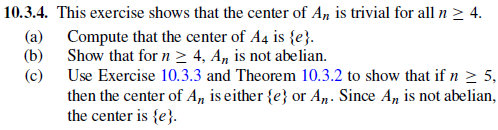


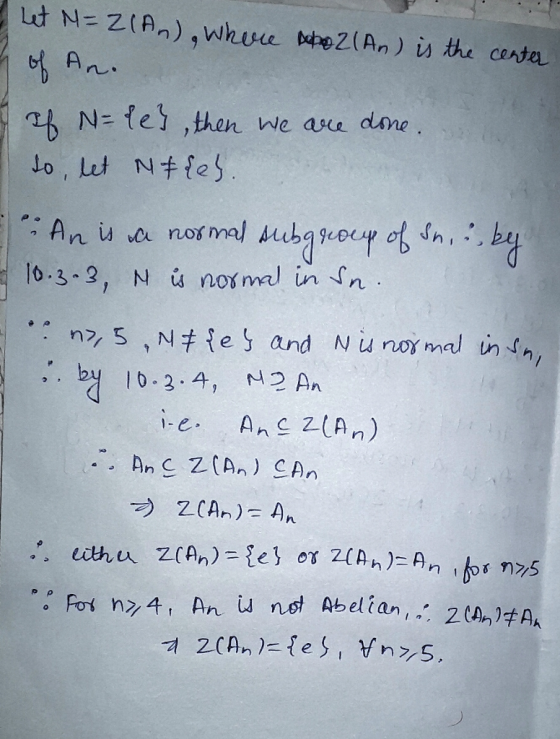
You don't need to prove 10.3.3 or the theorem 10.3.2. You just need to answer the 10.3.4 part (c) by using 10.3.3 and 10.3.2.
Homework Answers
Add Answer to:
You don't need to prove 10.3.3 or the theorem 10.3.2. You just
need to answer the...
This is 2(b): The following exercise shows that the converse to Lagrange's theorem is false, i.e....
 This is 2(b):
The following exercise shows that the converse to Lagrange's theorem is false, i.e. even if d ||G|, there need not be a subgroup of G with order d. (a) Let n > 4 and consider the alternating group An. Suppose that NC An is a normal subgroup and that there is a 3-cycle (abc) E N. Prove that N = An. Hint: it is enough to show that N contains all 3-cycles. What is the conjugate of...
This is 2(b):
The following exercise shows that the converse to Lagrange's theorem is false, i.e. even if d ||G|, there need not be a subgroup of G with order d. (a) Let n > 4 and consider the alternating group An. Suppose that NC An is a normal subgroup and that there is a 3-cycle (abc) E N. Prove that N = An. Hint: it is enough to show that N contains all 3-cycles. What is the conjugate of...
Please show lots of detailed work. Thank you. Exercise 2.5. Use the Binomial Theorem to prove...
 Please show lots of detailed work. Thank you.
Exercise 2.5. Use the Binomial Theorem to prove that, for all n 20 and for all x e R, Hint: Set y 1 in Theorem 2.2.8 and then differentiate. Exercise 2.6. Use the result of the previous exercise to find the value of the sum + 2 + 10 10
Please show lots of detailed work. Thank you.
Exercise 2.5. Use the Binomial Theorem to prove that, for all n 20 and for all x e R, Hint: Set y 1 in Theorem 2.2.8 and then differentiate. Exercise 2.6. Use the result of the previous exercise to find the value of the sum + 2 + 10 10
Prove the Binomial Theorem, that is Exercises 173 (vi) x+y y for all n e N...
 Prove the Binomial Theorem, that is Exercises 173 (vi) x+y y for all n e N C) Recall that for all 0rS L is divisible by 8 when n is an odd natural number vii))Show that 2 (vin) Prove Leibniz's Theorem for repeated differentiation of a product: If ande are functions of x, then prove that d (uv) d + +Mat0 for all n e N, where u, and d'a d/v and dy da respectively denote (You will need to...
And Heres theorem 10.1 Prove that the relation VR of Theorem 10,1 is an equivalence relation....
 And Heres theorem 10.1
Prove that the relation VR of Theorem 10,1 is an equivalence relation. ① show that a group with at least two elements but with no proper nontrivite subgroups must be finite and of prime order. 10.1 Theorem Let H be a subgroup of G. Let the relation ~1 be defined on G by a~lb if and only if albe H. Let ~R be defined by a~rb if and only if ab- € H. Then ~1 and...
And Heres theorem 10.1
Prove that the relation VR of Theorem 10,1 is an equivalence relation. ① show that a group with at least two elements but with no proper nontrivite subgroups must be finite and of prime order. 10.1 Theorem Let H be a subgroup of G. Let the relation ~1 be defined on G by a~lb if and only if albe H. Let ~R be defined by a~rb if and only if ab- € H. Then ~1 and...
Theorem 16.1. Let p be a prime number. Suppose r is a Gaussian integer satisfying N(r)...
 Theorem 16.1. Let p be a prime number. Suppose r is a Gaussian integer satisfying N(r) = p. Then r is irreducible in Z[i]. In particular, if a and b are integers such that a² +62 = p, then the Gaussian integers Ea – bi and £b£ai are irreducible. Exercise 16.1. Prove Theorem 16.1. (Hint: For the first part, suppose st is a factorization of r. You must show that this factorization is trivial. Apply the norm to obtain p=...
Please answer the questions with clear handwriting. Thank you so much To prove that N(A) =...
 Please answer the questions with clear handwriting. Thank you
so much
To prove that N(A) = C(AT)- we will be showing that a vector from either set is also in the other. 1. Prove Claim 1: If Xe N(A) then it is perpendicular to C(A) Outline: Let x be a vector in N(A), and consider the system of equations formed by Ax = 0. This will show that x is orthogonal to each row of A. Finally, show that x...
Please answer the questions with clear handwriting. Thank you
so much
To prove that N(A) = C(AT)- we will be showing that a vector from either set is also in the other. 1. Prove Claim 1: If Xe N(A) then it is perpendicular to C(A) Outline: Let x be a vector in N(A), and consider the system of equations formed by Ax = 0. This will show that x is orthogonal to each row of A. Finally, show that x...
Use MATLAB to prove the central limit theorem. To achieve this, you will need to generate N rando...
Use MATLAB to prove the central limit theorem. To achieve this, you will need to generate N random variables (I.I.D. with the distribution of your choice) and show that the distribution of the sum approaches a Guassian distribution. Plot the distribution and matlab code. Hint: you may find the hist) function helpful.
Explain this Theorem as if you talking to a 5 year old Theorem 22 For any...
 Explain this Theorem as if you talking to a 5 year old
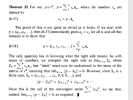
Theorem 22 For any pe2, p-* c,e,. defined by (6-57) where the numbers cr are c.-p.en The proof of this is not quite as trivial as it looks. If we start with p-(a1, a2, ), then (6-57) immediately gives a.-c" for all n, and all that remains is to show that (6-58) Cn e The only question lies in knowing what the right side means. As with series...
Explain this Theorem as if you talking to a 5 year old
Theorem 22 For any pe2, p-* c,e,. defined by (6-57) where the numbers cr are c.-p.en The proof of this is not quite as trivial as it looks. If we start with p-(a1, a2, ), then (6-57) immediately gives a.-c" for all n, and all that remains is to show that (6-58) Cn e The only question lies in knowing what the right side means. As with series...
1. (a) State and prove the Mean-Value Theorem. You may use Rolle's Theorem provided you state...
 1. (a) State and prove the Mean-Value Theorem. You may use Rolle's Theorem provided you state it clearly (b) A fired point of a function g: (a, bR is a point cE (a, b) such that g(c)-c Suppose g (a, b is differentiable and g'(x)< 1 for all x E (a, b Prove that g cannot have more than one fixed point. <「 for (c) Prove, for all 0 < x < 2π, that sin(x) < x.
prove e EOLU Exercise 4.1.1. Prove Theorem 4.1.6. (Hints: for (a) and (b), use the root...
 prove e
EOLU Exercise 4.1.1. Prove Theorem 4.1.6. (Hints: for (a) and (b), use the root test (Theorem 7.5.1). For (c), use the Weierstrass M-test (Theorem 3.5.7). For (d). use Theorem 3.7.1. For (e), use Corollary 3.6.2. The signale UI tre rauUS UI CUNvergence is the IUIUWII. Theorem 4.1.6. Let - Cn(x-a)" be a formal power series, and let R be its radius of convergence. (e) (Integration of power series) For any closed interval [y, z] con- tained in (a...
prove e
EOLU Exercise 4.1.1. Prove Theorem 4.1.6. (Hints: for (a) and (b), use the root test (Theorem 7.5.1). For (c), use the Weierstrass M-test (Theorem 3.5.7). For (d). use Theorem 3.7.1. For (e), use Corollary 3.6.2. The signale UI tre rauUS UI CUNvergence is the IUIUWII. Theorem 4.1.6. Let - Cn(x-a)" be a formal power series, and let R be its radius of convergence. (e) (Integration of power series) For any closed interval [y, z] con- tained in (a...
 This is 2(b):
The following exercise shows that the converse to Lagrange's theorem is false, i.e. even if d ||G|, there need not be a subgroup of G with order d. (a) Let n > 4 and consider the alternating group An. Suppose that NC An is a normal subgroup and that there is a 3-cycle (abc) E N. Prove that N = An. Hint: it is enough to show that N contains all 3-cycles. What is the conjugate of...
This is 2(b):
The following exercise shows that the converse to Lagrange's theorem is false, i.e. even if d ||G|, there need not be a subgroup of G with order d. (a) Let n > 4 and consider the alternating group An. Suppose that NC An is a normal subgroup and that there is a 3-cycle (abc) E N. Prove that N = An. Hint: it is enough to show that N contains all 3-cycles. What is the conjugate of...
 Please show lots of detailed work. Thank you.
Exercise 2.5. Use the Binomial Theorem to prove that, for all n 20 and for all x e R, Hint: Set y 1 in Theorem 2.2.8 and then differentiate. Exercise 2.6. Use the result of the previous exercise to find the value of the sum + 2 + 10 10
Please show lots of detailed work. Thank you.
Exercise 2.5. Use the Binomial Theorem to prove that, for all n 20 and for all x e R, Hint: Set y 1 in Theorem 2.2.8 and then differentiate. Exercise 2.6. Use the result of the previous exercise to find the value of the sum + 2 + 10 10
 Prove the Binomial Theorem, that is Exercises 173 (vi) x+y y for all n e N C) Recall that for all 0rS L is divisible by 8 when n is an odd natural number vii))Show that 2 (vin) Prove Leibniz's Theorem for repeated differentiation of a product: If ande are functions of x, then prove that d (uv) d + +Mat0 for all n e N, where u, and d'a d/v and dy da respectively denote (You will need to...
 And Heres theorem 10.1
Prove that the relation VR of Theorem 10,1 is an equivalence relation. ① show that a group with at least two elements but with no proper nontrivite subgroups must be finite and of prime order. 10.1 Theorem Let H be a subgroup of G. Let the relation ~1 be defined on G by a~lb if and only if albe H. Let ~R be defined by a~rb if and only if ab- € H. Then ~1 and...
And Heres theorem 10.1
Prove that the relation VR of Theorem 10,1 is an equivalence relation. ① show that a group with at least two elements but with no proper nontrivite subgroups must be finite and of prime order. 10.1 Theorem Let H be a subgroup of G. Let the relation ~1 be defined on G by a~lb if and only if albe H. Let ~R be defined by a~rb if and only if ab- € H. Then ~1 and...
 Theorem 16.1. Let p be a prime number. Suppose r is a Gaussian integer satisfying N(r) = p. Then r is irreducible in Z[i]. In particular, if a and b are integers such that a² +62 = p, then the Gaussian integers Ea – bi and £b£ai are irreducible. Exercise 16.1. Prove Theorem 16.1. (Hint: For the first part, suppose st is a factorization of r. You must show that this factorization is trivial. Apply the norm to obtain p=...
 Please answer the questions with clear handwriting. Thank you
so much
To prove that N(A) = C(AT)- we will be showing that a vector from either set is also in the other. 1. Prove Claim 1: If Xe N(A) then it is perpendicular to C(A) Outline: Let x be a vector in N(A), and consider the system of equations formed by Ax = 0. This will show that x is orthogonal to each row of A. Finally, show that x...
Please answer the questions with clear handwriting. Thank you
so much
To prove that N(A) = C(AT)- we will be showing that a vector from either set is also in the other. 1. Prove Claim 1: If Xe N(A) then it is perpendicular to C(A) Outline: Let x be a vector in N(A), and consider the system of equations formed by Ax = 0. This will show that x is orthogonal to each row of A. Finally, show that x...
 Explain this Theorem as if you talking to a 5 year old
Theorem 22 For any pe2, p-* c,e,. defined by (6-57) where the numbers cr are c.-p.en The proof of this is not quite as trivial as it looks. If we start with p-(a1, a2, ), then (6-57) immediately gives a.-c" for all n, and all that remains is to show that (6-58) Cn e The only question lies in knowing what the right side means. As with series...
Explain this Theorem as if you talking to a 5 year old
Theorem 22 For any pe2, p-* c,e,. defined by (6-57) where the numbers cr are c.-p.en The proof of this is not quite as trivial as it looks. If we start with p-(a1, a2, ), then (6-57) immediately gives a.-c" for all n, and all that remains is to show that (6-58) Cn e The only question lies in knowing what the right side means. As with series...
 1. (a) State and prove the Mean-Value Theorem. You may use Rolle's Theorem provided you state it clearly (b) A fired point of a function g: (a, bR is a point cE (a, b) such that g(c)-c Suppose g (a, b is differentiable and g'(x)< 1 for all x E (a, b Prove that g cannot have more than one fixed point. <「 for (c) Prove, for all 0 < x < 2π, that sin(x) < x.
 prove e
EOLU Exercise 4.1.1. Prove Theorem 4.1.6. (Hints: for (a) and (b), use the root test (Theorem 7.5.1). For (c), use the Weierstrass M-test (Theorem 3.5.7). For (d). use Theorem 3.7.1. For (e), use Corollary 3.6.2. The signale UI tre rauUS UI CUNvergence is the IUIUWII. Theorem 4.1.6. Let - Cn(x-a)" be a formal power series, and let R be its radius of convergence. (e) (Integration of power series) For any closed interval [y, z] con- tained in (a...
prove e
EOLU Exercise 4.1.1. Prove Theorem 4.1.6. (Hints: for (a) and (b), use the root test (Theorem 7.5.1). For (c), use the Weierstrass M-test (Theorem 3.5.7). For (d). use Theorem 3.7.1. For (e), use Corollary 3.6.2. The signale UI tre rauUS UI CUNvergence is the IUIUWII. Theorem 4.1.6. Let - Cn(x-a)" be a formal power series, and let R be its radius of convergence. (e) (Integration of power series) For any closed interval [y, z] con- tained in (a...
Most questions answered within 3 hours.
-
Where is the error in this code sequence?
String s1 = "Hello";
String s2 = "ello";...
asked 10 months ago -
Financial data for Joel de Paris, Inc., for last year
follow:
Joel de Paris, Inc.
Balance...
asked 10 months ago -
Consider this reaction:
Al2(SO4)3 (aq)+ BaCl3
(aq) Al2Cl6 (aq)- +
3BaSO4(s) . What is the...
asked 10 months ago -
Suppose that Savneet is considering increasing her
recent random sample from 20 car rentals to 40...
asked 10 months ago -
Trucks arrive at an unloading terminal at an average rate of 120
per hour.
Trucks arrive...
asked 10 months ago -
Why are methanol and ethanol completely soluble in water while
octanol is not very little soluble....
asked 10 months ago -
A facilities manager at a university reads in a research report
that the mean amount of...
asked 10 months ago -
When the CuSO4 is rehydrated by adding water to the anhydrous
compound, is this an endothermic...
asked 10 months ago -
A ray of sunlight is passing from diamond into crown glass; the
angle of incidence is...
asked 10 months ago -
A block of mass 0.249 kg is placed on top of a light, vertical
spring of...
asked 10 months ago -
how do the kidneys compensate in the presences of acidosis
a) trigger hyperventilate
b) reserve acid...
asked 10 months ago -
Question 501 pts
The rental rate of capital to the firm increases. Which of the
following...
asked 10 months ago