
Homework Answers
Add Answer to:
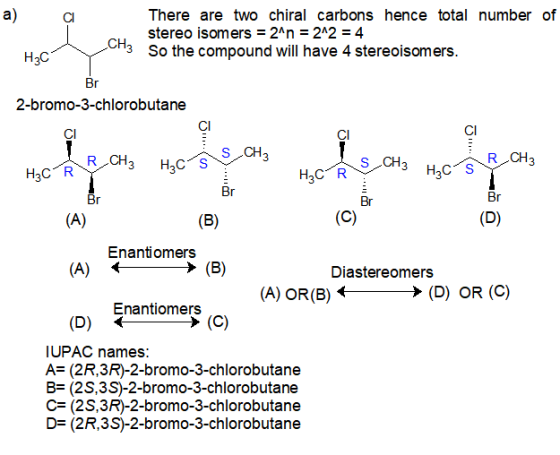
2) a) Consider 2-bromo-3-chlorobutane. How many stereoisomers are possible for this compound? Draw all stereoisomers, label...
A) how many stereoisomers are possible for this compound? Show how this can be easily determined...
 A) how many stereoisomers are possible for this compound? Show
how this can be easily determined mathematically
B) draw all stereoisomers for this compound. Use dashes and
wedges appropriately at each stereo center. DO NOT SHOW HYDROGEN
ATOMS @ EACH STEREOCENTER
C) Identify and label each pair of stereoisomers drawn in part
B (above) as either enantiomers or diastereomers
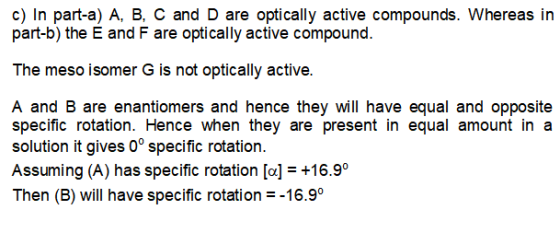
D) identify and label each pair(s) of stereoisomers that would
be optically inactive as 50/50 mixture in a polarimeter and explain...
A) how many stereoisomers are possible for this compound? Show
how this can be easily determined mathematically
B) draw all stereoisomers for this compound. Use dashes and
wedges appropriately at each stereo center. DO NOT SHOW HYDROGEN
ATOMS @ EACH STEREOCENTER
C) Identify and label each pair of stereoisomers drawn in part
B (above) as either enantiomers or diastereomers
D) identify and label each pair(s) of stereoisomers that would
be optically inactive as 50/50 mixture in a polarimeter and explain...
For the compound 3-bromo-4-methylhexane, there are two chiral centers. Draw all stereoisomers in both perspective formulas...
For the compound 3-bromo-4-methylhexane, there are two chiral centers. Draw all stereoisomers in both perspective formulas (3D) and Fischer projections. Indicate R or S on the formulas (you don’t need to name them). List the relationships among the stereoisomers as Enantiomers and/or Diastereomers.
5) (8 pts) Arrange the following compounds from most acidic through neutral to most basic. Briefly...
 5) (8 pts) Arrange the following compounds from most acidic through neutral to most basic. Briefly explain your reasoning. 7) (15 pts) a) Write out the 3-step arrow pushing mechanism showing how 1-pentene is hydrated to make 2-pentanol. b) Draw the other 2 alkenes (don't forgel cis/trans isomers!) that could also be hydrated to make 2-pentanol. Briefly explain why 1-pentene is the best choice. II, II,O a) heat Acidic Neutral Basic 6) (18 pts) Consider the Fischer projections of the...
IX. (12 pts) Draw Fischer projections of all possible stereoisomers of 3-bromo-2-chlorobutanoic acid: CHaCH(Br)CH(CI)CO2H. Determine the...
 IX. (12 pts) Draw Fischer projections of all possible stereoisomers of 3-bromo-2-chlorobutanoic acid: CHaCH(Br)CH(CI)CO2H. Determine the R/S configuration of each stereocenter. Indicate the relationship between each pair of stereoisomers.
3. Consider the molecules A and B shown. (2 points) i. How many stereoisomers are possible?...
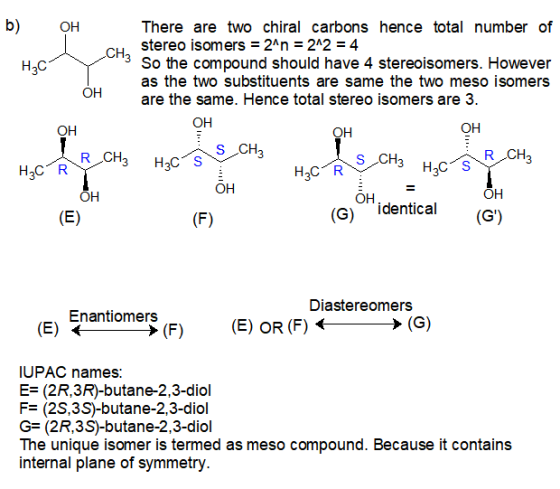
 3. Consider the molecules A and B shown. (2 points) i. How many stereoisomers are possible? ii. Draw each of the possible stereoisomers. он CI Он iii. Identify pairs of enantiomers and pairs of diastereomers. A. В
Draw all possible stereoisomers for each of the following.(a). 2- chloro-3-hexanol. (b). 2-bromo-4- chlorohexane . (c)...
Draw all possible stereoisomers for each of the following.(a). 2- chloro-3-hexanol. (b). 2-bromo-4- chlorohexane . (c) 2,3,-diachloro pentane. (d). 1,3-diabromopentane.(2) .Draw the stereoisomers of 2-methylcyclohexane.
3. (4 pts) Complete the Fischer projection drawn below by adding the four substituents to the chiral carbon of (s)...
 3. (4 pts) Complete the Fischer projection drawn below by adding the four substituents to the chiral carbon of (s)-2-methyl-3-bromo-hexane. 4. (4 pts) Draw a wedge and dash structure representing (1R 2R,3S)-1,2- dichloro3-ethylcyclohexane. 5. (4pts) 2-bromobutane is shown below. Is this (R)-2-bromobutane or (S)-2 bromobutane? 6. (6 pts) For each chiral carbon in ascorbic acid (vitamin C), shown below, assign Ror S to each stereocenter. How many stereoisomers of ascorbic acid are possible? OH HO ОН 7. (9 pts) (Are...
Solve 12-14 12. Consider the molecule shown below. OH OH f. How many stereoisomers are possible?...
 Solve 12-14
12. Consider the molecule shown below. OH OH f. How many stereoisomers are possible? g. Draw each of these stereoisomers. h. Identify pairs of enantiomers and pairs of diastereomers. i. Build a model of the stereoisomer that has both OH groups pointing out. Also, build a model of the mirror image of this molecule. j. Do your two molecules represent enantiomers? Are they chiral? Fischer Projections 13. Build a model of 1-bromo-1-chloroethane. a. Draw a3D representation of this...
Solve 12-14
12. Consider the molecule shown below. OH OH f. How many stereoisomers are possible? g. Draw each of these stereoisomers. h. Identify pairs of enantiomers and pairs of diastereomers. i. Build a model of the stereoisomer that has both OH groups pointing out. Also, build a model of the mirror image of this molecule. j. Do your two molecules represent enantiomers? Are they chiral? Fischer Projections 13. Build a model of 1-bromo-1-chloroethane. a. Draw a3D representation of this...
3. Draw all possible stereoisomers of 2-bromo-3-methoxypentane. Use solid and dashed wedges, where appropriate. (2 pts)...
 3. Draw all possible stereoisomers of 2-bromo-3-methoxypentane. Use solid and dashed wedges, where appropriate. (2 pts) осна 2-bromo-3-methoxypentane 4. Provide (RS)-designations for the four starred (*) chiral (stereogenic) centers. (2 pts) H
Which of the following statements is true regarding 13C-NMR How many stereoisomers are possible for 1-bromo-6-methyl-4-heptene-2-ol?...
 Which of the following statements is true regarding 13C-NMR
How many stereoisomers are possible for
1-bromo-6-methyl-4-heptene-2-ol?
Which of the following statements is true regarding symmetrical
compounds in NMR experiments?
Which of the following statements is true regarding C-NMR a. Carbon-13 is more sensitive than hydrogen NMR b. Carbon-13 resonances appear over a broader range than H-NMR c. Carbon-13 does not couple do adjacent carbons d. Carbon-13 nuclei cannot couple with Hydrogen nuclei How many stereoisomers are possible for 1-bromo-6-methyl-4-heptene-2-ol? a....
Which of the following statements is true regarding 13C-NMR
How many stereoisomers are possible for
1-bromo-6-methyl-4-heptene-2-ol?
Which of the following statements is true regarding symmetrical
compounds in NMR experiments?
Which of the following statements is true regarding C-NMR a. Carbon-13 is more sensitive than hydrogen NMR b. Carbon-13 resonances appear over a broader range than H-NMR c. Carbon-13 does not couple do adjacent carbons d. Carbon-13 nuclei cannot couple with Hydrogen nuclei How many stereoisomers are possible for 1-bromo-6-methyl-4-heptene-2-ol? a....
 A) how many stereoisomers are possible for this compound? Show
how this can be easily determined mathematically
B) draw all stereoisomers for this compound. Use dashes and
wedges appropriately at each stereo center. DO NOT SHOW HYDROGEN
ATOMS @ EACH STEREOCENTER
C) Identify and label each pair of stereoisomers drawn in part
B (above) as either enantiomers or diastereomers
D) identify and label each pair(s) of stereoisomers that would
be optically inactive as 50/50 mixture in a polarimeter and explain...
A) how many stereoisomers are possible for this compound? Show
how this can be easily determined mathematically
B) draw all stereoisomers for this compound. Use dashes and
wedges appropriately at each stereo center. DO NOT SHOW HYDROGEN
ATOMS @ EACH STEREOCENTER
C) Identify and label each pair of stereoisomers drawn in part
B (above) as either enantiomers or diastereomers
D) identify and label each pair(s) of stereoisomers that would
be optically inactive as 50/50 mixture in a polarimeter and explain...
 5) (8 pts) Arrange the following compounds from most acidic through neutral to most basic. Briefly explain your reasoning. 7) (15 pts) a) Write out the 3-step arrow pushing mechanism showing how 1-pentene is hydrated to make 2-pentanol. b) Draw the other 2 alkenes (don't forgel cis/trans isomers!) that could also be hydrated to make 2-pentanol. Briefly explain why 1-pentene is the best choice. II, II,O a) heat Acidic Neutral Basic 6) (18 pts) Consider the Fischer projections of the...
 IX. (12 pts) Draw Fischer projections of all possible stereoisomers of 3-bromo-2-chlorobutanoic acid: CHaCH(Br)CH(CI)CO2H. Determine the R/S configuration of each stereocenter. Indicate the relationship between each pair of stereoisomers.
 3. Consider the molecules A and B shown. (2 points) i. How many stereoisomers are possible? ii. Draw each of the possible stereoisomers. он CI Он iii. Identify pairs of enantiomers and pairs of diastereomers. A. В
 3. (4 pts) Complete the Fischer projection drawn below by adding the four substituents to the chiral carbon of (s)-2-methyl-3-bromo-hexane. 4. (4 pts) Draw a wedge and dash structure representing (1R 2R,3S)-1,2- dichloro3-ethylcyclohexane. 5. (4pts) 2-bromobutane is shown below. Is this (R)-2-bromobutane or (S)-2 bromobutane? 6. (6 pts) For each chiral carbon in ascorbic acid (vitamin C), shown below, assign Ror S to each stereocenter. How many stereoisomers of ascorbic acid are possible? OH HO ОН 7. (9 pts) (Are...
 Solve 12-14
12. Consider the molecule shown below. OH OH f. How many stereoisomers are possible? g. Draw each of these stereoisomers. h. Identify pairs of enantiomers and pairs of diastereomers. i. Build a model of the stereoisomer that has both OH groups pointing out. Also, build a model of the mirror image of this molecule. j. Do your two molecules represent enantiomers? Are they chiral? Fischer Projections 13. Build a model of 1-bromo-1-chloroethane. a. Draw a3D representation of this...
Solve 12-14
12. Consider the molecule shown below. OH OH f. How many stereoisomers are possible? g. Draw each of these stereoisomers. h. Identify pairs of enantiomers and pairs of diastereomers. i. Build a model of the stereoisomer that has both OH groups pointing out. Also, build a model of the mirror image of this molecule. j. Do your two molecules represent enantiomers? Are they chiral? Fischer Projections 13. Build a model of 1-bromo-1-chloroethane. a. Draw a3D representation of this...
 3. Draw all possible stereoisomers of 2-bromo-3-methoxypentane. Use solid and dashed wedges, where appropriate. (2 pts) осна 2-bromo-3-methoxypentane 4. Provide (RS)-designations for the four starred (*) chiral (stereogenic) centers. (2 pts) H
 Which of the following statements is true regarding 13C-NMR
How many stereoisomers are possible for
1-bromo-6-methyl-4-heptene-2-ol?
Which of the following statements is true regarding symmetrical
compounds in NMR experiments?
Which of the following statements is true regarding C-NMR a. Carbon-13 is more sensitive than hydrogen NMR b. Carbon-13 resonances appear over a broader range than H-NMR c. Carbon-13 does not couple do adjacent carbons d. Carbon-13 nuclei cannot couple with Hydrogen nuclei How many stereoisomers are possible for 1-bromo-6-methyl-4-heptene-2-ol? a....
Which of the following statements is true regarding 13C-NMR
How many stereoisomers are possible for
1-bromo-6-methyl-4-heptene-2-ol?
Which of the following statements is true regarding symmetrical
compounds in NMR experiments?
Which of the following statements is true regarding C-NMR a. Carbon-13 is more sensitive than hydrogen NMR b. Carbon-13 resonances appear over a broader range than H-NMR c. Carbon-13 does not couple do adjacent carbons d. Carbon-13 nuclei cannot couple with Hydrogen nuclei How many stereoisomers are possible for 1-bromo-6-methyl-4-heptene-2-ol? a....
Most questions answered within 3 hours.
-
Where is the error in this code sequence?
String s1 = "Hello";
String s2 = "ello";...
asked 10 months ago -
Financial data for Joel de Paris, Inc., for last year
follow:
Joel de Paris, Inc.
Balance...
asked 10 months ago -
Consider this reaction:
Al2(SO4)3 (aq)+ BaCl3
(aq) Al2Cl6 (aq)- +
3BaSO4(s) . What is the...
asked 10 months ago -
Suppose that Savneet is considering increasing her
recent random sample from 20 car rentals to 40...
asked 10 months ago -
Trucks arrive at an unloading terminal at an average rate of 120
per hour.
Trucks arrive...
asked 10 months ago -
Why are methanol and ethanol completely soluble in water while
octanol is not very little soluble....
asked 10 months ago -
A facilities manager at a university reads in a research report
that the mean amount of...
asked 10 months ago -
When the CuSO4 is rehydrated by adding water to the anhydrous
compound, is this an endothermic...
asked 10 months ago -
A ray of sunlight is passing from diamond into crown glass; the
angle of incidence is...
asked 10 months ago -
A block of mass 0.249 kg is placed on top of a light, vertical
spring of...
asked 10 months ago -
how do the kidneys compensate in the presences of acidosis
a) trigger hyperventilate
b) reserve acid...
asked 10 months ago -
Question 501 pts
The rental rate of capital to the firm increases. Which of the
following...
asked 10 months ago