![Ascoli - Arzola) : If tom) is uniformly bounded and equicontinuous sequence of functions defined on [a, b]. Then, there exists a subsequence which converges uniformly on [a, b]](http://img.homeworklib.com/questions/ec954510-fa8f-11eb-979e-b5ba5b3e515f.png?x-oss-process=image/resize,w_560)
Homework Answers
I am uploading proof, in this proof I am using 'f' instead of
'g'.![Let Ca b] C R be a clhted and bamded intevia otickis oni frewly bande and eCo then there is a sequance t f eleweuts of F ui Continnus, 3wth thct 千 m Converges uniformly on [a, b]. Now FİX an enumeration 呈X11new ap rational num has [a, bj . g,ince FİS Uniformly bwnded, these+of points, (%)SpEF b) banded, and hence by lzano weiestsass thesem there is a tn, Converges Repeating ane argument fir seguenee f ponsdbs (x Converges es inducthon this proces Con be Conthnued there i a choun af sbseg vences yut](http://img.homeworklib.com/questions/33e6cb80-fa90-11eb-8a41-ef32abdce190.png?x-oss-process=image/resize,w_560)
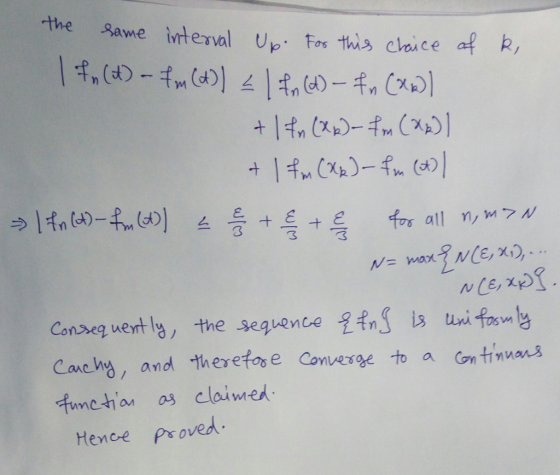
![w hase Bubsegvence anvesges at every satona point af L b Ther , g, nen ang E70 and ratom( χΡǐnpul fose 2 in та there is an integes - MCe, x2 uch that 3 Smce the fawily Fis equi ontimas, for this fixel and fo every χ In La, b] there irtesval Us containing x Jueh thot open 1チ(3) _ f (d)11-3 for all f EF and Such that Covesing ad Ur. There exi 私ite integes K 3nch that ech open irt eval Up Contains a athonalx ard so thet and Xp be long -to](http://img.homeworklib.com/questions/35079910-fa90-11eb-b7f1-af1ef87cb298.png?x-oss-process=image/resize,w_560)
Add Answer to:
Prove it ?
Ascoli - Arzola) : If tom) is uniformly bounded and equicontinuous sequence of...
(5) Let {fn} be a sequence in C((0, 1]) which converges uniformly (to C([0, 1]). Prove that {fn} is uniformly bounded a...
 (5) Let {fn} be a sequence in C((0, 1]) which converges uniformly (to C([0, 1]). Prove that {fn} is uniformly bounded and equicontinuous function f E a
(5) Let {fn} be a sequence in C((0, 1]) which converges uniformly (to C([0, 1]). Prove that {fn} is uniformly bounded and equicontinuous function f E a
(5) Let {fn} be a sequence in C((0, 1]) which converges uniformly (to C([0, 1]). Prove that {fn} is uniformly bounded and equicontinuous function f E a
Let {fn} ⊆ C([0, 1]). Prove that {fn} converges uniformly on [0, 1] if and only if {fn} is equicontinuous on [0, 1] and...
Let {fn} ⊆ C([0, 1]). Prove that {fn} converges uniformly on [0, 1] if and only if {fn} is equicontinuous on [0, 1] and converges pointwise on [0, 1].
Let (X, d) be a compact metric space. Prove that if F ⊆ C(X) is equicontinuous then it is uniformly equicontinuous.
Let (X, d) be a compact metric space. Prove that if F ⊆ C(X) is equicontinuous then it is uniformly equicontinuous.
5. Let the functions fon : [a, b] → R be uniformly bounded continuous func- tions....
 5. Let the functions fon : [a, b] → R be uniformly bounded continuous func- tions. Set di, astsb. Prove that F, has a uniformly convergent subsequence.
(2) Let {fJ be a sequence of continuous, real-valued functions that converges uniformly on the in...
 (2) Let {fJ be a sequence of continuous, real-valued functions that converges uniformly on the interval [0,1 (a) Show that there exists M> 0 such that n(x) M for all r E [0,1] and all n N. (b) Does the result in part (a) hold if uniform convergence is replaced by pointwise convergence? Prove or give a counterexample
(2) Let {fJ be a sequence of continuous, real-valued functions that converges uniformly on the interval [0,1 (a) Show that there exists...
(2) Let {fJ be a sequence of continuous, real-valued functions that converges uniformly on the interval [0,1 (a) Show that there exists M> 0 such that n(x) M for all r E [0,1] and all n N. (b) Does the result in part (a) hold if uniform convergence is replaced by pointwise convergence? Prove or give a counterexample
(2) Let {fJ be a sequence of continuous, real-valued functions that converges uniformly on the interval [0,1 (a) Show that there exists...
(a) Let Sk: KCR + R" be an equicontinuous sequence of functions on a compact set...
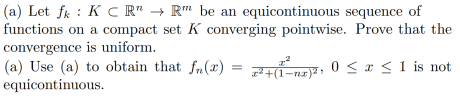 (a) Let Sk: KCR + R" be an equicontinuous sequence of functions on a compact set K converging pointwise. Prove that the convergence is uniform. (a) Use (a) to obtain that fn(x) x2 x2 +(1-nx)2, 0 < x < 1 is not equicontinuous. =
8) Given that the sequence [an) converges to 0 and (br) is bounded by M, then...
 8) Given that the sequence [an) converges to 0 and (br) is bounded by M, then the sequence an b) converges to 9) If two functions f.g are both bounded on a neighborhood of p (and p is an accumulation point of the intersection attention to not only the bound for the function f * g, but also the δ-neighborhood on which it is bounded) 0 of their domains), then prove that the function f g is also bounded on...
Let {yk}k=1infinity be a sequence of differentiable functions which map [a,b] to Rn. Assume the sequence...
Let {yk}k=1infinity be a sequence of differentiable functions which map [a,b] to Rn. Assume the sequence {yk(a)}k=1infinity is bounded. Assume the sequence of derivatives {yk' }k=1infinity is uniformly bounded: there exists a number M such that ||yk'(t)|| <= M for all t E [a,b] and k = 1,2,3.... Prove that there exists a sub-seqeunce {kj}j=1infinity such that the sequence {ykj}j=1infinity is convergent uniformly in [a,b].
For the following statements give a counterexample or demonstrate them: a)If fn (x) is a succession of functions uniformly bounded. Does this suc- cession have a subsucession that converges at le...
 For the following statements give a counterexample or demonstrate them: a)If fn (x) is a succession of functions uniformly bounded. Does this suc- cession have a subsucession that converges at least punctually in its domain? b)If {fn (2.)) is a succession of continuous, bounded, defined functions in a compact and that converge punctually in said compact. Is {fn (x)) a succes- sion of functions uniformly bounded?
For the following statements give a counterexample or demonstrate them: a)If fn (x) is...
For the following statements give a counterexample or demonstrate them: a)If fn (x) is a succession of functions uniformly bounded. Does this suc- cession have a subsucession that converges at least punctually in its domain? b)If {fn (2.)) is a succession of continuous, bounded, defined functions in a compact and that converge punctually in said compact. Is {fn (x)) a succes- sion of functions uniformly bounded?
For the following statements give a counterexample or demonstrate them: a)If fn (x) is...
3) Let (an)2- be a sequence of real numbers such that lim inf lanl 0. Prove...
 3) Let (an)2- be a sequence of real numbers such that lim inf lanl 0. Prove that there exists a subsequence (mi)2-1 such that Σ . an, converges に1
 (5) Let {fn} be a sequence in C((0, 1]) which converges uniformly (to C([0, 1]). Prove that {fn} is uniformly bounded and equicontinuous function f E a
(5) Let {fn} be a sequence in C((0, 1]) which converges uniformly (to C([0, 1]). Prove that {fn} is uniformly bounded and equicontinuous function f E a
(5) Let {fn} be a sequence in C((0, 1]) which converges uniformly (to C([0, 1]). Prove that {fn} is uniformly bounded and equicontinuous function f E a
 5. Let the functions fon : [a, b] → R be uniformly bounded continuous func- tions. Set di, astsb. Prove that F, has a uniformly convergent subsequence.
 (2) Let {fJ be a sequence of continuous, real-valued functions that converges uniformly on the interval [0,1 (a) Show that there exists M> 0 such that n(x) M for all r E [0,1] and all n N. (b) Does the result in part (a) hold if uniform convergence is replaced by pointwise convergence? Prove or give a counterexample
(2) Let {fJ be a sequence of continuous, real-valued functions that converges uniformly on the interval [0,1 (a) Show that there exists...
(2) Let {fJ be a sequence of continuous, real-valued functions that converges uniformly on the interval [0,1 (a) Show that there exists M> 0 such that n(x) M for all r E [0,1] and all n N. (b) Does the result in part (a) hold if uniform convergence is replaced by pointwise convergence? Prove or give a counterexample
(2) Let {fJ be a sequence of continuous, real-valued functions that converges uniformly on the interval [0,1 (a) Show that there exists...
 (a) Let Sk: KCR + R" be an equicontinuous sequence of functions on a compact set K converging pointwise. Prove that the convergence is uniform. (a) Use (a) to obtain that fn(x) x2 x2 +(1-nx)2, 0 < x < 1 is not equicontinuous. =
 8) Given that the sequence [an) converges to 0 and (br) is bounded by M, then the sequence an b) converges to 9) If two functions f.g are both bounded on a neighborhood of p (and p is an accumulation point of the intersection attention to not only the bound for the function f * g, but also the δ-neighborhood on which it is bounded) 0 of their domains), then prove that the function f g is also bounded on...
 For the following statements give a counterexample or demonstrate them: a)If fn (x) is a succession of functions uniformly bounded. Does this suc- cession have a subsucession that converges at least punctually in its domain? b)If {fn (2.)) is a succession of continuous, bounded, defined functions in a compact and that converge punctually in said compact. Is {fn (x)) a succes- sion of functions uniformly bounded?
For the following statements give a counterexample or demonstrate them: a)If fn (x) is...
For the following statements give a counterexample or demonstrate them: a)If fn (x) is a succession of functions uniformly bounded. Does this suc- cession have a subsucession that converges at least punctually in its domain? b)If {fn (2.)) is a succession of continuous, bounded, defined functions in a compact and that converge punctually in said compact. Is {fn (x)) a succes- sion of functions uniformly bounded?
For the following statements give a counterexample or demonstrate them: a)If fn (x) is...
 3) Let (an)2- be a sequence of real numbers such that lim inf lanl 0. Prove that there exists a subsequence (mi)2-1 such that Σ . an, converges に1
Most questions answered within 3 hours.
-
Where is the error in this code sequence?
String s1 = "Hello";
String s2 = "ello";...
asked 11 months ago -
Financial data for Joel de Paris, Inc., for last year
follow:
Joel de Paris, Inc.
Balance...
asked 11 months ago -
Consider this reaction:
Al2(SO4)3 (aq)+ BaCl3
(aq) Al2Cl6 (aq)- +
3BaSO4(s) . What is the...
asked 11 months ago -
Suppose that Savneet is considering increasing her
recent random sample from 20 car rentals to 40...
asked 11 months ago -
Trucks arrive at an unloading terminal at an average rate of 120
per hour.
Trucks arrive...
asked 11 months ago -
Why are methanol and ethanol completely soluble in water while
octanol is not very little soluble....
asked 11 months ago -
A facilities manager at a university reads in a research report
that the mean amount of...
asked 11 months ago -
When the CuSO4 is rehydrated by adding water to the anhydrous
compound, is this an endothermic...
asked 11 months ago -
A ray of sunlight is passing from diamond into crown glass; the
angle of incidence is...
asked 11 months ago -
A block of mass 0.249 kg is placed on top of a light, vertical
spring of...
asked 11 months ago -
how do the kidneys compensate in the presences of acidosis
a) trigger hyperventilate
b) reserve acid...
asked 11 months ago -
Question 501 pts
The rental rate of capital to the firm increases. Which of the
following...
asked 11 months ago