
Homework Answers
Electronic configuration is written using 3 principles :-
Aufbau principle, Pauli's exclusion principle & Hund's rule.
Then sub shells are rearranged according to main shell no.
2)
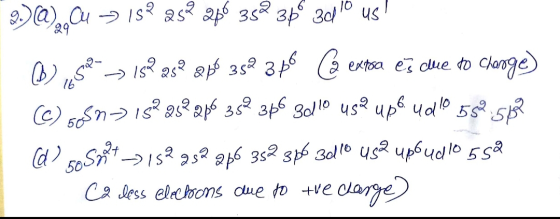
a)Some elements have exceptional electronic configuration like Cu in above case. An electron from 4s get excited to 3d to acquire extra stability of fully filled 3d sub-shell.
b) 2 extra electrons added due to 2 negative charge on sulphur & total electrons becomes 18.
c) Sn is written normally.
d) In Sn2+ two electrons are removed fro 5s due to two positive charge on Sn. So total electrons becomes 48.
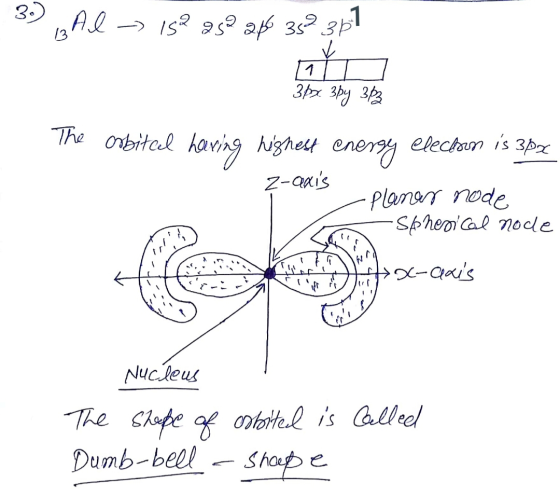
3) Energy of orbitals increases from inside to outside . So highest energy electron in Al is in 3px having nucleus at center & dumb-bell shape. This orbital possesses one planar node and one spherical node.
As given below:-
Add Answer to:
2. Use your periodic table to write the shorthand (noble gas) electron configurations: 8 pts a)...
. 1. Draw the orbital diagram (noble gas shorthand) for these elements: a) K b) P...
. 1. Draw the orbital diagram (noble gas shorthand) for these elements: a) K b) P c) Cu d) Sn
1. 18] Give electron configurations for each atom or ion 1. Show spdf noble gas core....
 1. 18] Give electron configurations for each atom or ion 1. Show spdf noble gas core. 2. Show orbital diagrams (box notation) noble gas core. Fr Ni 2. /12) Complete the following table BF, BF, ACLSCE! Lewis structure VSEPR notation geometry name) Molecular geometry picture and name Indicate an angle between terminal- Type of hybridization of the central com (sp. sp.sp. spid spd
Represent the electron configurations for Ga3+, V3+, I- and Sb3+ using a) noble gas cores with...
Represent the electron configurations for Ga3+, V3+, I- and Sb3+ using a) noble gas cores with spdf notation. b) orbital diagrams (boxes) for the valence electrons
8. Write the condensed electron configurations for each of the following ions. (The condensed electron configurations...
 8. Write the condensed electron configurations for each of the following ions. (The condensed electron configurations use the prior noble gas symbol enclosed in square brackets to depict the core electrons.) a) Cr3+ b) 52 Co2+,
Electron Configurations and the Periodic Table 13 of 19 Number the rows within each block of...
 Electron Configurations and the Periodic Table 13 of 19 Number the rows within each block of the periodic table according to the shell for the highest-energy electrons in an atom of those elements. Drag the appropriate labels to their respective targets. View Available Hint(s)
20. How do atoms achieve noble-gas electron configurations in single covalent bonds? a. One atom completely...
 20. How do atoms achieve noble-gas electron configurations in single covalent bonds? a. One atom completely loses two electrons to the other atom in the bond. b. Two atoms share two pairs of electrons. C. Two atoms share two electrons. d. Two atoms share one electron 21. Why do atoms share electrons in covalent bonds? a to become ions and attract each other b. to attain a noble-gas electron configuration c. to become more polar d. to increase their atomic...
Write condensed electron configurations for the following atoms and ions, using appropriate noble-gas core abbreviations. Put...
Write condensed electron configurations for the following atoms and ions, using appropriate noble-gas core abbreviations. Put superscripted electron count numbers in parentheses. Examples: Fe = [Ar]4s(2)3d(6), Sn2+ = [Kr]4d(10)5s(2), S2- = [Ar]. (a) Si= (b) Zn2+=
could you help with 1,2 and 4 ? Part I: Review of Electron Configurations and Periodic...
 could you help with 1,2 and 4 ?
Part I: Review of Electron Configurations and Periodic Properties 1. Write the complete electron configuration and the noble gas shorthand for each of the following ions. a. CI b. Zn2+ C. Sn* 2. For the following questions, consider these five elements: S Br Ca kr Li a. Which element has the largest atomic radius? b. Which element has the smallest atomic radius? C. Which elements have exactly six valence electrons? d. Which...
could you help with 1,2 and 4 ?
Part I: Review of Electron Configurations and Periodic Properties 1. Write the complete electron configuration and the noble gas shorthand for each of the following ions. a. CI b. Zn2+ C. Sn* 2. For the following questions, consider these five elements: S Br Ca kr Li a. Which element has the largest atomic radius? b. Which element has the smallest atomic radius? C. Which elements have exactly six valence electrons? d. Which...
Write condensed electron configurations for the following atoms and ions, using appropriate noble...
Write condensed electron configurations for the following atoms and ions, using appropriate noble-gas core abbreviations. Put superscripted electron count numbers in parentheses. Examples: Fe = [Ar]4s(2)3d(6), Sn2+ = [Kr]4d(10)5s(2), S2- = [Ar]. (a) Ba2+ = [Xe]6s(0) Incorrect: Your answer is incorrect. (b) Ca2+ = [Ar] Correct: Your answer is correct. (c) Cu+ = Incorrect: Your answer is incorrect. (d) Ti2+ = [Ar]3d(2)4s(0) Incorrect: Your answer is incorrect. (e) Co = Incorrect: Your answer is incorrect.
Electron Configurations of lons ③ 19 01 23 Review Constants Periodic Table When an atom forms...
 Electron Configurations of lons ③ 19 01 23 Review Constants Periodic Table When an atom forms an ion, it will gain or lose electrons to attain a more stable electron configuration, frequently that of a noblo gas. Nonmetals tend to form anions by gaining electrons, which enter the lowest energy unoccupied orbital. Metais tend to form cations by losing electrons. Main group motals lose electrons in the reverso order of filling. Transition metals, however, lose s electrons first. Part A...
 1. 18] Give electron configurations for each atom or ion 1. Show spdf noble gas core. 2. Show orbital diagrams (box notation) noble gas core. Fr Ni 2. /12) Complete the following table BF, BF, ACLSCE! Lewis structure VSEPR notation geometry name) Molecular geometry picture and name Indicate an angle between terminal- Type of hybridization of the central com (sp. sp.sp. spid spd
 8. Write the condensed electron configurations for each of the following ions. (The condensed electron configurations use the prior noble gas symbol enclosed in square brackets to depict the core electrons.) a) Cr3+ b) 52 Co2+,
 Electron Configurations and the Periodic Table 13 of 19 Number the rows within each block of the periodic table according to the shell for the highest-energy electrons in an atom of those elements. Drag the appropriate labels to their respective targets. View Available Hint(s)
 20. How do atoms achieve noble-gas electron configurations in single covalent bonds? a. One atom completely loses two electrons to the other atom in the bond. b. Two atoms share two pairs of electrons. C. Two atoms share two electrons. d. Two atoms share one electron 21. Why do atoms share electrons in covalent bonds? a to become ions and attract each other b. to attain a noble-gas electron configuration c. to become more polar d. to increase their atomic...
 could you help with 1,2 and 4 ?
Part I: Review of Electron Configurations and Periodic Properties 1. Write the complete electron configuration and the noble gas shorthand for each of the following ions. a. CI b. Zn2+ C. Sn* 2. For the following questions, consider these five elements: S Br Ca kr Li a. Which element has the largest atomic radius? b. Which element has the smallest atomic radius? C. Which elements have exactly six valence electrons? d. Which...
could you help with 1,2 and 4 ?
Part I: Review of Electron Configurations and Periodic Properties 1. Write the complete electron configuration and the noble gas shorthand for each of the following ions. a. CI b. Zn2+ C. Sn* 2. For the following questions, consider these five elements: S Br Ca kr Li a. Which element has the largest atomic radius? b. Which element has the smallest atomic radius? C. Which elements have exactly six valence electrons? d. Which...
 Electron Configurations of lons ③ 19 01 23 Review Constants Periodic Table When an atom forms an ion, it will gain or lose electrons to attain a more stable electron configuration, frequently that of a noblo gas. Nonmetals tend to form anions by gaining electrons, which enter the lowest energy unoccupied orbital. Metais tend to form cations by losing electrons. Main group motals lose electrons in the reverso order of filling. Transition metals, however, lose s electrons first. Part A...
Most questions answered within 3 hours.
-
Where is the error in this code sequence?
String s1 = "Hello";
String s2 = "ello";...
asked 10 months ago -
Financial data for Joel de Paris, Inc., for last year
follow:
Joel de Paris, Inc.
Balance...
asked 10 months ago -
Consider this reaction:
Al2(SO4)3 (aq)+ BaCl3
(aq) Al2Cl6 (aq)- +
3BaSO4(s) . What is the...
asked 10 months ago -
Suppose that Savneet is considering increasing her
recent random sample from 20 car rentals to 40...
asked 10 months ago -
Trucks arrive at an unloading terminal at an average rate of 120
per hour.
Trucks arrive...
asked 10 months ago -
Why are methanol and ethanol completely soluble in water while
octanol is not very little soluble....
asked 10 months ago -
A facilities manager at a university reads in a research report
that the mean amount of...
asked 10 months ago -
When the CuSO4 is rehydrated by adding water to the anhydrous
compound, is this an endothermic...
asked 10 months ago -
A ray of sunlight is passing from diamond into crown glass; the
angle of incidence is...
asked 10 months ago -
A block of mass 0.249 kg is placed on top of a light, vertical
spring of...
asked 10 months ago -
how do the kidneys compensate in the presences of acidosis
a) trigger hyperventilate
b) reserve acid...
asked 10 months ago -
Question 501 pts
The rental rate of capital to the firm increases. Which of the
following...
asked 10 months ago