4. Consider trade relations between the United States and Mexico. Assume that the leaders of the...
United States' Decision Mexico's Decision
Low Tariffs U.S. gains $25 billion Mexico gains $25 billion
High Tariffs U.S. gains $20 billion Mexico gains $20 billion
US low tariff/Mexico high tariff U.S. gains $10 billion Mexico gains $30 billion
US high tariff/Mexico low tariff U.S. gains $30 billion Mexico gains $10 billion
a. What is the dominant strategy for the United States? For Mexico? Explain?
b. Define Nash equilibrium. What is the Nash equilibrium for trade policy?
c. In 1993, the U.S. Congress ratified the North American Free Trade Agreement, in which the United States and Mexico agreed to reduce trade barriers simultaneously. Do the perceived payoffs shown here justify this approach to trade policy? Explain.
d. Based on your understanding of the gains from trade (discussed in Chapters 3 and 9), do you think that these payoffs actually reflect a nation's welfare under the four possible outcomes?
Homework Answers
First let us draw the normal form game to help us answer the problems.
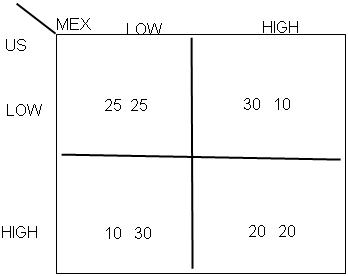
a. What is the dominant strategy for the United States? For Mexico? Explain?
In this case, we compare payoffs. US compares the first column vertically and Mex compars the second column vertically
25 25 30 10
10 30 20 20
In this case, both US and Mex independently have a dominat strategy to choose low
b. Define Nash equilibrium. What is the Nash equilibrium for trade policy?
Nash equilibrium is the strategy set/ combination when both players choose their best position. In this case, the nash equilibrium is the box low,low . We know this because there are two highlighted outcomes
c. In 1993, the U.S. Congress ratified the North American
Free Trade Agreement, in which the United States and Mexico agreed
to reduce trade barriers simultaneously. Do the perceived payoffs
shown here justify this approach to trade policy?
Explain.
Yes, they do. In this case, we see that if both produce low, both countries will earn a higher outcome than both choosing high. If one trys to cheat, the other will also cheat and the result will always be low,low
d. Based on your understanding of the gains from trade
(discussed in Chapters 3 and 9), do you think that these payoffs
actually reflect a nation's welfare under the four possible
outcomes?
This does, acurately portray gains from trade. If both collude and price high, they will earn 20, if one decides to cheat, they essentially steal the other firms profit, and if both price low, they will both recieve a higher paypout because of the higher demand of quantity.
Hope this helps
Add Answer to:
4. Consider trade relations between the United States and Mexico. Assume that the leaders of the...
Most questions answered within 3 hours.
-
Where is the error in this code sequence?
String s1 = "Hello";
String s2 = "ello";...
asked 11 months ago -
Financial data for Joel de Paris, Inc., for last year
follow:
Joel de Paris, Inc.
Balance...
asked 11 months ago -
Consider this reaction:
Al2(SO4)3 (aq)+ BaCl3
(aq) Al2Cl6 (aq)- +
3BaSO4(s) . What is the...
asked 11 months ago -
Suppose that Savneet is considering increasing her
recent random sample from 20 car rentals to 40...
asked 11 months ago -
Trucks arrive at an unloading terminal at an average rate of 120
per hour.
Trucks arrive...
asked 11 months ago -
Why are methanol and ethanol completely soluble in water while
octanol is not very little soluble....
asked 11 months ago -
A facilities manager at a university reads in a research report
that the mean amount of...
asked 11 months ago -
When the CuSO4 is rehydrated by adding water to the anhydrous
compound, is this an endothermic...
asked 11 months ago -
A ray of sunlight is passing from diamond into crown glass; the
angle of incidence is...
asked 11 months ago -
A block of mass 0.249 kg is placed on top of a light, vertical
spring of...
asked 11 months ago -
how do the kidneys compensate in the presences of acidosis
a) trigger hyperventilate
b) reserve acid...
asked 11 months ago -
Question 501 pts
The rental rate of capital to the firm increases. Which of the
following...
asked 11 months ago