Given the effects of COVID-19, some predict that the U.S. economy will contract 1.6% in the first quarter and 2.5% in the second quarter. Some estimates portray a more gruesome picture.
A record 6.65 million people filed a new jobless claim in the week that ended March 28. While 40% of Americans would have trouble covering an unexpected $400 expense, according to a survey by the Federal Reserve.
Part 1.
Explain, using the diagram below, how all this would impact wages in the medium term. Refer to the diagram and mention the changes in demand and/or supply of labor to explain the effect in equilibrium wages.
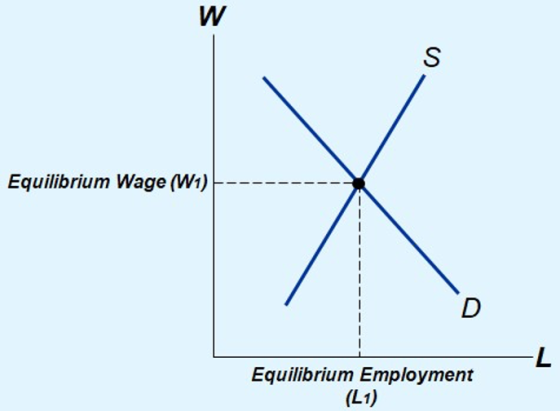
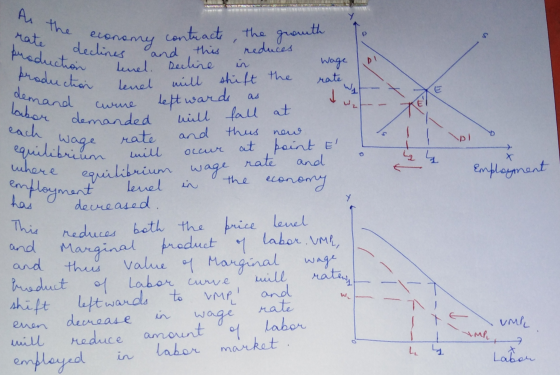
Complement your answer provided in Part 1 with a more "microeconomic" illustration of the changes (if any) on wages. In other words, would the value of the marginal product of labor (VMPL) change? Why so? How would this affect the equilibrium wage?
Homework Answers
Add Answer to:
Given the effects of COVID-19, some predict that the
U.S. economy will contract 1.6% in the...
QUESTION 10 Consider the monthly data, including the estimates for March 2020, and the information in...
 QUESTION 10
Consider the monthly data, including the estimates for March
2020, and the information in the articles. Which of the following
is the best analysis of and prediction for the money market in the
U.S. economy for the next few months?
a.
Shortages are causing panic buying by households, which has
increased money demand. Lenders are increasing their lending to
keep up with the needs of households and businesses. Money demand
is increasing more than money supply.
b.
Shortages...
QUESTION 10
Consider the monthly data, including the estimates for March
2020, and the information in the articles. Which of the following
is the best analysis of and prediction for the money market in the
U.S. economy for the next few months?
a.
Shortages are causing panic buying by households, which has
increased money demand. Lenders are increasing their lending to
keep up with the needs of households and businesses. Money demand
is increasing more than money supply.
b.
Shortages...
 QUESTION 10
Consider the monthly data, including the estimates for March
2020, and the information in the articles. Which of the following
is the best analysis of and prediction for the money market in the
U.S. economy for the next few months?
a.
Shortages are causing panic buying by households, which has
increased money demand. Lenders are increasing their lending to
keep up with the needs of households and businesses. Money demand
is increasing more than money supply.
b.
Shortages...
QUESTION 10
Consider the monthly data, including the estimates for March
2020, and the information in the articles. Which of the following
is the best analysis of and prediction for the money market in the
U.S. economy for the next few months?
a.
Shortages are causing panic buying by households, which has
increased money demand. Lenders are increasing their lending to
keep up with the needs of households and businesses. Money demand
is increasing more than money supply.
b.
Shortages...
Most questions answered within 3 hours.
-
Where is the error in this code sequence?
String s1 = "Hello";
String s2 = "ello";...
asked 10 months ago -
Financial data for Joel de Paris, Inc., for last year
follow:
Joel de Paris, Inc.
Balance...
asked 10 months ago -
Consider this reaction:
Al2(SO4)3 (aq)+ BaCl3
(aq) Al2Cl6 (aq)- +
3BaSO4(s) . What is the...
asked 10 months ago -
Suppose that Savneet is considering increasing her
recent random sample from 20 car rentals to 40...
asked 10 months ago -
Trucks arrive at an unloading terminal at an average rate of 120
per hour.
Trucks arrive...
asked 10 months ago -
Why are methanol and ethanol completely soluble in water while
octanol is not very little soluble....
asked 10 months ago -
A facilities manager at a university reads in a research report
that the mean amount of...
asked 10 months ago -
When the CuSO4 is rehydrated by adding water to the anhydrous
compound, is this an endothermic...
asked 10 months ago -
A ray of sunlight is passing from diamond into crown glass; the
angle of incidence is...
asked 10 months ago -
A block of mass 0.249 kg is placed on top of a light, vertical
spring of...
asked 10 months ago -
how do the kidneys compensate in the presences of acidosis
a) trigger hyperventilate
b) reserve acid...
asked 10 months ago -
Question 501 pts
The rental rate of capital to the firm increases. Which of the
following...
asked 10 months ago