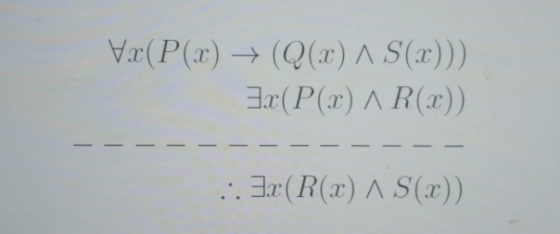
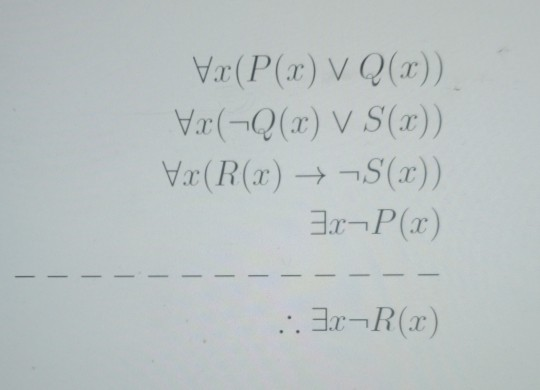
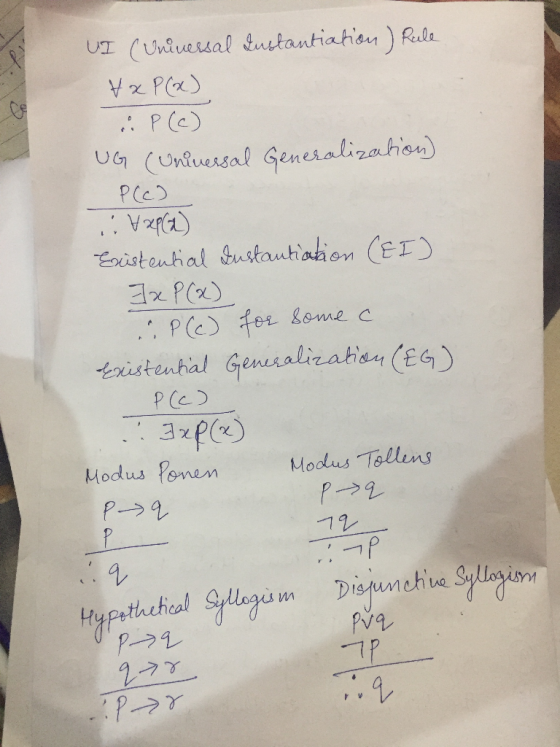
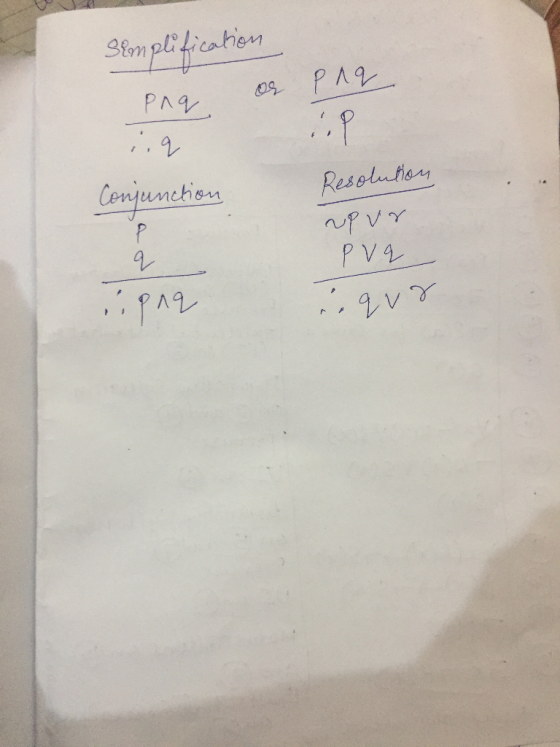
prove that the arguments are valid using rules of inference and laws of predicate logic, (state the laws/rules used)
Homework Answers
 Plz feel free to comment in
case of doubts as i am happy to help you. Plz upvote the solution
if u r satisfied. It means a lot to me. Thanks
Plz feel free to comment in
case of doubts as i am happy to help you. Plz upvote the solution
if u r satisfied. It means a lot to me. Thanks
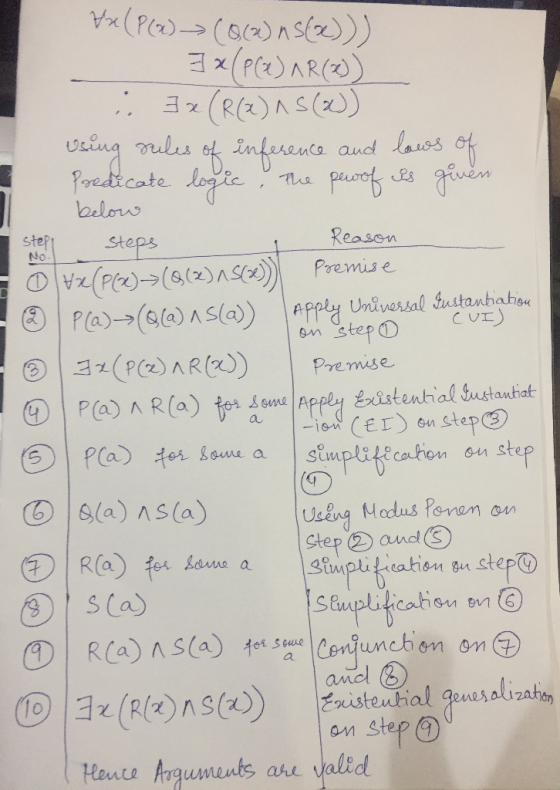
a)
1) 
2) 
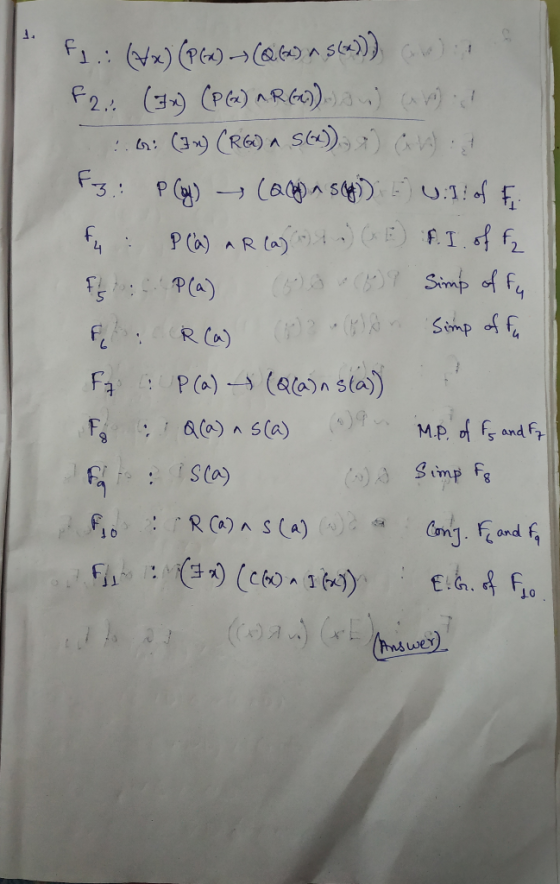
From 1) we can get:-
3)  [Universal instantiation using an element 'a' within the domain of
x]
[Universal instantiation using an element 'a' within the domain of
x]
From 2) we get:-
4)  [Existential instantiation using an element 'a' within the domain
of x]
[Existential instantiation using an element 'a' within the domain
of x]
From 4) we get:-
5) P(a) [Simplification]
From 3) and 5) we get:-
6)  [Modus Ponens]
From 6) we get:-
7) S(a) [Simplification]
From 4) we get:-
8) R(a) [Simplification]
From 7) and 8) we get:-
9)  [Conjunction]
From 9) we get:-
10)  [Existential generalization]
Hence Proved.
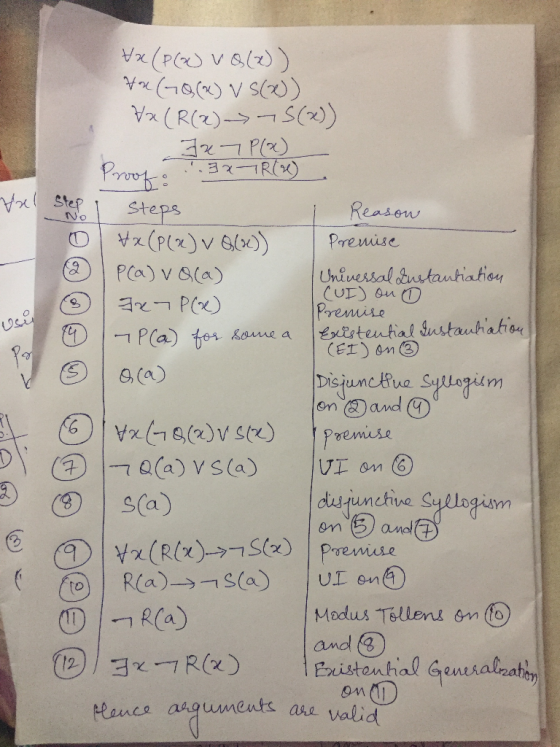
b)
1)
2)
3) 
4) 
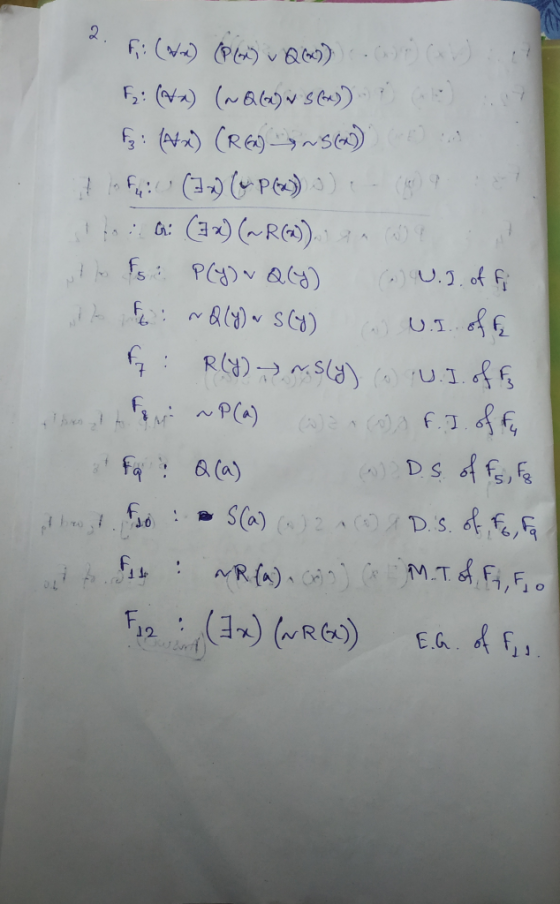
From 1) we get:-
5) P(a) V Q(a) [Universal instantiation using an element 'a' within the domain of x]
From 2) we get:-
6) ~Q(a) V S(a) [Universal instantiation using an element 'a' within the domain of x]
From 3) we get:-
7) R(a) -> ~S(x) [Universal instantiation using an element 'a' within the domain of x]
From 4) we get:-
8) ~P(a) [Existential instantiation using an element 'a' within the domain of x]
From 7) we get:-
9) S(a) -> ~R(a) [Contrapositive]
From 5) and 6) we get:-
10) P(a) V S(a) [Resolution]
From 10) and 8) we get:-
11) S(a) [Disjunctive syllogism]
From 9) and 11) we get:-
12) ~R(x) [Modus Ponens]
From 12) we get:-
13)  [Existential generalization]
Hence Proved.
The solutions of the given problems as follows;
Add Answer to:
prove that the arguments are valid using rules of
inference and laws of predicate logic, (state...
-Use the rules of inference and the laws of propositional logic to prove that each argument...
-Use the rules of inference and the laws of propositional logic to prove that each argument is valid. Number each line of your argument and label each line of your proof "Hypothesis" or with the name of the rule of inference used at that line. If a rule of inference is used, then include the numbers of the previous lines to which the rule is applied. For the arguments stated in English, transform them into propositional logic first. a) (10...
I just need help with detailed explanations for b and c Use the rules of inference...
 I just need help with detailed explanations for b and c
Use the rules of inference and the laws of propositional logic to prove that each argument is valid. Number each line of your argument and label each line of your proof "Hypothesis" or with the name of the rule of inference used at that line. If a rule of inference is used, then include the numbers of the previous lines to which the rule is applied. (a) p q...
I just need help with detailed explanations for b and c
Use the rules of inference and the laws of propositional logic to prove that each argument is valid. Number each line of your argument and label each line of your proof "Hypothesis" or with the name of the rule of inference used at that line. If a rule of inference is used, then include the numbers of the previous lines to which the rule is applied. (a) p q...
Use propositional logic to prove that the following arguments are valid. Do not use truth tables....
 Use propositional logic to prove that the following arguments are valid. Do not use truth tables. 1. ( A C)^(C --B) AB: A 2. (P→ (QAR)) AP: (PA) 3. Z. (ZAZ) 4. A: (AV B)^(AVC) 5. (I → H) A (FV-H) AI: F
Using inference rules Show that the argument form with premises (p t) rightarrow (r s), q...
 Using inference rules
Show that the argument form with premises (p t) rightarrow (r s), q rightarrow (u t), u rightarrow p, and s and conclusion q rightarrow r is valid by first using Exercise 11 and then using rules of inference from Table 1.
Using inference rules
Show that the argument form with premises (p t) rightarrow (r s), q rightarrow (u t), u rightarrow p, and s and conclusion q rightarrow r is valid by first using Exercise 11 and then using rules of inference from Table 1.
Problem 1 [8pt] Prove that the following two Hoare triples are valid. (Hint: in predicate logic...
 Problem 1 [8pt] Prove that the following two Hoare triples are valid. (Hint: in predicate logic Pi equivalent to -P V P2) is a) (4pt) y:= x * 2; y:= y + 3; lu > o) b) (4pt) if (y>2) x := y-1; elsex5-y: fr > 1)
Use laws of equivalence and inference rules to show how you can derive the conclusions from...
Use laws of equivalence and inference rules to show how you can derive the conclusions from the given premises. Be sure to cite the rule used at each line and the line numbers of the hypotheses used for each rule. a) Givens: 1. a ∧ b 2. c → ¬a 3. c ∨ d Conclusion: d b) Givens 1. p → (q ∧ r) 2. ¬r Conclusion ¬p
Consider the following arguments. If an argument is valid, then present a proof sequence; otherwise, prove...
Consider the following arguments. If an argument is valid, then present a proof sequence; otherwise, prove that the argument is invalid. You are forbidden to use truth tables to justify your answers (but, you may use them otherwise). ((p → r) ∨ (q → r)) → ((p ∨ q) → r) ((q → r) ∧ (p → (q ∨ r))) → (p → r) ((p → (q ∧ r)) ∧ (s → r) ∧ (s → t)) → (t →...
5. Symbolize the following argument and prove it is a valid argument. Let B ( x...
5. Symbolize the following argument and prove it is a valid argument. Let B ( x ) = x is a bear; D ( x ) = x is dangerous, and H ( x ) = x is hungry. Every bear that is hungry is dangerous. There is a hungry animal that is not dangerous. Therefore there is an animal that is not a bear. 6. In order to prove an quantificational argument invalid it is only necessary to find a...
Directions. Determine whether the following three arguments are valid using the truth table method. Use the...
Directions. Determine whether the following three arguments are valid using the truth table method. Use the Indirect Truth Table method as found in the link on Canvas. Indicate whether each is valid or not. Note that ‘//’ is used as the conclusion indicator and ‘/’ is used to separate the premises. [Note: Use only the following logical symbols: ‘&’ for conjunctions, ‘v’ for disjunctions, ‘->’ for conditionals, ‘<->’ for biconditionals, ‘~’ for negations.] Show your truth tables. 1. (S <->...
it is about the classical logic in the subject of formal method: the question is shown...
 it is about the classical logic in the subject of formal method:
the question is shown as the picture
Question 1: Classical Logic [25 marks)
a) Answer the following questions briefly but precisely.
i. State what it means for an argument to be valid in Predicate
Logic. [3 marks
ii. Suppose you use resolution to prove that KB = a. Does this
mean that a is valid? And why? [3 marks
b) Consider the following three English sentences: Sl: If...
it is about the classical logic in the subject of formal method:
the question is shown as the picture
Question 1: Classical Logic [25 marks)
a) Answer the following questions briefly but precisely.
i. State what it means for an argument to be valid in Predicate
Logic. [3 marks
ii. Suppose you use resolution to prove that KB = a. Does this
mean that a is valid? And why? [3 marks
b) Consider the following three English sentences: Sl: If...
 I just need help with detailed explanations for b and c
Use the rules of inference and the laws of propositional logic to prove that each argument is valid. Number each line of your argument and label each line of your proof "Hypothesis" or with the name of the rule of inference used at that line. If a rule of inference is used, then include the numbers of the previous lines to which the rule is applied. (a) p q...
I just need help with detailed explanations for b and c
Use the rules of inference and the laws of propositional logic to prove that each argument is valid. Number each line of your argument and label each line of your proof "Hypothesis" or with the name of the rule of inference used at that line. If a rule of inference is used, then include the numbers of the previous lines to which the rule is applied. (a) p q...
 Use propositional logic to prove that the following arguments are valid. Do not use truth tables. 1. ( A C)^(C --B) AB: A 2. (P→ (QAR)) AP: (PA) 3. Z. (ZAZ) 4. A: (AV B)^(AVC) 5. (I → H) A (FV-H) AI: F
 Using inference rules
Show that the argument form with premises (p t) rightarrow (r s), q rightarrow (u t), u rightarrow p, and s and conclusion q rightarrow r is valid by first using Exercise 11 and then using rules of inference from Table 1.
Using inference rules
Show that the argument form with premises (p t) rightarrow (r s), q rightarrow (u t), u rightarrow p, and s and conclusion q rightarrow r is valid by first using Exercise 11 and then using rules of inference from Table 1.
 Problem 1 [8pt] Prove that the following two Hoare triples are valid. (Hint: in predicate logic Pi equivalent to -P V P2) is a) (4pt) y:= x * 2; y:= y + 3; lu > o) b) (4pt) if (y>2) x := y-1; elsex5-y: fr > 1)
 it is about the classical logic in the subject of formal method:
the question is shown as the picture
Question 1: Classical Logic [25 marks)
a) Answer the following questions briefly but precisely.
i. State what it means for an argument to be valid in Predicate
Logic. [3 marks
ii. Suppose you use resolution to prove that KB = a. Does this
mean that a is valid? And why? [3 marks
b) Consider the following three English sentences: Sl: If...
it is about the classical logic in the subject of formal method:
the question is shown as the picture
Question 1: Classical Logic [25 marks)
a) Answer the following questions briefly but precisely.
i. State what it means for an argument to be valid in Predicate
Logic. [3 marks
ii. Suppose you use resolution to prove that KB = a. Does this
mean that a is valid? And why? [3 marks
b) Consider the following three English sentences: Sl: If...
Most questions answered within 3 hours.
-
Where is the error in this code sequence?
String s1 = "Hello";
String s2 = "ello";...
asked 11 months ago -
Financial data for Joel de Paris, Inc., for last year
follow:
Joel de Paris, Inc.
Balance...
asked 11 months ago -
Consider this reaction:
Al2(SO4)3 (aq)+ BaCl3
(aq) Al2Cl6 (aq)- +
3BaSO4(s) . What is the...
asked 11 months ago -
Suppose that Savneet is considering increasing her
recent random sample from 20 car rentals to 40...
asked 11 months ago -
Trucks arrive at an unloading terminal at an average rate of 120
per hour.
Trucks arrive...
asked 11 months ago -
Why are methanol and ethanol completely soluble in water while
octanol is not very little soluble....
asked 11 months ago -
A facilities manager at a university reads in a research report
that the mean amount of...
asked 11 months ago -
When the CuSO4 is rehydrated by adding water to the anhydrous
compound, is this an endothermic...
asked 11 months ago -
A ray of sunlight is passing from diamond into crown glass; the
angle of incidence is...
asked 11 months ago -
A block of mass 0.249 kg is placed on top of a light, vertical
spring of...
asked 11 months ago -
how do the kidneys compensate in the presences of acidosis
a) trigger hyperventilate
b) reserve acid...
asked 11 months ago -
Question 501 pts
The rental rate of capital to the firm increases. Which of the
following...
asked 11 months ago