
Homework Answers
Add Answer to:
. An experimentalist has measured the u-velocity component of a steady, two- imensional flow field. It...
6. An experimentalist has measured the u-velocity component of a steady, two- dimensional flow field. It...
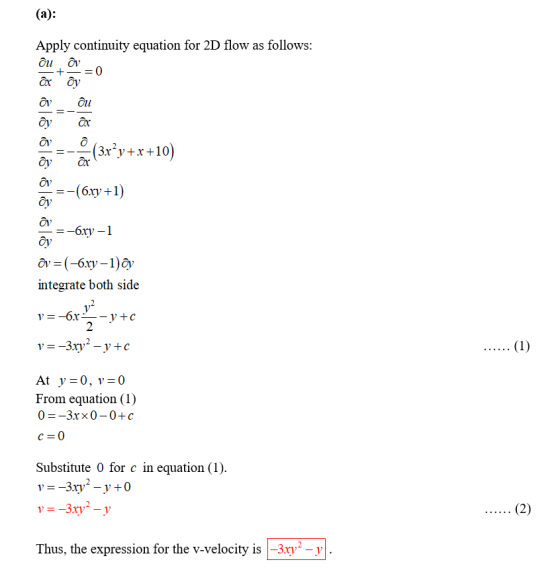
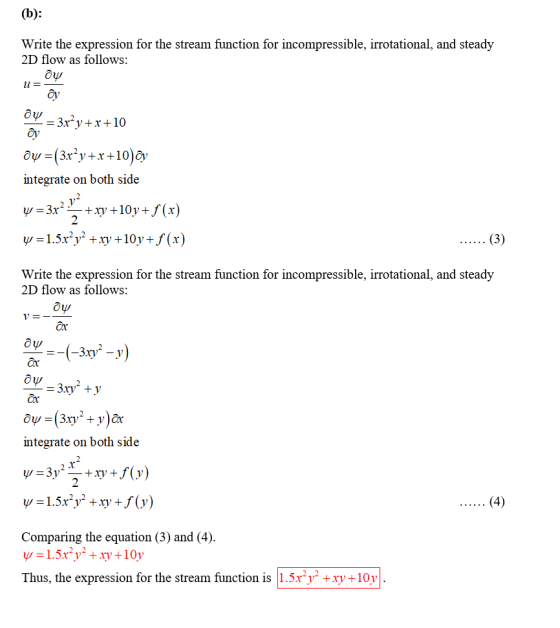
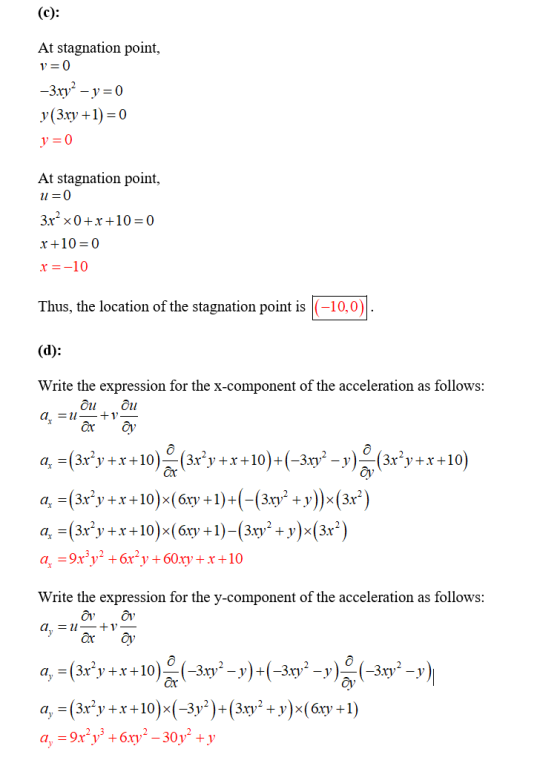
 6. An experimentalist has measured the u-velocity component of a steady, two- dimensional flow field. It is approximated by u 3x2y x 10 It is also known that the v-velocity is zero along the line y-O. a) Find an expression for the v-velocity in the entire field b) Find an expression for the streamfunction, 11, for this flow c) Determine the location of any stagnation points in the flow (stagnation means V-0) d) Calculate the acceleration field (ax and ay)...
The y component of velocity in a steady, incompressible flow field in the xy plane is...
The y component of velocity in a steady, incompressible flow field in the xy plane is v = -Bxy3, where B = 0.7 m-3 · s-1, and x and y are measured in meters. (a) Find the simplest x component of velocity for this flow field. (b) Find the equation of the streamlines for this flow (use C as constant).
Advanced Fluid Mechanics Determine the streamfunction and velocity potential for uniform flow of strength U over a p...
 Advanced Fluid Mechanics
Determine the streamfunction and velocity potential for uniform flow of strength U over a point source and sink of equal strength, m, located on the x-axis at +/-b (the source is at-b with the sink at +b, where b is not small). Write expressions for the u and v velocity components, and draw streamlines of the flow. Determine the location(s) of any and all stagnation points.
Determine the streamfunction and velocity potential for uniform flow of strength...
Advanced Fluid Mechanics
Determine the streamfunction and velocity potential for uniform flow of strength U over a point source and sink of equal strength, m, located on the x-axis at +/-b (the source is at-b with the sink at +b, where b is not small). Write expressions for the u and v velocity components, and draw streamlines of the flow. Determine the location(s) of any and all stagnation points.
Determine the streamfunction and velocity potential for uniform flow of strength...
C- A steady, incompressible, two-dimensional velocity field of a fluid is given by に(u, v) =...
 C- A steady, incompressible, two-dimensional velocity field of a fluid is given by に(u, v) = (0.5 + 0.8x) velocity is in m/s. Determine: i+(1.5-0.8y) j where the x- and y-coordinates are in meters and the of 1-The stagnation point of the flow 2-The material acceleration at the point (x 2 m, y - 3m).
The components of a velocity field are given by u = x + y, and v...
The components of a velocity field are given by u = x + y, and v = xy3 + 81 and w = 0. Determine the location of the stagnation point (V = 0) in the flow field where y is positive
A two-dimensional unsteady flow with velocity V = ui + vj has the velocity component u...
A two-dimensional unsteady flow with velocity V = ui + vj has the velocity component u = 1, v = cos(t) 1. Derive the streamline y(x) that goes through point (0, 0) at time t = 0 (the final expression for y should be a function of x only). Sketch the result. 2. Derive the pathline y(x) of the fluid particle that goes through point (0, 0) at t = 0 (the final expression for y should be a function...
A two-dimensional unsteady flow with velocity V = ui + vj has the velocity component u...
A two-dimensional unsteady flow with velocity V = ui + vj has the velocity component u = 1, v = cos(t) Derive the pathline y(x) of the fluid particle that goes through point (0, 0) at t = 0 (the final expression for y should be a function of x only). Sketch the result.
Consider the following steady, two-dimensional velocity field: V(u,v) = (0.51 + 2.1x)i + (−3.4 – 2.1y)j...
Consider the following steady, two-dimensional velocity field: V(u,v) = (0.51 + 2.1x)i + (−3.4 – 2.1y)j where V(u,v) is the velocity field vector and i and j are the standard unit vectors. The locations of the stagnation points are:
Consider incompressible, steady, inviscid flow at vertical velocity vo though a porous surface into a narrow...
 Consider incompressible, steady, inviscid flow at vertical velocity vo though a porous surface into a narrow gap of height h, as shown. Assume that the flow is 2D planar, so neglect any variations or velocity components in the z direction. Find the x-component of velocity, assuming uniform flow at every x location. Find the y-component of velocity. Find an expression for the pressure variation, assuming that the pressure at the outer edge of the gap is Parm (hint: we can...
The radial component of a velocity field in an incompressible, 2D, flow field is measured to...
 The radial component of a velocity field in an incompressible, 2D, flow field is measured to be Use the continuity equation to calculate ve
 6. An experimentalist has measured the u-velocity component of a steady, two- dimensional flow field. It is approximated by u 3x2y x 10 It is also known that the v-velocity is zero along the line y-O. a) Find an expression for the v-velocity in the entire field b) Find an expression for the streamfunction, 11, for this flow c) Determine the location of any stagnation points in the flow (stagnation means V-0) d) Calculate the acceleration field (ax and ay)...
 Advanced Fluid Mechanics
Determine the streamfunction and velocity potential for uniform flow of strength U over a point source and sink of equal strength, m, located on the x-axis at +/-b (the source is at-b with the sink at +b, where b is not small). Write expressions for the u and v velocity components, and draw streamlines of the flow. Determine the location(s) of any and all stagnation points.
Determine the streamfunction and velocity potential for uniform flow of strength...
Advanced Fluid Mechanics
Determine the streamfunction and velocity potential for uniform flow of strength U over a point source and sink of equal strength, m, located on the x-axis at +/-b (the source is at-b with the sink at +b, where b is not small). Write expressions for the u and v velocity components, and draw streamlines of the flow. Determine the location(s) of any and all stagnation points.
Determine the streamfunction and velocity potential for uniform flow of strength...
 C- A steady, incompressible, two-dimensional velocity field of a fluid is given by に(u, v) = (0.5 + 0.8x) velocity is in m/s. Determine: i+(1.5-0.8y) j where the x- and y-coordinates are in meters and the of 1-The stagnation point of the flow 2-The material acceleration at the point (x 2 m, y - 3m).
 Consider incompressible, steady, inviscid flow at vertical velocity vo though a porous surface into a narrow gap of height h, as shown. Assume that the flow is 2D planar, so neglect any variations or velocity components in the z direction. Find the x-component of velocity, assuming uniform flow at every x location. Find the y-component of velocity. Find an expression for the pressure variation, assuming that the pressure at the outer edge of the gap is Parm (hint: we can...
 The radial component of a velocity field in an incompressible, 2D, flow field is measured to be Use the continuity equation to calculate ve
Most questions answered within 3 hours.
-
Where is the error in this code sequence?
String s1 = "Hello";
String s2 = "ello";...
asked 10 months ago -
Financial data for Joel de Paris, Inc., for last year
follow:
Joel de Paris, Inc.
Balance...
asked 10 months ago -
Consider this reaction:
Al2(SO4)3 (aq)+ BaCl3
(aq) Al2Cl6 (aq)- +
3BaSO4(s) . What is the...
asked 10 months ago -
Suppose that Savneet is considering increasing her
recent random sample from 20 car rentals to 40...
asked 10 months ago -
Trucks arrive at an unloading terminal at an average rate of 120
per hour.
Trucks arrive...
asked 10 months ago -
Why are methanol and ethanol completely soluble in water while
octanol is not very little soluble....
asked 10 months ago -
A facilities manager at a university reads in a research report
that the mean amount of...
asked 10 months ago -
When the CuSO4 is rehydrated by adding water to the anhydrous
compound, is this an endothermic...
asked 10 months ago -
A ray of sunlight is passing from diamond into crown glass; the
angle of incidence is...
asked 10 months ago -
A block of mass 0.249 kg is placed on top of a light, vertical
spring of...
asked 10 months ago -
how do the kidneys compensate in the presences of acidosis
a) trigger hyperventilate
b) reserve acid...
asked 10 months ago -
Question 501 pts
The rental rate of capital to the firm increases. Which of the
following...
asked 10 months ago