need a clear explantion for the velocity, accelcation, and how
to get the angles please step by step.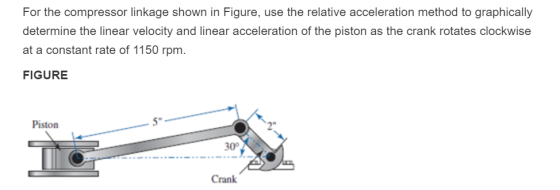
Homework Answers

Add Answer to:
need a clear explantion for the velocity, accelcation, and how
to get the angles please step...
In the engine system shown, 1 - 160 mm and b 60 mm. Knowing that crank AB rotates with a constant...
 can you work it out step by step please. I really need
help
In the engine system shown, 1 - 160 mm and b 60 mm. Knowing that crank AB rotates with a constant angular velocity of 1000 rpm clockwise, use computational software to determine and plot for values of 0 from 0 to 180° and using 10° increments, (a) the angular velocity and angular acceleration of rod BD, (b) the velocity and acceleration of the piston F.
In the...
can you work it out step by step please. I really need
help
In the engine system shown, 1 - 160 mm and b 60 mm. Knowing that crank AB rotates with a constant angular velocity of 1000 rpm clockwise, use computational software to determine and plot for values of 0 from 0 to 180° and using 10° increments, (a) the angular velocity and angular acceleration of rod BD, (b) the velocity and acceleration of the piston F.
In the...
I need this project Manual and simulation solution
 An internal combustion engine slider-crank mechanism is shown in the figure. Crank AB rotates in selected clockwise positive direction as shown. Piston position is Y=AD. is angular position of the crank, is angular velocity of the crank, is angular acceleration of the crank. A-Analytical formulations part: 1) With the given parameters find analytical expressions for :a) Piston position, Y [mm]b) Piston velocity, [mm/s]c) Piston acceleration [mm/s2].(Show all the details of the derivations including your figure with given coordinate directions etc.) B-Computer Simulations part: 2) ...
please explain your work Problem 3: Crank arm OB rotates about point with a constant clockwise...
 please explain your work
Problem 3: Crank arm OB rotates about point with a constant clockwise angular velocity of 990 rpm. TE connecting link AB drives the piston A. Ifr = 5 inches and I = 12 inches, determine the following when 0 = 60°: (a) the angular velocity and the angular acceleration of the connecting link. (6) the velocity and the acceleration of the piston.
please explain your work
Problem 3: Crank arm OB rotates about point with a constant clockwise angular velocity of 990 rpm. TE connecting link AB drives the piston A. Ifr = 5 inches and I = 12 inches, determine the following when 0 = 60°: (a) the angular velocity and the angular acceleration of the connecting link. (6) the velocity and the acceleration of the piston.
Could i get help writing the code for this question in matlab? An internal combustion engine...
 Could i get help writing the code for this question in
matlab?
An internal combustion engine slider-crank mechanism is shown in the figure. Crank AB rotates in selected clockwise positive direction as shown. Piston position is Y=AD. o(t) is angular position of the crank, 0(t) is angular velocity of the crank, ő is angular acceleration of the crank. Crank AB rotates with a constant angular velocity of 5 rad/s clockwise in positive O direction as shown. Perform computer simulations using...
Could i get help writing the code for this question in
matlab?
An internal combustion engine slider-crank mechanism is shown in the figure. Crank AB rotates in selected clockwise positive direction as shown. Piston position is Y=AD. o(t) is angular position of the crank, 0(t) is angular velocity of the crank, ő is angular acceleration of the crank. Crank AB rotates with a constant angular velocity of 5 rad/s clockwise in positive O direction as shown. Perform computer simulations using...
Need help ... Need to solve it in vector form OA-100 OB-200 Dimensions in mm The...
 Need help ... Need to solve it in vector form
OA-100 OB-200 Dimensions in mm The collar A slides on the pivoted arm BC and is pinned to the crank OA as shown in Figure. At the instant shown, crank OA rotates at a constant angular velocity of 2 rad/s clockwise Determine the angular velocity and angular acceleration of arm BC when θ-45"
Need help ... Need to solve it in vector form
OA-100 OB-200 Dimensions in mm The collar A slides on the pivoted arm BC and is pinned to the crank OA as shown in Figure. At the instant shown, crank OA rotates at a constant angular velocity of 2 rad/s clockwise Determine the angular velocity and angular acceleration of arm BC when θ-45"
2) (120 pts) After successfully landing on the planet Mars, some scientists want to experimentally test the compressor mechanism given below. The compressor mechanism shown below is driven clockw...
 2) (120 pts) After successfully landing on the planet Mars, some scientists want to experimentally test the compressor mechanism given below. The compressor mechanism shown below is driven clockwise by a DC electric motor at a constant rate of 800 rpm, and accelerating at 1000 rad/s'. In the position shown, the cylinder pressure is 70 psi, and the plston weighs 2 lb. The coefficient of friction between the piston and the compressor cylinder is 0.5. The weight of all other...
can you please prioritize #4 Piston velocity Y [mm/s] vs 0 [rad] Piston acceleration ï [mm/s?]...
 can you please prioritize #4
Piston velocity Y [mm/s] vs 0 [rad] Piston acceleration ï [mm/s?] vs 0 [rad] 4) Crank AB rotates starting from rest with a constant angular acceleration of 0.25 rad/sec (= 0.25 rad/sec ) clockwise in positive direction as shown Perform computer simulations using above formulas to plot Piston displacement - Y [mm] vs Time [sec] Piston velocity Y [mm/s] vs Time [sec] Piston acceleration Y [mm/s?] vs Time [sec] Р 150 mm 5) Crank AB...
can you please prioritize #4
Piston velocity Y [mm/s] vs 0 [rad] Piston acceleration ï [mm/s?] vs 0 [rad] 4) Crank AB rotates starting from rest with a constant angular acceleration of 0.25 rad/sec (= 0.25 rad/sec ) clockwise in positive direction as shown Perform computer simulations using above formulas to plot Piston displacement - Y [mm] vs Time [sec] Piston velocity Y [mm/s] vs Time [sec] Piston acceleration Y [mm/s?] vs Time [sec] Р 150 mm 5) Crank AB...
Part A Q1: The crank OP of a mechanism as shown in figure below rotates uniformly...
 Part A
Q1: The crank OP of a mechanism as shown in figure below rotates uniformly at 60 rpm counter-clockwise. Various links have following dimensions: OP = 50 mm; RQ= 200 mm; RS = 200 mm; PR = 300 mm a) Make appropriate scale to draw position diagram using graphical method. b) Find the linear velocities (mm/sec) and angular velocities (rad/sec) for all links and draw velocity diagram. c) Find the tangential accelerations (mm/sec) and radial acceleration (mm/sec) and angular...
Part A
Q1: The crank OP of a mechanism as shown in figure below rotates uniformly at 60 rpm counter-clockwise. Various links have following dimensions: OP = 50 mm; RQ= 200 mm; RS = 200 mm; PR = 300 mm a) Make appropriate scale to draw position diagram using graphical method. b) Find the linear velocities (mm/sec) and angular velocities (rad/sec) for all links and draw velocity diagram. c) Find the tangential accelerations (mm/sec) and radial acceleration (mm/sec) and angular...
PLEASE SHOW ACCURATE STEP-BY-STEP SOLUTION . Question 20 ar BDE is attached to two links AB...
 PLEASE SHOW ACCURATE STEP-BY-STEP SOLUTION
.
Question 20 ar BDE is attached to two links AB and CD. Knowing that at the instant shown link AB rotates with a constant angular velocity of 6 rad/s clockwise, determine the angular acceleration of link CD 240 mm 150 rm 150 mm 180m
PLEASE SHOW ACCURATE STEP-BY-STEP SOLUTION
.
Question 20 ar BDE is attached to two links AB and CD. Knowing that at the instant shown link AB rotates with a constant angular velocity of 6 rad/s clockwise, determine the angular acceleration of link CD 240 mm 150 rm 150 mm 180m
Q1: The crank OP of a mechanism as shown in figure below rotates uniformly at 60...
 Q1: The crank OP of a mechanism as shown in figure below rotates uniformly at 60 rpm counter-clockwise. Various links have following dimensions: OP - 50 mm; RQ-200 mm; RS - 200 mm; PR = 300 mm a) Make appropriate scale to draw position diagram using graphical method. b) Find the linear velosities (mm/sec) and angular velosities (rad/sec) for all links and draw velocity diagram. c) Find the tangential accelerations (mm/sec) and radial acceleration (mm/sec) and angular accelerations (rad/sec) for...
 can you work it out step by step please. I really need
help
In the engine system shown, 1 - 160 mm and b 60 mm. Knowing that crank AB rotates with a constant angular velocity of 1000 rpm clockwise, use computational software to determine and plot for values of 0 from 0 to 180° and using 10° increments, (a) the angular velocity and angular acceleration of rod BD, (b) the velocity and acceleration of the piston F.
In the...
can you work it out step by step please. I really need
help
In the engine system shown, 1 - 160 mm and b 60 mm. Knowing that crank AB rotates with a constant angular velocity of 1000 rpm clockwise, use computational software to determine and plot for values of 0 from 0 to 180° and using 10° increments, (a) the angular velocity and angular acceleration of rod BD, (b) the velocity and acceleration of the piston F.
In the...
 please explain your work
Problem 3: Crank arm OB rotates about point with a constant clockwise angular velocity of 990 rpm. TE connecting link AB drives the piston A. Ifr = 5 inches and I = 12 inches, determine the following when 0 = 60°: (a) the angular velocity and the angular acceleration of the connecting link. (6) the velocity and the acceleration of the piston.
please explain your work
Problem 3: Crank arm OB rotates about point with a constant clockwise angular velocity of 990 rpm. TE connecting link AB drives the piston A. Ifr = 5 inches and I = 12 inches, determine the following when 0 = 60°: (a) the angular velocity and the angular acceleration of the connecting link. (6) the velocity and the acceleration of the piston.
 Could i get help writing the code for this question in
matlab?
An internal combustion engine slider-crank mechanism is shown in the figure. Crank AB rotates in selected clockwise positive direction as shown. Piston position is Y=AD. o(t) is angular position of the crank, 0(t) is angular velocity of the crank, ő is angular acceleration of the crank. Crank AB rotates with a constant angular velocity of 5 rad/s clockwise in positive O direction as shown. Perform computer simulations using...
Could i get help writing the code for this question in
matlab?
An internal combustion engine slider-crank mechanism is shown in the figure. Crank AB rotates in selected clockwise positive direction as shown. Piston position is Y=AD. o(t) is angular position of the crank, 0(t) is angular velocity of the crank, ő is angular acceleration of the crank. Crank AB rotates with a constant angular velocity of 5 rad/s clockwise in positive O direction as shown. Perform computer simulations using...
 Need help ... Need to solve it in vector form
OA-100 OB-200 Dimensions in mm The collar A slides on the pivoted arm BC and is pinned to the crank OA as shown in Figure. At the instant shown, crank OA rotates at a constant angular velocity of 2 rad/s clockwise Determine the angular velocity and angular acceleration of arm BC when θ-45"
Need help ... Need to solve it in vector form
OA-100 OB-200 Dimensions in mm The collar A slides on the pivoted arm BC and is pinned to the crank OA as shown in Figure. At the instant shown, crank OA rotates at a constant angular velocity of 2 rad/s clockwise Determine the angular velocity and angular acceleration of arm BC when θ-45"
 2) (120 pts) After successfully landing on the planet Mars, some scientists want to experimentally test the compressor mechanism given below. The compressor mechanism shown below is driven clockwise by a DC electric motor at a constant rate of 800 rpm, and accelerating at 1000 rad/s'. In the position shown, the cylinder pressure is 70 psi, and the plston weighs 2 lb. The coefficient of friction between the piston and the compressor cylinder is 0.5. The weight of all other...
 can you please prioritize #4
Piston velocity Y [mm/s] vs 0 [rad] Piston acceleration ï [mm/s?] vs 0 [rad] 4) Crank AB rotates starting from rest with a constant angular acceleration of 0.25 rad/sec (= 0.25 rad/sec ) clockwise in positive direction as shown Perform computer simulations using above formulas to plot Piston displacement - Y [mm] vs Time [sec] Piston velocity Y [mm/s] vs Time [sec] Piston acceleration Y [mm/s?] vs Time [sec] Р 150 mm 5) Crank AB...
can you please prioritize #4
Piston velocity Y [mm/s] vs 0 [rad] Piston acceleration ï [mm/s?] vs 0 [rad] 4) Crank AB rotates starting from rest with a constant angular acceleration of 0.25 rad/sec (= 0.25 rad/sec ) clockwise in positive direction as shown Perform computer simulations using above formulas to plot Piston displacement - Y [mm] vs Time [sec] Piston velocity Y [mm/s] vs Time [sec] Piston acceleration Y [mm/s?] vs Time [sec] Р 150 mm 5) Crank AB...
 Part A
Q1: The crank OP of a mechanism as shown in figure below rotates uniformly at 60 rpm counter-clockwise. Various links have following dimensions: OP = 50 mm; RQ= 200 mm; RS = 200 mm; PR = 300 mm a) Make appropriate scale to draw position diagram using graphical method. b) Find the linear velocities (mm/sec) and angular velocities (rad/sec) for all links and draw velocity diagram. c) Find the tangential accelerations (mm/sec) and radial acceleration (mm/sec) and angular...
Part A
Q1: The crank OP of a mechanism as shown in figure below rotates uniformly at 60 rpm counter-clockwise. Various links have following dimensions: OP = 50 mm; RQ= 200 mm; RS = 200 mm; PR = 300 mm a) Make appropriate scale to draw position diagram using graphical method. b) Find the linear velocities (mm/sec) and angular velocities (rad/sec) for all links and draw velocity diagram. c) Find the tangential accelerations (mm/sec) and radial acceleration (mm/sec) and angular...
 PLEASE SHOW ACCURATE STEP-BY-STEP SOLUTION
.
Question 20 ar BDE is attached to two links AB and CD. Knowing that at the instant shown link AB rotates with a constant angular velocity of 6 rad/s clockwise, determine the angular acceleration of link CD 240 mm 150 rm 150 mm 180m
PLEASE SHOW ACCURATE STEP-BY-STEP SOLUTION
.
Question 20 ar BDE is attached to two links AB and CD. Knowing that at the instant shown link AB rotates with a constant angular velocity of 6 rad/s clockwise, determine the angular acceleration of link CD 240 mm 150 rm 150 mm 180m
 Q1: The crank OP of a mechanism as shown in figure below rotates uniformly at 60 rpm counter-clockwise. Various links have following dimensions: OP - 50 mm; RQ-200 mm; RS - 200 mm; PR = 300 mm a) Make appropriate scale to draw position diagram using graphical method. b) Find the linear velosities (mm/sec) and angular velosities (rad/sec) for all links and draw velocity diagram. c) Find the tangential accelerations (mm/sec) and radial acceleration (mm/sec) and angular accelerations (rad/sec) for...
Most questions answered within 3 hours.
-
Where is the error in this code sequence?
String s1 = "Hello";
String s2 = "ello";...
asked 10 months ago -
Financial data for Joel de Paris, Inc., for last year
follow:
Joel de Paris, Inc.
Balance...
asked 10 months ago -
Consider this reaction:
Al2(SO4)3 (aq)+ BaCl3
(aq) Al2Cl6 (aq)- +
3BaSO4(s) . What is the...
asked 10 months ago -
Suppose that Savneet is considering increasing her
recent random sample from 20 car rentals to 40...
asked 10 months ago -
Trucks arrive at an unloading terminal at an average rate of 120
per hour.
Trucks arrive...
asked 10 months ago -
Why are methanol and ethanol completely soluble in water while
octanol is not very little soluble....
asked 10 months ago -
A facilities manager at a university reads in a research report
that the mean amount of...
asked 10 months ago -
When the CuSO4 is rehydrated by adding water to the anhydrous
compound, is this an endothermic...
asked 10 months ago -
A ray of sunlight is passing from diamond into crown glass; the
angle of incidence is...
asked 10 months ago -
A block of mass 0.249 kg is placed on top of a light, vertical
spring of...
asked 10 months ago -
how do the kidneys compensate in the presences of acidosis
a) trigger hyperventilate
b) reserve acid...
asked 10 months ago -
Question 501 pts
The rental rate of capital to the firm increases. Which of the
following...
asked 10 months ago