
Homework Answers
Ans:
Using third kinematical equation,

Putting all the values,
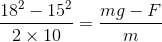
Here , F is the constant force,

78.4 - F = 39.6
F = 38.8 N
Add Answer to:
a
ball with mass of 8.00kg...
2. A ball with mass of 8.00 kg is thrown...
A block with mass 0.400 kg is on a horizontal frictionless surface and is attached to...
A block with mass 0.400 kg is on a horizontal frictionless surface and is attached to a horizontal compressed spring that has force constant k=200 N/m. The other end of the spring is attached to a wall. The block is released, and it moves back and forth on the end of the spring. During this motion the block has speed 3.00 m/s when the spring is stretched 0.160 m. (a) During the motion of the block, what is its maximum...
A mass of 9 kg is placed on a horizontal frictionless surface and attached to a...
A mass of 9 kg is placed on a horizontal frictionless surface and attached to a spring. The mass is compressed 0.69 meters on the spring from equilibrium and held still. It is then released and it travels across the horizontal surface, around a frictionless quarter circular ramp, and it is launched into the air vertically and reaches a maximum height of 6 meters above the ground. The same mass is then attached to the same spring and hung vertically...
A 0.82 kg mass is attached to the end of a spring and set into oscillation...
 A 0.82 kg mass is attached to the end of a spring and set into oscillation on a horizontal frictionless surface by releasing it from a compressed position. The record of time is started when the oscillating mass passes through the equilibrium position and the position of the mass at any time is shown in the drawing. Determine the following. amplitude A of the motion m angular frequency omega rad/s spring constant k N/m speed of the object at t=...
A 0.81-kg mass is attached to the end of a spring and set into oscillation on...
 A 0.81-kg mass is attached to the end of a spring and set into oscillation on a horizontal frictionless surface by releasing it from a compressed position. The record of time is started when the oscillating mass passes through the equilibrium position and the position of the mass at any time is shown in the drawing, x (m) 0.10 --- 04 16.0 -0.10 - - - - - - Determine the following. (a) amplitude A of the motion (b) angular...
A 3kg mass sliding on a frictionless horizontal surface with a speed of 3m/s eventually collided...
A 3kg mass sliding on a frictionless horizontal surface with a speed of 3m/s eventually collided with a spring that is attached to a rigid wall. The spring has a spring constant of 3N/m. The masses will compress the spring, and eventually get pushed back away from the wall. A) what will the final speed of the be after it gets pushed back outward? Explain B) By what length is the spring maximally compressed? C) What will the magnitude of...
A small ball of mass = 0.1 kg is attached to a small spring of stiffness...
A small ball of mass = 0.1 kg is attached to a small spring of stiffness = 10 kN×m-1 that has been compressed a distance = 8 mm. The spring is housed at one end of a box of length = 1 m and mass = 1 kg that is, in turn, resting on a smooth horizontal table. The spring is then released and the ball travels to the other end of the box where it sticks to the surface....
A small ball is attached to one end of a spring that has an unstrained length...
 A small ball is attached to one end of a spring that has an unstrained length of 0.222 m. The spring is held by the other end, and the ball is whirled around in a horizontal circle at a speed of 3.20 m/s. The spring remains nearly parallel to the ground during the motion and is observed to stretch by 0.0197 m. By how much would the spring stretch if it were attached to the ceiling and the ball allowed...
A small ball is attached to one end of a spring that has an unstrained length...
A small ball is attached to one end of a spring that has an unstrained length of 0.257 m. The spring is held by the other end, and the ball is whirled around in a horizontal circle at a speed of 4.05 m/s. The spring remains nearly parallel to the ground during the motion and is observed to stretch by 0.0101 m. By how much would the spring stretch if it were attached to the ceiling and the ball allowed...
A 0.33-kg mass is attached to the end of a spring and set into oscillation on...
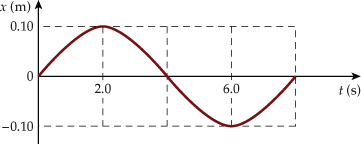 A 0.33-kg mass is attached to the end of a spring and set into
oscillation on a horizontal frictionless surface by releasing it
from a compressed position. The record of time is started when the
oscillating mass passes through the equilibrium position and the
position of the mass at any time is shown in the drawing.
https://www.webassign.net/webassignalgphys1/16-p-027.gif
Coordinates at (0,0), (2.0,.10), (3,0), (6.0,-.10)
Determine the following.
(a) amplitude A of the motion
.1 m
(b) angular frequency ω
How is...
A 0.33-kg mass is attached to the end of a spring and set into
oscillation on a horizontal frictionless surface by releasing it
from a compressed position. The record of time is started when the
oscillating mass passes through the equilibrium position and the
position of the mass at any time is shown in the drawing.
https://www.webassign.net/webassignalgphys1/16-p-027.gif
Coordinates at (0,0), (2.0,.10), (3,0), (6.0,-.10)
Determine the following.
(a) amplitude A of the motion
.1 m
(b) angular frequency ω
How is...
1. In 0.720 s, a 6.95-kg block is pulled through a distance of 3.70 m on...
1. In 0.720 s, a 6.95-kg block is pulled through a distance of 3.70 m on a frictionless horizontal surface, starting from rest. The block has a constant acceleration and is pulled by means of a horizontal spring that is attached to the block. The spring constant of the spring is 460 N/m. By how much does the spring stretch in kg? 2. An object attached to a horizontal spring is oscillating back and forth along a frictionless surface. The...
 A 0.82 kg mass is attached to the end of a spring and set into oscillation on a horizontal frictionless surface by releasing it from a compressed position. The record of time is started when the oscillating mass passes through the equilibrium position and the position of the mass at any time is shown in the drawing. Determine the following. amplitude A of the motion m angular frequency omega rad/s spring constant k N/m speed of the object at t=...
 A 0.81-kg mass is attached to the end of a spring and set into oscillation on a horizontal frictionless surface by releasing it from a compressed position. The record of time is started when the oscillating mass passes through the equilibrium position and the position of the mass at any time is shown in the drawing, x (m) 0.10 --- 04 16.0 -0.10 - - - - - - Determine the following. (a) amplitude A of the motion (b) angular...
 A small ball is attached to one end of a spring that has an unstrained length of 0.222 m. The spring is held by the other end, and the ball is whirled around in a horizontal circle at a speed of 3.20 m/s. The spring remains nearly parallel to the ground during the motion and is observed to stretch by 0.0197 m. By how much would the spring stretch if it were attached to the ceiling and the ball allowed...
Most questions answered within 3 hours.
-
Where is the error in this code sequence?
String s1 = "Hello";
String s2 = "ello";...
asked 11 months ago -
Financial data for Joel de Paris, Inc., for last year
follow:
Joel de Paris, Inc.
Balance...
asked 11 months ago -
Consider this reaction:
Al2(SO4)3 (aq)+ BaCl3
(aq) Al2Cl6 (aq)- +
3BaSO4(s) . What is the...
asked 11 months ago -
Suppose that Savneet is considering increasing her
recent random sample from 20 car rentals to 40...
asked 11 months ago -
Trucks arrive at an unloading terminal at an average rate of 120
per hour.
Trucks arrive...
asked 11 months ago -
Why are methanol and ethanol completely soluble in water while
octanol is not very little soluble....
asked 11 months ago -
A facilities manager at a university reads in a research report
that the mean amount of...
asked 11 months ago -
When the CuSO4 is rehydrated by adding water to the anhydrous
compound, is this an endothermic...
asked 11 months ago -
A ray of sunlight is passing from diamond into crown glass; the
angle of incidence is...
asked 11 months ago -
A block of mass 0.249 kg is placed on top of a light, vertical
spring of...
asked 11 months ago -
how do the kidneys compensate in the presences of acidosis
a) trigger hyperventilate
b) reserve acid...
asked 11 months ago -
Question 501 pts
The rental rate of capital to the firm increases. Which of the
following...
asked 11 months ago