
Homework Answers

Add Answer to:
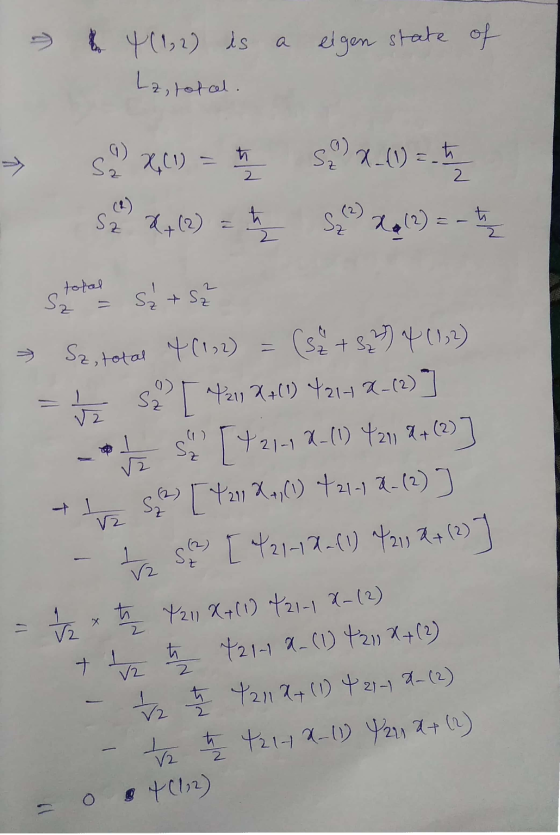
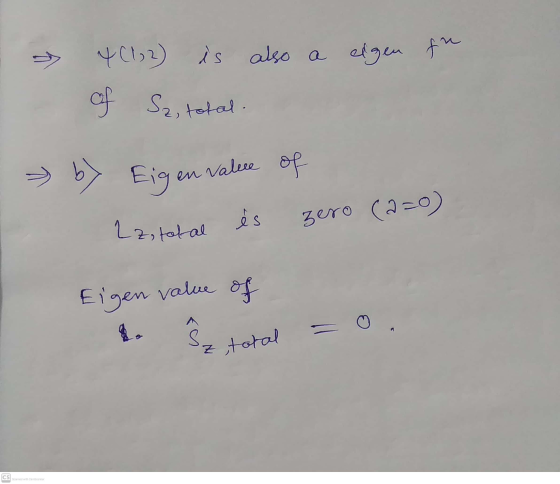
1. (30 pt) Consider the atomic wave function Y(1,2) 1.14211X+(1) 421-1X-(1) VE 14211X+(2) 421-1X-(2)|| where 421+1...
Consider the following wave function: y(x, t) = cos(kx - omega t). a. Show that the...
 Consider the following wave function: y(x, t) = cos(kx - omega t). a. Show that the above function is an eigenfunction of the operator partialdifferential^2/partialdifferential x^2[...] and determine its eigenvalue. b. Show that the above function is a solution of the wave equation expressed as partialdifferential^2 y(x, t)/partialdifferential x^2 = 1/v^2 partialdifferential^2 y(x, t)/partialdifferential t^2, given the wave velocity is v = omega/k (where omega = 2 pi V and k = 2pi/lambda).
Consider the excited state wave function for He atom given by the following Slater determinant 1...
 Consider the excited state wave function for He atom given by the following Slater determinant 1 432,0(1) V3.2,-2B(1) He (1,2)= V2 V3.2,a(2) W32,-2B(2) Here Y 3,2,-and Y3,2,-2 are hydrogenic wave functions (with Z = 2, see the equation sheet). Show that He (1, 2) is an eigenfunction of Î. = Î., +Î.2. What is the eigenvalue? Î.,, ..2, and Î, are the z-components of the orbital angular momentum operators for electrons 1 and 2, and the z-component of the total...
a) Show that the wave function y(x) = N exp( – x²/(2a?)) with a? = ()...
 a) Show that the wave function y(x) = N exp( – x²/(2a?)) with a? = () is a solution of the Schrödinger equation for harmonic oscillator with potential V(x) = k x2/2. (10 pt) b) What is the energy of harmonic oscillator with the wave function y(x) in terms of k and m? (5 pt) c) Sketch the potential energy of harmonic oscillator, the energy level corresponding to y(x), the wave function (x), and the probability density associated with y(x)...
3. Consider the wave function ψ(x)- 슬 읔 ets, where σ s a real valued constant...
 3. Consider the wave function ψ(x)- 슬 읔 ets, where σ s a real valued constant (a) Calculate the expectation value of K). K (b) Estimate the uncertainty Δ.r and Ap using Δ.1-V (.12)-(A)2. 4. Consider the eigenfunctions of the moment uni operator y p r her (a) Show that p,(r) is an eigenfunction of p with an cigenvalue p. (b) Find the coeflicients. w, in the espansion of (r)( upypp ) using the momentum eigenfunctions.
Consider the harmonic oscillator wave function 1/4 where α = (-)"*. Here k, is the stiffness...
 Consider the harmonic oscillator wave function 1/4 where α = (-)"*. Here k, is the stiffness coefficient of the oscillator and m is mass. Recall that the oscillation frequency iso,s:,k, / m In class we showed that Ψ0(x) Is an eigenfunction of the Hamiltonian, with an eigenvalue Eo (1/2)ha a) Normalize the wave function in Eq.(1) b) Graph the probability density. Note that a has units of length and measures the "width" of the wave function. It's easier to use...
1. Show y = sin ax is not an eigenfunction of the operator d/dx, but is...
 1. Show y = sin ax is not an eigenfunction of the operator d/dx, but is an eigenfunction of the operator da/dx. 2. Show that the function 0 = Aeimo , where i, m, and A are constants, is an eigenfunction of the angular momentum operator is the z-direction: M =; 2i ap' and what are the eigenvalues? 3. Show the the function y = Jź sin MA where n and L are constants, is an eigenfunction of the Hamiltonian...
Consider an autonomous ODE y = f(y) where f(y) = y2 - 1 A. (1 pt)...
 Consider an autonomous ODE y = f(y) where f(y) = y2 - 1 A. (1 pt) Draw the graph of function f(y) in the y,y plane and specify the points y where f(y) is singular (that is, f(y) takes an infinite value). B. (1 pt) Finf the equilibrium solution and determine its type: stable, un- stable or semi-stable. Indicate on which side it attracts/repels nearby solutions. C. (2 pt) By separating y and t, specify the general solution y=yt,C) t+C...
4. An orbital of atomic hydrogen is described by the wave function, ¥(,0,4) = (20 -...
 4. An orbital of atomic hydrogen is described by the wave function, ¥(,0,4) = (20 - 4) ze zo cos e (a) Consider the radial part, R(r), of this orbital. By considering the values of r for which R(r) = 0 identify the number of radial nodes (points where the R(r) = 0 when r IS NOT equal to 0 or oo). [3 marks) ( Consider the angular part, Y (0.). of this orbital. By considering the values of 0...
(a) Show that (@) = sin e- is an eigenfunction of both Î, and Î", where...
 (a) Show that (@) = sin e- is an eigenfunction of both Î, and Î", where = -1 1 a 1 22 sin + sin 020 sin0 and derive the corresponding eigenvalues. You may use the identity 1 a 1 sin sin 2 sin sin 0 80 sino 31 (sin 00 (5 marks) (6) Consider the function $(,0,4)= A - 1/200 sin 6e-ip, 20 where A is a constant and an is the Bohr radius. This is a hydrogen atom...
4 Consider the system represented in state variable form 0 x+ 2 y [1-1x +[0]u B...
 4 Consider the system represented in state variable form 0 x+ 2 y [1-1x +[0]u B C(sl- A) Show that a transfer function is related to the state equation by H(s) a) D, and find the transfer function for the system above. (5 marks) Sketch the Bode plot. b) (5 marks)
4 Consider the system represented in state variable form 0 x+ 2 y [1-1x +[0]u B C(sl- A) Show that a transfer function is related to the state equation...
4 Consider the system represented in state variable form 0 x+ 2 y [1-1x +[0]u B C(sl- A) Show that a transfer function is related to the state equation by H(s) a) D, and find the transfer function for the system above. (5 marks) Sketch the Bode plot. b) (5 marks)
4 Consider the system represented in state variable form 0 x+ 2 y [1-1x +[0]u B C(sl- A) Show that a transfer function is related to the state equation...
 Consider the following wave function: y(x, t) = cos(kx - omega t). a. Show that the above function is an eigenfunction of the operator partialdifferential^2/partialdifferential x^2[...] and determine its eigenvalue. b. Show that the above function is a solution of the wave equation expressed as partialdifferential^2 y(x, t)/partialdifferential x^2 = 1/v^2 partialdifferential^2 y(x, t)/partialdifferential t^2, given the wave velocity is v = omega/k (where omega = 2 pi V and k = 2pi/lambda).
 Consider the excited state wave function for He atom given by the following Slater determinant 1 432,0(1) V3.2,-2B(1) He (1,2)= V2 V3.2,a(2) W32,-2B(2) Here Y 3,2,-and Y3,2,-2 are hydrogenic wave functions (with Z = 2, see the equation sheet). Show that He (1, 2) is an eigenfunction of Î. = Î., +Î.2. What is the eigenvalue? Î.,, ..2, and Î, are the z-components of the orbital angular momentum operators for electrons 1 and 2, and the z-component of the total...
 a) Show that the wave function y(x) = N exp( – x²/(2a?)) with a? = () is a solution of the Schrödinger equation for harmonic oscillator with potential V(x) = k x2/2. (10 pt) b) What is the energy of harmonic oscillator with the wave function y(x) in terms of k and m? (5 pt) c) Sketch the potential energy of harmonic oscillator, the energy level corresponding to y(x), the wave function (x), and the probability density associated with y(x)...
 3. Consider the wave function ψ(x)- 슬 읔 ets, where σ s a real valued constant (a) Calculate the expectation value of K). K (b) Estimate the uncertainty Δ.r and Ap using Δ.1-V (.12)-(A)2. 4. Consider the eigenfunctions of the moment uni operator y p r her (a) Show that p,(r) is an eigenfunction of p with an cigenvalue p. (b) Find the coeflicients. w, in the espansion of (r)( upypp ) using the momentum eigenfunctions.
 Consider the harmonic oscillator wave function 1/4 where α = (-)"*. Here k, is the stiffness coefficient of the oscillator and m is mass. Recall that the oscillation frequency iso,s:,k, / m In class we showed that Ψ0(x) Is an eigenfunction of the Hamiltonian, with an eigenvalue Eo (1/2)ha a) Normalize the wave function in Eq.(1) b) Graph the probability density. Note that a has units of length and measures the "width" of the wave function. It's easier to use...
 1. Show y = sin ax is not an eigenfunction of the operator d/dx, but is an eigenfunction of the operator da/dx. 2. Show that the function 0 = Aeimo , where i, m, and A are constants, is an eigenfunction of the angular momentum operator is the z-direction: M =; 2i ap' and what are the eigenvalues? 3. Show the the function y = Jź sin MA where n and L are constants, is an eigenfunction of the Hamiltonian...
 Consider an autonomous ODE y = f(y) where f(y) = y2 - 1 A. (1 pt) Draw the graph of function f(y) in the y,y plane and specify the points y where f(y) is singular (that is, f(y) takes an infinite value). B. (1 pt) Finf the equilibrium solution and determine its type: stable, un- stable or semi-stable. Indicate on which side it attracts/repels nearby solutions. C. (2 pt) By separating y and t, specify the general solution y=yt,C) t+C...
 4. An orbital of atomic hydrogen is described by the wave function, ¥(,0,4) = (20 - 4) ze zo cos e (a) Consider the radial part, R(r), of this orbital. By considering the values of r for which R(r) = 0 identify the number of radial nodes (points where the R(r) = 0 when r IS NOT equal to 0 or oo). [3 marks) ( Consider the angular part, Y (0.). of this orbital. By considering the values of 0...
 (a) Show that (@) = sin e- is an eigenfunction of both Î, and Î", where = -1 1 a 1 22 sin + sin 020 sin0 and derive the corresponding eigenvalues. You may use the identity 1 a 1 sin sin 2 sin sin 0 80 sino 31 (sin 00 (5 marks) (6) Consider the function $(,0,4)= A - 1/200 sin 6e-ip, 20 where A is a constant and an is the Bohr radius. This is a hydrogen atom...
 4 Consider the system represented in state variable form 0 x+ 2 y [1-1x +[0]u B C(sl- A) Show that a transfer function is related to the state equation by H(s) a) D, and find the transfer function for the system above. (5 marks) Sketch the Bode plot. b) (5 marks)
4 Consider the system represented in state variable form 0 x+ 2 y [1-1x +[0]u B C(sl- A) Show that a transfer function is related to the state equation...
4 Consider the system represented in state variable form 0 x+ 2 y [1-1x +[0]u B C(sl- A) Show that a transfer function is related to the state equation by H(s) a) D, and find the transfer function for the system above. (5 marks) Sketch the Bode plot. b) (5 marks)
4 Consider the system represented in state variable form 0 x+ 2 y [1-1x +[0]u B C(sl- A) Show that a transfer function is related to the state equation...
Most questions answered within 3 hours.
-
Where is the error in this code sequence?
String s1 = "Hello";
String s2 = "ello";...
asked 10 months ago -
Financial data for Joel de Paris, Inc., for last year
follow:
Joel de Paris, Inc.
Balance...
asked 10 months ago -
Consider this reaction:
Al2(SO4)3 (aq)+ BaCl3
(aq) Al2Cl6 (aq)- +
3BaSO4(s) . What is the...
asked 10 months ago -
Suppose that Savneet is considering increasing her
recent random sample from 20 car rentals to 40...
asked 10 months ago -
Trucks arrive at an unloading terminal at an average rate of 120
per hour.
Trucks arrive...
asked 10 months ago -
Why are methanol and ethanol completely soluble in water while
octanol is not very little soluble....
asked 10 months ago -
A facilities manager at a university reads in a research report
that the mean amount of...
asked 10 months ago -
When the CuSO4 is rehydrated by adding water to the anhydrous
compound, is this an endothermic...
asked 10 months ago -
A ray of sunlight is passing from diamond into crown glass; the
angle of incidence is...
asked 10 months ago -
A block of mass 0.249 kg is placed on top of a light, vertical
spring of...
asked 10 months ago -
how do the kidneys compensate in the presences of acidosis
a) trigger hyperventilate
b) reserve acid...
asked 10 months ago -
Question 501 pts
The rental rate of capital to the firm increases. Which of the
following...
asked 10 months ago