Ten moles of a gas are placed in a rigid container. Initially the gas is at...
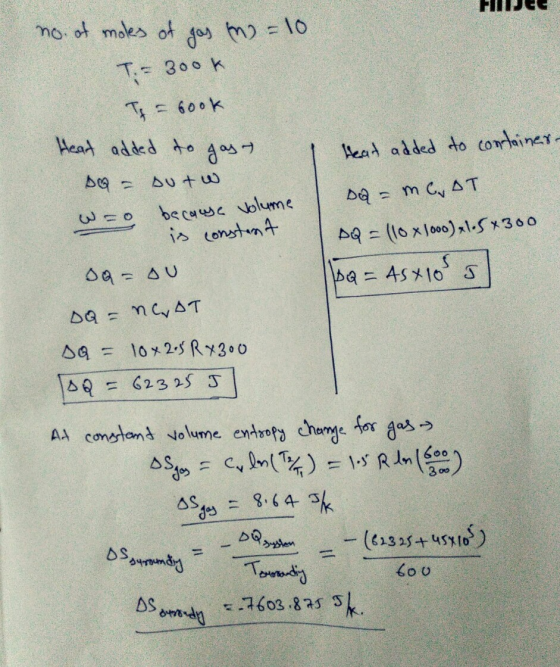
Ten moles of a gas are placed in a rigid container. Initially the gas is at P=0.5 bar and T= 300 K and the container is also at T= 300K. The container is placed in a furnace,
where its surroundings are at a constant T = 600K. The container is left in the furnace until both the container and the gas inside it reach equilibrium with the surroundings.
The gas has a constant heat capacity of Cv = 2.5 R. The container itself has a mass of 10kg (not including the mass of the gas inside) and a heat capacity of Cv=1.5 J/gK.
Find: heat added to the gas, heat added to the container, change in entropy of the gas, change in entropy of universe. Finally, in your own words frame this problem in terms of
reversibility or irreversibility.
Homework Answers
Add Answer to:
Ten moles of a gas are placed in a rigid container. Initially
the gas is at...
A sample of 1.3 mol of CO2 (g) is placed in a 5.0 L rigid container...
A sample of 1.3 mol of CO2 (g) is placed in a 5.0 L rigid container at an initial temperature is 300 K. When 6.98 kJ of heat is added to the system (at constant volume), the temperature rises to 353 K. Calculate q, w, ∆U, ∆H, and CV. The molar heat capacity of O2(g) at constant pressure, is 31.2 J/(K mol) around room temperature. 2.5 mol of O2(g) is heated at constant pressure from 265 K to 310 K....
300 J of heat are added to a gas inside a 2.00 L container with rigid...
300 J of heat are added to a gas inside a 2.00 L container with rigid walls at constant volume. Simultaneously, the pressure increases from 1.00 atm to 1.70atm. The initial temperature is is 25.0 degrees celcius. What is the change in enthaly, delta H?
(c) 0.15 moles of He is held in a container with a piston. The gas is...
 (c) 0.15 moles of He is held in a container with a piston. The gas is allowed to expand reversibly and isothermally from 1 to 3 dm3. The gas is kept at 350 K. Calculate: (i) The work done if the expansion is carried out reversibly and isothermally. (3 marks) (ii) The heat change grev of the system. (3 marks) (iii) The change in the entropy of the surroundings ASsurr for the expansion. (3 marks) (iii) Calculate ASsys for the...
A rigid tank contains an ideal gas at 40'C that is being stirred by a paddle...
 A rigid tank contains an ideal gas at 40'C that is being stirred by a paddle wheel. The paddle wheel does 200 kJ of work on the ideal gas. It is observed that the temperature of the ideal gas remains constant during this process as a result of heat transfer between the system and the surroundings at 30°C. Determine the entropy change of the ideal gas. Heat Ideal gas 40°C 30°C The entropy change of the ideal gas is JK
The temperature of an ideal gas in a sealed 0,2-m3 rigid container is reduced from 340,5...
The temperature of an ideal gas in a sealed 0,2-m3 rigid container is reduced from 340,5 K to 288,2 K. The final pressure of the gas is 43,5 kPA. The molar heat capacity at constant volume of the gas is 29,39 J/mol · K. Calcukate the heat (kJ)absorbed by the gas. Answer in two decimal places.
Two containers of the same gas each holding the same amount of mass, initially at temperature...
Two containers of the same gas each holding the same amount of mass, initially at temperature T1 and T2 are brought into thermal equilibrium Assuming no heat loss to the atmosphere and constant container volumes calculate (neglect the mass of the containers): 1) The final temperature of the gas in each container 2) The change of internal energy 3) The change of entropy For this process- if: A) The containers are placed in thermal contact. B) A reversible cycle works...
Calculate the change in entropy ΔS for 5.2 moles of an ideal gas when its thermodynamic...
Calculate the change in entropy ΔS for 5.2 moles of an ideal gas when its thermodynamic state changes from p1 = 1.50 atm and T1 = 400.0 K to p2 = 3.00 atm and T2 = 600.0 K. The molar heat capacity of the gas at constant volume is CV,m = (7/2) R, and is independent of the temperature.
A process has been proposed whereby an ideal gas is taken from P=10 bar and T=300...
A process has been proposed whereby an ideal gas is taken from P=10 bar and T=300 K to P=1 bar and T=500K in a closed system. During the process the system performs 1,000 [J] of work and receives 6,430 [J] of heat from the surroundings at a constant temperature of 300 K. The constant pressure heat capacity of the gas cp=30 [J/(mol K)] . Gas constant R=8.314 [J/(mol K)]. (a) (7 pts.) What is the change of molar internal energy...
Answer all Parts Please 4) (Conceptual question) Consider a well-insulated container of total volume V0. (a)...
Answer all Parts Please 4) (Conceptual question) Consider a well-insulated container of total volume V0. (a) Initially, the container is divided into two equal parts, using a very thin partition of negligible thickness. One side is filled with a mole of argon at temperature T0 and pressure P0 whereas the other side is under vacuum. The partition is then suddenly removed and the system is allowed to reach equilibrium. Write an expression for: a. Final T and P b. Change...
A gas is combined in a closed rigid tank. An electric resistor in the tank transfer...
 A gas is combined in a closed rigid tank. An electric resistor in the tank transfer energy to the 5. gas at a constant rate of 1000 W. Heat trans fer between the gas and the surroundings occurs at the rate of Q = -60t, where is in watts, and t is time, in minutes. Determine the net change in energy of the gas after 15 min, in kJ. (20 pts) [IN 1 kg.m/s; 1 J=1 N.m; 1 kW =...
 (c) 0.15 moles of He is held in a container with a piston. The gas is allowed to expand reversibly and isothermally from 1 to 3 dm3. The gas is kept at 350 K. Calculate: (i) The work done if the expansion is carried out reversibly and isothermally. (3 marks) (ii) The heat change grev of the system. (3 marks) (iii) The change in the entropy of the surroundings ASsurr for the expansion. (3 marks) (iii) Calculate ASsys for the...
 A rigid tank contains an ideal gas at 40'C that is being stirred by a paddle wheel. The paddle wheel does 200 kJ of work on the ideal gas. It is observed that the temperature of the ideal gas remains constant during this process as a result of heat transfer between the system and the surroundings at 30°C. Determine the entropy change of the ideal gas. Heat Ideal gas 40°C 30°C The entropy change of the ideal gas is JK
 A gas is combined in a closed rigid tank. An electric resistor in the tank transfer energy to the 5. gas at a constant rate of 1000 W. Heat trans fer between the gas and the surroundings occurs at the rate of Q = -60t, where is in watts, and t is time, in minutes. Determine the net change in energy of the gas after 15 min, in kJ. (20 pts) [IN 1 kg.m/s; 1 J=1 N.m; 1 kW =...
Most questions answered within 3 hours.
-
Where is the error in this code sequence?
String s1 = "Hello";
String s2 = "ello";...
asked 11 months ago -
Financial data for Joel de Paris, Inc., for last year
follow:
Joel de Paris, Inc.
Balance...
asked 11 months ago -
Consider this reaction:
Al2(SO4)3 (aq)+ BaCl3
(aq) Al2Cl6 (aq)- +
3BaSO4(s) . What is the...
asked 11 months ago -
Suppose that Savneet is considering increasing her
recent random sample from 20 car rentals to 40...
asked 11 months ago -
Trucks arrive at an unloading terminal at an average rate of 120
per hour.
Trucks arrive...
asked 11 months ago -
Why are methanol and ethanol completely soluble in water while
octanol is not very little soluble....
asked 11 months ago -
A facilities manager at a university reads in a research report
that the mean amount of...
asked 11 months ago -
When the CuSO4 is rehydrated by adding water to the anhydrous
compound, is this an endothermic...
asked 11 months ago -
A ray of sunlight is passing from diamond into crown glass; the
angle of incidence is...
asked 11 months ago -
A block of mass 0.249 kg is placed on top of a light, vertical
spring of...
asked 11 months ago -
how do the kidneys compensate in the presences of acidosis
a) trigger hyperventilate
b) reserve acid...
asked 11 months ago -
Question 501 pts
The rental rate of capital to the firm increases. Which of the
following...
asked 11 months ago