


Homework Answers
Add Answer to:
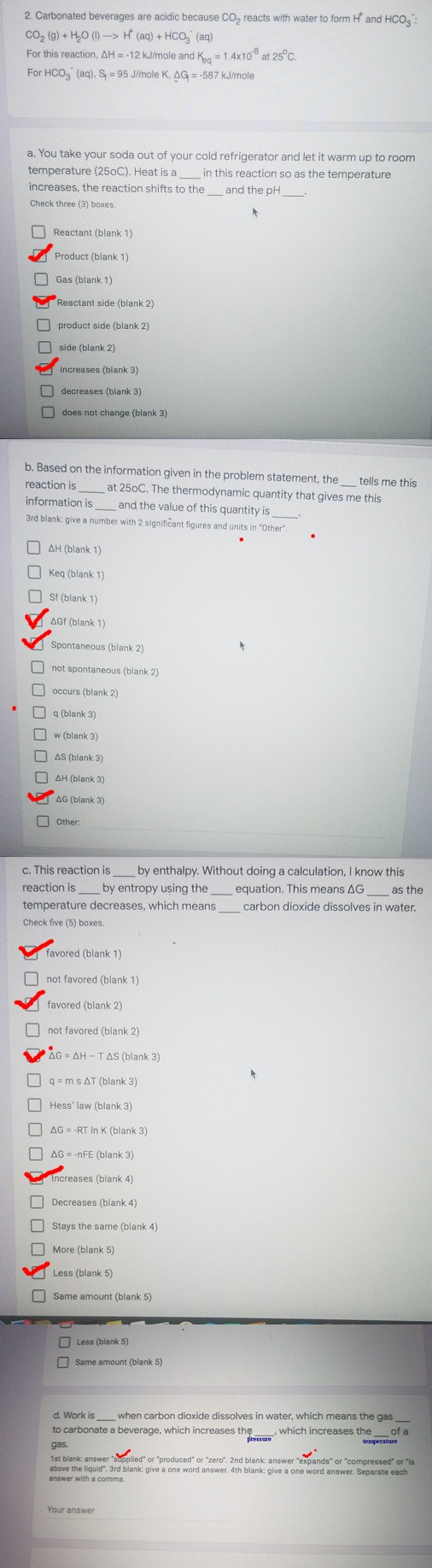
and HCO 2. Carbonated beverages are acidic because CO, reacts with water to form CO2 (g)...
3. Carbonated beverages are acidic because CO 2 reacts with water to form H + and HCO3 CO2 (g)+H2...
 3. Carbonated beverages are acidic because CO 2 reacts with water to form H + and HCO3 CO2 (g)+H20()(aa) +HCO3 (a) For this reaction, dH =-12 kJ/mole and K eg-42x107 at 25°C. For HCOs (aq), S9Jole K, AG 587 J/ole a. Calculate for this reaction. Give a number only in J/mole K Do not include text. Your answer b. You take your soda out of your cold refrigerator and let it warm up to room temperature (25oC) The pH_ increases...
For the reaction CO(g) + H2O(1)—*CO2(g) + H2(g) AH° = 2.8 kJ and AS° = 76.8...
 For the reaction CO(g) + H2O(1)—*CO2(g) + H2(g) AH° = 2.8 kJ and AS° = 76.8 J/K The standard free energy change for the reaction of 2.33 moles of CO(g) at 288 K, 1 atm would be kJ. This reaction is (reactant, product) favored under standard conditions at 288 K. Assume that AH° and ASº are independent of temperature. Submit Answer Retry Entire Group 9 more group attempts remaining For the reaction 2 NO(g) + O2(g) → 2 NO2(g) AG°...
the correct answer to #11 is supposed to be b but i keep getting c. what...
 the
correct answer to #11 is supposed to be b but i keep getting c.
what am i doing wrong? also, the correct answer to #14 is b but i
keep getting d. please explain where i am going wrong. thank
you
11. Consider the reaction in the previous question, what the equilibrium constant would be equal to at 25°C? a) 0.645 AGE-RT enk b) 1.03x10⁻¹⁶ c) 9.64x10⁻¹. 91.2-0008314 (298,15) enk d) 7.03x10⁸ -0.036B-Ink 12. When a reaction is found...
the
correct answer to #11 is supposed to be b but i keep getting c.
what am i doing wrong? also, the correct answer to #14 is b but i
keep getting d. please explain where i am going wrong. thank
you
11. Consider the reaction in the previous question, what the equilibrium constant would be equal to at 25°C? a) 0.645 AGE-RT enk b) 1.03x10⁻¹⁶ c) 9.64x10⁻¹. 91.2-0008314 (298,15) enk d) 7.03x10⁸ -0.036B-Ink 12. When a reaction is found...
question. Consider the following reaction at 298K. Pb2+ (aq) + Co (s) Pb (s) + Co2+...
 question. Consider the following reaction at 298K. Pb2+ (aq) + Co (s) Pb (s) + Co2+ (aq) Which of the following statements are correct? Choose all that apply. OK<1 On= 5 mol electrons E cell <0 The reaction is product-favored. delta Gº<0 Submit Answer Retry Entire Group 4 more group attempts remaining Consider the following reaction at 298K. Ni2+ (aq) + Pb (8) -Ni (6) + Pb2+ (aq) Which of the following statements are correct? Choose all that apply. AG°...
For the reaction 2 BrF3(g) - Br2(g) + 3 F2(g) AG° = 470.3 kJ and AH°...
 For the reaction 2 BrF3(g) - Br2(g) + 3 F2(g) AG° = 470.3 kJ and AH° = 542.1 kJ at 267 K and 1 atm. This reaction is (reactant, product) favored under standard conditions at 267 K. The entropy change for the reaction of 2.38 moles of BrF3(g) at this temperature would be J/K.
Chapter 18 Thermodynamics Homework 1.Predict the sign of AS for each process: a) The boiling of water b)2HgO(s)-2Hg(I) + 02(s) c) CaCO, (s)CaO(s)+ CO (g) 2. Is the following process spontaneous o...
 Chapter 18 Thermodynamics Homework 1.Predict the sign of AS for each process: a) The boiling of water b)2HgO(s)-2Hg(I) + 02(s) c) CaCO, (s)CaO(s)+ CO (g) 2. Is the following process spontaneous or nonspontaneous at a given temperature? NaNO,(s) ->NaNO,(aq) 3. If a reaction has ΔS < 0 and ΔΗ < 0 will the reaction always be spontaneous, spontaneous at low T, spontaneous at high T, or never spontaneous? 4.Consider this reaction: Calculate ΔG at 25 °C and determine whether the...
please help with the 3 questions :) Review Topics (References Use the References to access important...
 please help with the 3 questions :)
Review Topics (References Use the References to access important values if needed for this question. M M For the reaction reg 2H2(g) + 302(8) 2H2O() +250 (6) AH = -1036.0 kJ and AS - 152.9 J/K . The standard free energy change for the reaction of 1.67 moles of H2S(e) at 317 K, 1 atm would be This reaction is (reactant, product) favored under standard conditions at 317 K. Assume that AH and...
please help with the 3 questions :)
Review Topics (References Use the References to access important values if needed for this question. M M For the reaction reg 2H2(g) + 302(8) 2H2O() +250 (6) AH = -1036.0 kJ and AS - 152.9 J/K . The standard free energy change for the reaction of 1.67 moles of H2S(e) at 317 K, 1 atm would be This reaction is (reactant, product) favored under standard conditions at 317 K. Assume that AH and...
Consider the following reaction at 25 °C. CO2 (g) + 2NH3 (g) → CO(NH2 )2 (s)...
Consider the following reaction at 25 °C. CO2 (g) + 2NH3 (g) → CO(NH2 )2 (s) + H2 O(l) ; ∆H° = -134kJmol-1 Which of the following is correct regarding this reaction? (1) ∆S° is always a negative value for the reaction. (2) ∆H° increases with the temperature. (3) The decrease in the entropy change can determine the spontaneity of the reaction. (4) The reaction is spontaneous at all temperatures. (5) At high temperatures the value of ∆G° becomes more...
Predict the sign of AS for each of these changes. a) O2 (g) → O2 (aq)...
 Predict the sign of AS for each of these changes. a) O2 (g) → O2 (aq) b) C.H. (8) → C.H. (1) - c) C(s) + CO2(g) → 2 CO (g) d) C12H22011 (8) ► 12H2011 (aq) e) 2 NO2(g) → N.04 (g) 2) Indicate the correct type of process for the following: Process Spontaneous Non-Spontaneous 1. Melting of ice cubes at -5°C and 1 atm pressure 2. Dissolution of sugar in a cup of hot coffee 3. Reaction of...
free energy enthal Name Entropy (S) The second factor involved in determining whether or not a...
 free energy enthal
Name Entropy (S) The second factor involved in determining whether or not a process is spontaneous is the change in randomness or entropy (AS). Entropy is represented by the symbol S. Again, experience can help us understand the relationship between entropy and spontaneous processes. If we look at the two drawings below, we can predict which picture represents the stack of marbles "before and after they are bumped. We expect the stack of marbles (less random; lower...
free energy enthal
Name Entropy (S) The second factor involved in determining whether or not a process is spontaneous is the change in randomness or entropy (AS). Entropy is represented by the symbol S. Again, experience can help us understand the relationship between entropy and spontaneous processes. If we look at the two drawings below, we can predict which picture represents the stack of marbles "before and after they are bumped. We expect the stack of marbles (less random; lower...
 3. Carbonated beverages are acidic because CO 2 reacts with water to form H + and HCO3 CO2 (g)+H20()(aa) +HCO3 (a) For this reaction, dH =-12 kJ/mole and K eg-42x107 at 25°C. For HCOs (aq), S9Jole K, AG 587 J/ole a. Calculate for this reaction. Give a number only in J/mole K Do not include text. Your answer b. You take your soda out of your cold refrigerator and let it warm up to room temperature (25oC) The pH_ increases...
 For the reaction CO(g) + H2O(1)—*CO2(g) + H2(g) AH° = 2.8 kJ and AS° = 76.8 J/K The standard free energy change for the reaction of 2.33 moles of CO(g) at 288 K, 1 atm would be kJ. This reaction is (reactant, product) favored under standard conditions at 288 K. Assume that AH° and ASº are independent of temperature. Submit Answer Retry Entire Group 9 more group attempts remaining For the reaction 2 NO(g) + O2(g) → 2 NO2(g) AG°...
 the
correct answer to #11 is supposed to be b but i keep getting c.
what am i doing wrong? also, the correct answer to #14 is b but i
keep getting d. please explain where i am going wrong. thank
you
11. Consider the reaction in the previous question, what the equilibrium constant would be equal to at 25°C? a) 0.645 AGE-RT enk b) 1.03x10⁻¹⁶ c) 9.64x10⁻¹. 91.2-0008314 (298,15) enk d) 7.03x10⁸ -0.036B-Ink 12. When a reaction is found...
the
correct answer to #11 is supposed to be b but i keep getting c.
what am i doing wrong? also, the correct answer to #14 is b but i
keep getting d. please explain where i am going wrong. thank
you
11. Consider the reaction in the previous question, what the equilibrium constant would be equal to at 25°C? a) 0.645 AGE-RT enk b) 1.03x10⁻¹⁶ c) 9.64x10⁻¹. 91.2-0008314 (298,15) enk d) 7.03x10⁸ -0.036B-Ink 12. When a reaction is found...
 question. Consider the following reaction at 298K. Pb2+ (aq) + Co (s) Pb (s) + Co2+ (aq) Which of the following statements are correct? Choose all that apply. OK<1 On= 5 mol electrons E cell <0 The reaction is product-favored. delta Gº<0 Submit Answer Retry Entire Group 4 more group attempts remaining Consider the following reaction at 298K. Ni2+ (aq) + Pb (8) -Ni (6) + Pb2+ (aq) Which of the following statements are correct? Choose all that apply. AG°...
 For the reaction 2 BrF3(g) - Br2(g) + 3 F2(g) AG° = 470.3 kJ and AH° = 542.1 kJ at 267 K and 1 atm. This reaction is (reactant, product) favored under standard conditions at 267 K. The entropy change for the reaction of 2.38 moles of BrF3(g) at this temperature would be J/K.
 Chapter 18 Thermodynamics Homework 1.Predict the sign of AS for each process: a) The boiling of water b)2HgO(s)-2Hg(I) + 02(s) c) CaCO, (s)CaO(s)+ CO (g) 2. Is the following process spontaneous or nonspontaneous at a given temperature? NaNO,(s) ->NaNO,(aq) 3. If a reaction has ΔS < 0 and ΔΗ < 0 will the reaction always be spontaneous, spontaneous at low T, spontaneous at high T, or never spontaneous? 4.Consider this reaction: Calculate ΔG at 25 °C and determine whether the...
 please help with the 3 questions :)
Review Topics (References Use the References to access important values if needed for this question. M M For the reaction reg 2H2(g) + 302(8) 2H2O() +250 (6) AH = -1036.0 kJ and AS - 152.9 J/K . The standard free energy change for the reaction of 1.67 moles of H2S(e) at 317 K, 1 atm would be This reaction is (reactant, product) favored under standard conditions at 317 K. Assume that AH and...
please help with the 3 questions :)
Review Topics (References Use the References to access important values if needed for this question. M M For the reaction reg 2H2(g) + 302(8) 2H2O() +250 (6) AH = -1036.0 kJ and AS - 152.9 J/K . The standard free energy change for the reaction of 1.67 moles of H2S(e) at 317 K, 1 atm would be This reaction is (reactant, product) favored under standard conditions at 317 K. Assume that AH and...
 Predict the sign of AS for each of these changes. a) O2 (g) → O2 (aq) b) C.H. (8) → C.H. (1) - c) C(s) + CO2(g) → 2 CO (g) d) C12H22011 (8) ► 12H2011 (aq) e) 2 NO2(g) → N.04 (g) 2) Indicate the correct type of process for the following: Process Spontaneous Non-Spontaneous 1. Melting of ice cubes at -5°C and 1 atm pressure 2. Dissolution of sugar in a cup of hot coffee 3. Reaction of...
 free energy enthal
Name Entropy (S) The second factor involved in determining whether or not a process is spontaneous is the change in randomness or entropy (AS). Entropy is represented by the symbol S. Again, experience can help us understand the relationship between entropy and spontaneous processes. If we look at the two drawings below, we can predict which picture represents the stack of marbles "before and after they are bumped. We expect the stack of marbles (less random; lower...
free energy enthal
Name Entropy (S) The second factor involved in determining whether or not a process is spontaneous is the change in randomness or entropy (AS). Entropy is represented by the symbol S. Again, experience can help us understand the relationship between entropy and spontaneous processes. If we look at the two drawings below, we can predict which picture represents the stack of marbles "before and after they are bumped. We expect the stack of marbles (less random; lower...
Most questions answered within 3 hours.
-
Where is the error in this code sequence?
String s1 = "Hello";
String s2 = "ello";...
asked 10 months ago -
Financial data for Joel de Paris, Inc., for last year
follow:
Joel de Paris, Inc.
Balance...
asked 10 months ago -
Consider this reaction:
Al2(SO4)3 (aq)+ BaCl3
(aq) Al2Cl6 (aq)- +
3BaSO4(s) . What is the...
asked 10 months ago -
Suppose that Savneet is considering increasing her
recent random sample from 20 car rentals to 40...
asked 10 months ago -
Trucks arrive at an unloading terminal at an average rate of 120
per hour.
Trucks arrive...
asked 10 months ago -
Why are methanol and ethanol completely soluble in water while
octanol is not very little soluble....
asked 10 months ago -
A facilities manager at a university reads in a research report
that the mean amount of...
asked 10 months ago -
When the CuSO4 is rehydrated by adding water to the anhydrous
compound, is this an endothermic...
asked 10 months ago -
A ray of sunlight is passing from diamond into crown glass; the
angle of incidence is...
asked 10 months ago -
A block of mass 0.249 kg is placed on top of a light, vertical
spring of...
asked 10 months ago -
how do the kidneys compensate in the presences of acidosis
a) trigger hyperventilate
b) reserve acid...
asked 10 months ago -
Question 501 pts
The rental rate of capital to the firm increases. Which of the
following...
asked 10 months ago