
Homework Answers
Ans) 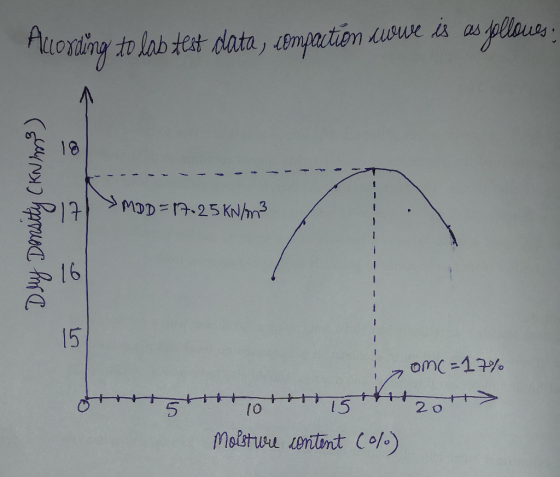
From above compaction curve .
Optimum moisture content (OMC) = 17 %
Maximum dry density (MDD) = 17.25 kN/m3
For field test data we have to first calculate dry density :
Dry density = Moist density / ( 1 + W) , where W = water content
Below table contain dry density calculated using above formula :
| Location | Moisture content (%) | Moist density ,  (kN/m3)
 |
Dry density, |
| 1 | 14.67 | 20.62 | 17.98 |
| 2 | 15.82 | 19.78 | 17.07 |
| 3 | 16.41 | 19.54 | 16.78 |
| 4 | 17.57 | 19.70 | 16.75 |
| 5 | 19.70 | 21.98 | 18.36 |
Required compacted soil = 0.95 x 17.25 = 16.38 kN/m3
Required water content = 17  2 = 15% - 19
%
2 = 15% - 19
%
For location 1, d =
17.98 and W = 14.67% , water content is less then required
For location 2, d =
17.07 > 15.82 , soil meets requirements
For location 3, d =
16.78 and W = 16.41 , soil meets requirements
For location 4, d =
16.75 and W = 17.57 , soil meets requirements
For location 5, d =
18.36 and W = 19.71 , moisture is more than required
Add Answer to:
Example 2. The Navy is building a road at a new installation. Pavement base coarse specifications...
A series of Proctor compaction tests were performed on fill material used for a roadway application. The results are shown in the Table below.
A series of Proctor compaction tests were performed on fill material used for a roadway application. The results are shown in the Table below.Data Point No.12345Mass of compacted soil + mould (kg)3.7623.9214.0344.0914.04Moisture content, w (%)4.57.510.112.916.4 The mass of the compaction mould was 2.031 kg. The mould volume was 1×10⁻³ m3.(a) Compute dry unit weight gd for each data point. (b) Draw the Proctor compaction curve of the soil, and determine the maximum dry unit weight gd max and optimum moisture content...
You are a field engineer for a construction services testing firm. Your current job assignment is to evaluate fill place...
 You are a field engineer for a construction services
testing firm. Your current job assignment is
to evaluate fill placement for a new roadway being constructed in
Tg, Lumpur, Pahang. The
project specifications for the roadway require fill compaction to
98% of the ASTM D1557
compaction test results. Your lab manager sends you the results of
the Standard and Modified
Proctor compaction testing on the fill being placed. These results
are presented in Figure 2. Your
field compaction test results...
You are a field engineer for a construction services
testing firm. Your current job assignment is
to evaluate fill placement for a new roadway being constructed in
Tg, Lumpur, Pahang. The
project specifications for the roadway require fill compaction to
98% of the ASTM D1557
compaction test results. Your lab manager sends you the results of
the Standard and Modified
Proctor compaction testing on the fill being placed. These results
are presented in Figure 2. Your
field compaction test results...
 You are a field engineer for a construction services
testing firm. Your current job assignment is
to evaluate fill placement for a new roadway being constructed in
Tg, Lumpur, Pahang. The
project specifications for the roadway require fill compaction to
98% of the ASTM D1557
compaction test results. Your lab manager sends you the results of
the Standard and Modified
Proctor compaction testing on the fill being placed. These results
are presented in Figure 2. Your
field compaction test results...
You are a field engineer for a construction services
testing firm. Your current job assignment is
to evaluate fill placement for a new roadway being constructed in
Tg, Lumpur, Pahang. The
project specifications for the roadway require fill compaction to
98% of the ASTM D1557
compaction test results. Your lab manager sends you the results of
the Standard and Modified
Proctor compaction testing on the fill being placed. These results
are presented in Figure 2. Your
field compaction test results...
Most questions answered within 3 hours.
-
Where is the error in this code sequence?
String s1 = "Hello";
String s2 = "ello";...
asked 10 months ago -
Financial data for Joel de Paris, Inc., for last year
follow:
Joel de Paris, Inc.
Balance...
asked 10 months ago -
Consider this reaction:
Al2(SO4)3 (aq)+ BaCl3
(aq) Al2Cl6 (aq)- +
3BaSO4(s) . What is the...
asked 10 months ago -
Suppose that Savneet is considering increasing her
recent random sample from 20 car rentals to 40...
asked 10 months ago -
Trucks arrive at an unloading terminal at an average rate of 120
per hour.
Trucks arrive...
asked 10 months ago -
Why are methanol and ethanol completely soluble in water while
octanol is not very little soluble....
asked 10 months ago -
A facilities manager at a university reads in a research report
that the mean amount of...
asked 10 months ago -
When the CuSO4 is rehydrated by adding water to the anhydrous
compound, is this an endothermic...
asked 10 months ago -
A ray of sunlight is passing from diamond into crown glass; the
angle of incidence is...
asked 10 months ago -
A block of mass 0.249 kg is placed on top of a light, vertical
spring of...
asked 10 months ago -
how do the kidneys compensate in the presences of acidosis
a) trigger hyperventilate
b) reserve acid...
asked 10 months ago -
Question 501 pts
The rental rate of capital to the firm increases. Which of the
following...
asked 10 months ago