
Homework Answers
Request Answer!
We need at least 10 more requests to produce the answer.
0 / 10 have requested this problem solution
The more requests, the faster the answer.
Add Answer to:
Suppose there is a single commodity that absorbs all of a consumer's income. a.What is the...
3. Assume that a typical consumer's utility function is U(qI.4p) qi+q. and this consumer's income is...
 3. Assume that a typical consumer's utility function is U(qI.4p) qi+q. and this consumer's income is 1-100. The prices for these two goods are pi and p2, and pi p2- b. Assume that there are m-20 identical consumers and p2-80. The supply of good 1 What are the price elasticity of demand and price elasticity of supply? (4 points) a. Derive the demands for these two goods. (4 points) is Qis=10+P1. Find the equilibrium of the good 1 market? (6...
Consumer's Surplus A consumer has the utility function U(, y)v) where is the good in concern...
 Consumer's Surplus A consumer has the utility function U(, y)v) where is the good in concern ail y is the money that can be spent on all other goods (so the price of y is normalized to be 1). The income of - this consumer is 100. Bi Pr X10 (In(x)y) (10%) Derive the demand function of z for this consumer. (10%) Calculate the price elasticity of the demand function in (b) Is it true that the absolute value of...
A Consumer's Demand for Burgers Suppose that the consumer has income, I = $20, and the...
 A Consumer's Demand for Burgers Suppose that the consumer has income, I = $20, and the price of French fries is pe = $2. You are given the following information about the price of burgers and the number of burgers the consumer will buy at that price: Price of Burgers Quantity of Burgers A B C $1.00 $2.00 $5.00 10 5 2 Use an indifference curve and budget line diagram to draw the consumer's three budget lines and three optimal...
Consumer's surplus: A consumer has the utility function U(x,y) =e^((ln(X)+Y)^1/3) where X is the good in...
Consumer's surplus: A consumer has the utility function U(x,y) =e^((ln(X)+Y)^1/3) where X is the good in concern and Y is the money that can be spent on all other goods. (So the price of Y is normalized to be 1). The income of this consumer is 100. (a) (10pts) Derive the demand function of x for this consumer. Make sure that at every price of x, the consumer always has enough income to buy the amount of x as indicated...
3. A consumer's utility function is: u x025y0.7s where x and y are two goods ()...
 3. A consumer's utility function is: u x025y0.7s where x and y are two goods () Suppose total income is £10,000 and the prices of the two goods are £4 and £6 respectively. Use constrained optimisation to find the consumer's demand for both goods. Now replace the price of the second good with p. Find a formula for the consumer's demand for this good. Draw the demand curve and comment on its properties (ii) (ii) What is the own-price elasticity...
8) Suppose a consumer's utility function is defined by u(x,y)=3x+y for every x>0 and y>0 and...
 8) Suppose a consumer's utility function is defined by u(x,y)=3x+y for every x>0 and y>0 and the consumer's initial endowment of wealth is w=100. Graphically depict the income and substitution effects for this consumer if initially P=1 P, and then the price of commodity x decreases to Px=1/2. 10 pts
Question Two Suppose that in a two-commodity world, the consumer's utility function takes the form (x)-la...
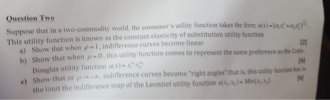 Question Two Suppose that in a two-commodity world, the consumer's utility function takes the form (x)-la +. This utility function is known as the constant elasticity of substitution utility function a) Show that when p-1, indifference curves become linear Show that when p o. this utility function comes to represent the same preference as the cable Douglas utility function () c) Show that as , indifference curves become right angles" that is this utility function has the limit the indifference...
You have observed a consumer's demand behavior and were able to determine that the consumer's behavior...
You have observed a consumer's demand behavior and were able to determine that the consumer's behavior is consistent with the following indirect utility function V(px,py,I)=I2/4px,py, where I is the consumer's income and px and py are the prices of the two goods. (a) Find the expenditure function E(px,py,U) (b) Use your answer to derive the compensated demand functions xc,yc (c) Currently, the consumer's income is I0=100. The price of Good X is p0x = 4 and the price of Good...
Suppose that demand for and supply of a commodity in a market are shown on a...
Suppose that demand for and supply of a commodity in a market are shown on a graph with price on the vertical axis and quantity on the horizontal axis. The y-intercept of the demand curve is equal to $30. The equilibrium price and quantity are $17.5 and 300 units respectively. Total Consumer Surplus in this market is ____.
A consumer earns I a week and spends his entire weekly income on new dress shirts...
A consumer earns I a week and spends his entire weekly income on new dress shirts and ties, because these are the only two items that provide utility to him. Further- more, he insists that for every shirt he buys, he must also buy a tie (without the ties, the new shirts are worthless and vice versa). Let Ps and Pt denotes the price of a shirt and the price of a tie, respectively. (a) Derive the consumer's demand function...
 3. Assume that a typical consumer's utility function is U(qI.4p) qi+q. and this consumer's income is 1-100. The prices for these two goods are pi and p2, and pi p2- b. Assume that there are m-20 identical consumers and p2-80. The supply of good 1 What are the price elasticity of demand and price elasticity of supply? (4 points) a. Derive the demands for these two goods. (4 points) is Qis=10+P1. Find the equilibrium of the good 1 market? (6...
 Consumer's Surplus A consumer has the utility function U(, y)v) where is the good in concern ail y is the money that can be spent on all other goods (so the price of y is normalized to be 1). The income of - this consumer is 100. Bi Pr X10 (In(x)y) (10%) Derive the demand function of z for this consumer. (10%) Calculate the price elasticity of the demand function in (b) Is it true that the absolute value of...
 A Consumer's Demand for Burgers Suppose that the consumer has income, I = $20, and the price of French fries is pe = $2. You are given the following information about the price of burgers and the number of burgers the consumer will buy at that price: Price of Burgers Quantity of Burgers A B C $1.00 $2.00 $5.00 10 5 2 Use an indifference curve and budget line diagram to draw the consumer's three budget lines and three optimal...
 3. A consumer's utility function is: u x025y0.7s where x and y are two goods () Suppose total income is £10,000 and the prices of the two goods are £4 and £6 respectively. Use constrained optimisation to find the consumer's demand for both goods. Now replace the price of the second good with p. Find a formula for the consumer's demand for this good. Draw the demand curve and comment on its properties (ii) (ii) What is the own-price elasticity...
 8) Suppose a consumer's utility function is defined by u(x,y)=3x+y for every x>0 and y>0 and the consumer's initial endowment of wealth is w=100. Graphically depict the income and substitution effects for this consumer if initially P=1 P, and then the price of commodity x decreases to Px=1/2. 10 pts
 Question Two Suppose that in a two-commodity world, the consumer's utility function takes the form (x)-la +. This utility function is known as the constant elasticity of substitution utility function a) Show that when p-1, indifference curves become linear Show that when p o. this utility function comes to represent the same preference as the cable Douglas utility function () c) Show that as , indifference curves become right angles" that is this utility function has the limit the indifference...
Most questions answered within 3 hours.
-
Where is the error in this code sequence?
String s1 = "Hello";
String s2 = "ello";...
asked 10 months ago -
Financial data for Joel de Paris, Inc., for last year
follow:
Joel de Paris, Inc.
Balance...
asked 10 months ago -
Consider this reaction:
Al2(SO4)3 (aq)+ BaCl3
(aq) Al2Cl6 (aq)- +
3BaSO4(s) . What is the...
asked 10 months ago -
Suppose that Savneet is considering increasing her
recent random sample from 20 car rentals to 40...
asked 10 months ago -
Trucks arrive at an unloading terminal at an average rate of 120
per hour.
Trucks arrive...
asked 10 months ago -
Why are methanol and ethanol completely soluble in water while
octanol is not very little soluble....
asked 10 months ago -
A facilities manager at a university reads in a research report
that the mean amount of...
asked 10 months ago -
When the CuSO4 is rehydrated by adding water to the anhydrous
compound, is this an endothermic...
asked 10 months ago -
A ray of sunlight is passing from diamond into crown glass; the
angle of incidence is...
asked 10 months ago -
A block of mass 0.249 kg is placed on top of a light, vertical
spring of...
asked 10 months ago -
how do the kidneys compensate in the presences of acidosis
a) trigger hyperventilate
b) reserve acid...
asked 10 months ago -
Question 501 pts
The rental rate of capital to the firm increases. Which of the
following...
asked 10 months ago