Two statically charged balloons feel a repulsive force of 0.84 N. If the balloons are charged...
Homework Answers
F = k q1 q2/(r^2)
==> r = sqrt(k q1 q2/F)
==> r = sqrt((9e9)*(4.5e-6)*(0.71e-6)/(0.84))
==> r = 0.185 m
Add Answer to:
Two statically charged balloons feel a repulsive force of 0.84 N.
If the balloons are charged...
At a separation distance of 0.250-m, two like-charged balloons experience a repulsive force of 0.480 N....
 At a separation distance of 0.250-m, two like-charged balloons experience a repulsive force of 0.480 N. If the distance is doubled, then the repulsive force would be 8) 9) Two objects are located along the y-axis. Object A has a charge of +25 uC and is located at the origin. Object B has a charge of -15 HC and is located a distance of 45 cm above object A. Determine the y- coordinate location where the electric field is zero.
Two electrostatic point charges of +59.0 μC and +58.0 μC exert a repulsive force on each...
Two electrostatic point charges of +59.0 μC and +58.0 μC exert a repulsive force on each other of 168 N. What is the distance between the two charges? The value of the Coulomb constant is 8.98755×10 N·m /C . Answer in units of m.
Two charged particles exert an electrostatic force of 5 N on each other. What will the...
Two charged particles exert an electrostatic force of 5 N on each other. What will the magnitude of the electrostatic force be if the distance between the two charges is reduced to one-third of the original distance? 4.5 N 45 N 0.45 N 5 N
Two balloons are charged with an identical quantity and type of charge: -0.007 C. They are...
Two balloons are charged with an identical quantity and type of charge: -0.007 C. They are held apart at a separation distance of 5 m. Determine the magnitude of the electrical force of repulsion between them.
Two equal, negatively charged objects are separated by 0.5m. There is a 1N repulsive force between...
 Two equal, negatively charged objects are separated by 0.5m. There is a 1N repulsive force between them. How many excess electrons are on one of the charged objects? 1.74 x 10⁸ 3.30 * 1013 3.63 x 10¹⁴ 4.66 x 10¹³
9. The repulsive force between two protons has a magnitude of 2.00 N. What is the...
 9. The repulsive force between two protons has a magnitude of 2.00 N. What is the distance potnt) between them? 01.07 x 10⁻¹⁴m 01.28 x10-38 m 07.198 10-10 m 02.68 x 10⁴m 10. Two identical point charges in outer space are held apart at a distance D. As soon as the pont charges are released, each begins moving at an acceleration a. If instead they were released at a distance, the acceleration of one charge would be 04a
Two point charges totaling 8.50 HC exert a repulsive force of o.200 N on one another...
 Two point charges totaling 8.50 HC exert a repulsive force of o.200 N on one another when separated by smallest charge (in μC)?
UUUUU 818 Two positive charges are separated by 25,00 and feel mutual repulsive force of 8.50nNS...
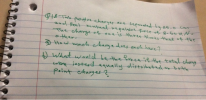 UUUUU 818 Two positive charges are separated by 25,00 and feel mutual repulsive force of 8.50nNS the charge of one is three times that of the other & How much charge does each have? 6) What would be the force if the total charge were instead equally distributed on both point charges ?
Two balloons are equally charged and suspended from a common point. the electrostatic repulsion between the...
Two balloons are equally charged and suspended from a common point. the electrostatic repulsion between the balloons causes them to separate a distance of 40 cm and make an angle of 30 degrees with the vertical as shown. Assuming that the balloons can be treated as point charges, what is the charge on each balloon? Each balloon has a mass of 4 g.
There are two charged particles. They exert an electrostatic force of 15 N on each other....
There are two charged particles. They exert an electrostatic force of 15 N on each other. Suppose the distance between the two particles is increased to five times the original distance. What will the magnitude of the force?
 At a separation distance of 0.250-m, two like-charged balloons experience a repulsive force of 0.480 N. If the distance is doubled, then the repulsive force would be 8) 9) Two objects are located along the y-axis. Object A has a charge of +25 uC and is located at the origin. Object B has a charge of -15 HC and is located a distance of 45 cm above object A. Determine the y- coordinate location where the electric field is zero.
 Two equal, negatively charged objects are separated by 0.5m. There is a 1N repulsive force between them. How many excess electrons are on one of the charged objects? 1.74 x 10⁸ 3.30 * 1013 3.63 x 10¹⁴ 4.66 x 10¹³
 9. The repulsive force between two protons has a magnitude of 2.00 N. What is the distance potnt) between them? 01.07 x 10⁻¹⁴m 01.28 x10-38 m 07.198 10-10 m 02.68 x 10⁴m 10. Two identical point charges in outer space are held apart at a distance D. As soon as the pont charges are released, each begins moving at an acceleration a. If instead they were released at a distance, the acceleration of one charge would be 04a
 Two point charges totaling 8.50 HC exert a repulsive force of o.200 N on one another when separated by smallest charge (in μC)?
 UUUUU 818 Two positive charges are separated by 25,00 and feel mutual repulsive force of 8.50nNS the charge of one is three times that of the other & How much charge does each have? 6) What would be the force if the total charge were instead equally distributed on both point charges ?
Most questions answered within 3 hours.
-
Where is the error in this code sequence?
String s1 = "Hello";
String s2 = "ello";...
asked 10 months ago -
Financial data for Joel de Paris, Inc., for last year
follow:
Joel de Paris, Inc.
Balance...
asked 10 months ago -
Consider this reaction:
Al2(SO4)3 (aq)+ BaCl3
(aq) Al2Cl6 (aq)- +
3BaSO4(s) . What is the...
asked 10 months ago -
Suppose that Savneet is considering increasing her
recent random sample from 20 car rentals to 40...
asked 10 months ago -
Trucks arrive at an unloading terminal at an average rate of 120
per hour.
Trucks arrive...
asked 10 months ago -
Why are methanol and ethanol completely soluble in water while
octanol is not very little soluble....
asked 10 months ago -
A facilities manager at a university reads in a research report
that the mean amount of...
asked 10 months ago -
When the CuSO4 is rehydrated by adding water to the anhydrous
compound, is this an endothermic...
asked 10 months ago -
A ray of sunlight is passing from diamond into crown glass; the
angle of incidence is...
asked 10 months ago -
A block of mass 0.249 kg is placed on top of a light, vertical
spring of...
asked 10 months ago -
how do the kidneys compensate in the presences of acidosis
a) trigger hyperventilate
b) reserve acid...
asked 10 months ago -
Question 501 pts
The rental rate of capital to the firm increases. Which of the
following...
asked 10 months ago