

Homework Answers
Option B is correct
Increase in the unemployment instance will increased unemployment insurance. Because it is a part of government spending, government spending increases when unemployment increases. This causes the budget to turn into deficit
Add Answer to:
7. When the unemployment rate increases, the budget: a. is unaffected. b. tends to move into...
The natural rate of unemployment tends to be lower when O A. the minimum wage is...
 The natural rate of unemployment tends to be lower when O A. the minimum wage is higher than the market wage. OB. unemployment insurance benefits are paid for fewer weeks. O C. labor unions are more effective OD. firms pay efficiency wages.
7. Those who advocate counter-cyclical fiscal policy would agree with all but one of the following...
 7. Those who advocate counter-cyclical fiscal policy would agree with all but one of the following statements. Which is the exception? A) Governments should be non-interventionist. B) Automatic stabilizers are not particularly effective. C) The economy is not capable of automatic self-adjustment in response the problems of unemployment and inflation. D) Counter cyclical fiscal policy is a powerful and effective tool. E) Government budget deficits are a less serious problem than income gaps. 8. Assume that the economy is in...
Q60. If the government increases spending and raises taxes by just enough to finance this increase...
Q60. If the government increases spending and raises taxes by just enough to finance this increase it will-------------------- a. Reduce output b. increase the MPC c. leave output unchanged d. increase output Q61. Starting from a balanced budget, for a given tax rate, an increase in income will cause the government budget to a. Remain unchanged b. move into surplus c. move into deficit d. both b and c Q62. For given government spending and taxation, the government budget deficit...
1. When the government increases spending by issuing more bonds, it causes: a) nations currency to...
1. When the government increases spending by issuing more bonds, it causes: a) nations currency to appreciate b)exports increase c)interest rates decrease d)demand for loanable funds decrease e)decreases merchandise trade deficit 2. When the Fed decreases money supply to combat inflation, it cuases: a)the price of the U.S. dollar to decrease b) capital to flow out of the US c)an increase in the merchandise trade deficit d)an increase in private spending e) a decrease in the interest rates 3. Which...
The net present value: a) increases as the required rate of return increases. b) is equal...
The net present value: a) increases as the required rate of return increases. b) is equal to the initial investment when the internal rate of return is equal to the required return. c) method of analysis cannot be applied to mutually exclusive projects. d) is inversely related to the discount rate. e) is unaffected by the timing of the related cash flows.
1. "Full employment" exists when the unemployment rate equals? a. zero b. the cyclical unemployment rate...
1. "Full employment" exists when the unemployment rate equals? a. zero b. the cyclical unemployment rate c. the structural unemployment rate d. the natural unemployment rate e. none of above 2. Which of the following is probably not true regarding unemployment in Europe? a. unemployment benefits tend to last longer than in the US b. unemployment benefits tend to replace a larger portion of one's salary than in the US c. structural unemployment is generally lower than in the US...
9. Which of the following statements is (are) correct? (x) A budget surplus occurs when government receipts are more tha...
9. Which of the following statements is (are) correct? (x) A budget surplus occurs when government receipts are more than spending and a budget deficit occurs when government spending is more than receipts. (y) The most common methods that the U.S. government uses to finance the budget deficit is by borrowing solely from the Federal Reserve or printing currency in the amount of the budget deficit. (z) If interest rates remain constant, then government must spend a larger amount of...
Agree or disagree (7 sentences) A budget deficit is when an individual, business, or government budgets...
Agree or disagree (7 sentences) A budget deficit is when an individual, business, or government budgets more spending than there is revenue available to pay for that spending. Deficits are the debts accumulated over time from the spending. It affects interest rates because the higher the deficit gets, the higher the interest rates go. When the budget deficits go up, the investment numbers decrease. This also tends to make economic growth decrease as well. So in conclusion, when the budget...
The natural unemployment rate is the unemployment rate when the economy is in A neither a...
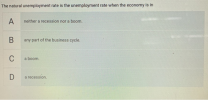 The natural unemployment rate is the unemployment rate when the economy is in A neither a recession nor a boom. B any part of the business cycle. C a boom. D a recession
7) As solute particle size increases, the rate of dissolving a) increases. b) decreases. c) remains...
 7) As solute particle size increases, the rate of dissolving a) increases. b) decreases. c) remains the same. 8) Which of the following solutions will have the lowest freezing point? Why? (2 points show calculations) a) 2.5 g of KCl in 100 g of water b) 2.5 g of NH4CI in 100 g of water c) 2.5 g of NaOH in 100 g of water d) All the solutions will have the same freezing point.
 The natural rate of unemployment tends to be lower when O A. the minimum wage is higher than the market wage. OB. unemployment insurance benefits are paid for fewer weeks. O C. labor unions are more effective OD. firms pay efficiency wages.
 7. Those who advocate counter-cyclical fiscal policy would agree with all but one of the following statements. Which is the exception? A) Governments should be non-interventionist. B) Automatic stabilizers are not particularly effective. C) The economy is not capable of automatic self-adjustment in response the problems of unemployment and inflation. D) Counter cyclical fiscal policy is a powerful and effective tool. E) Government budget deficits are a less serious problem than income gaps. 8. Assume that the economy is in...
 The natural unemployment rate is the unemployment rate when the economy is in A neither a recession nor a boom. B any part of the business cycle. C a boom. D a recession
 7) As solute particle size increases, the rate of dissolving a) increases. b) decreases. c) remains the same. 8) Which of the following solutions will have the lowest freezing point? Why? (2 points show calculations) a) 2.5 g of KCl in 100 g of water b) 2.5 g of NH4CI in 100 g of water c) 2.5 g of NaOH in 100 g of water d) All the solutions will have the same freezing point.
Most questions answered within 3 hours.
-
Where is the error in this code sequence?
String s1 = "Hello";
String s2 = "ello";...
asked 10 months ago -
Financial data for Joel de Paris, Inc., for last year
follow:
Joel de Paris, Inc.
Balance...
asked 10 months ago -
Consider this reaction:
Al2(SO4)3 (aq)+ BaCl3
(aq) Al2Cl6 (aq)- +
3BaSO4(s) . What is the...
asked 10 months ago -
Suppose that Savneet is considering increasing her
recent random sample from 20 car rentals to 40...
asked 10 months ago -
Trucks arrive at an unloading terminal at an average rate of 120
per hour.
Trucks arrive...
asked 10 months ago -
Why are methanol and ethanol completely soluble in water while
octanol is not very little soluble....
asked 10 months ago -
A facilities manager at a university reads in a research report
that the mean amount of...
asked 10 months ago -
When the CuSO4 is rehydrated by adding water to the anhydrous
compound, is this an endothermic...
asked 10 months ago -
A ray of sunlight is passing from diamond into crown glass; the
angle of incidence is...
asked 10 months ago -
A block of mass 0.249 kg is placed on top of a light, vertical
spring of...
asked 10 months ago -
how do the kidneys compensate in the presences of acidosis
a) trigger hyperventilate
b) reserve acid...
asked 10 months ago -
Question 501 pts
The rental rate of capital to the firm increases. Which of the
following...
asked 10 months ago