
Homework Answers
Add Answer to:
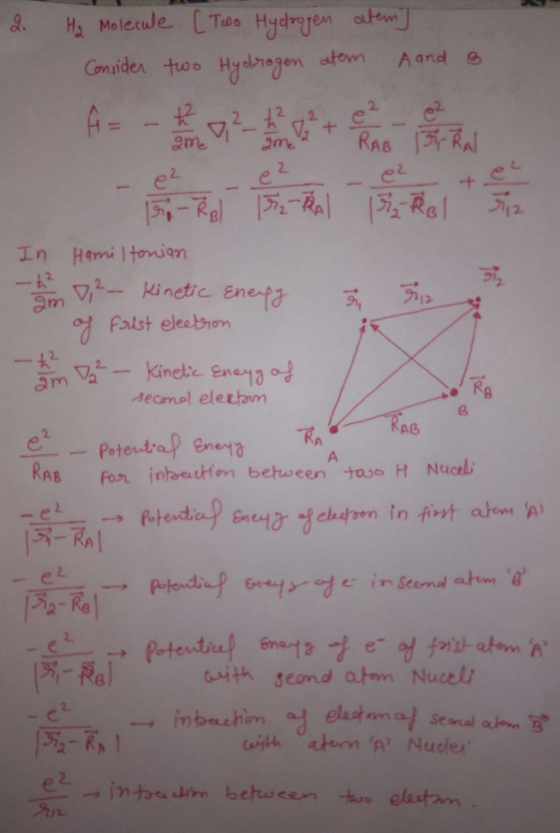
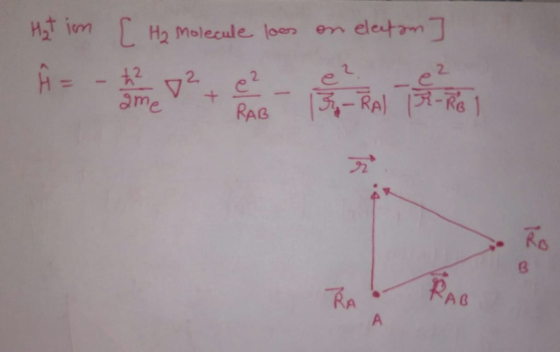
Write the Hamiltonian for the 2 and H molecules and explain/label each term. What terms differ...
1. Give the Schrodinger equation for free electrons. Explain all terms: Hamiltonian, potential. 2. Solve the...
 1. Give the Schrodinger equation for free electrons. Explain all terms: Hamiltonian, potential. 2. Solve the Schrodinger equation and find the wavefunction and the energy. 3. Draw the energy dispersion.
Explain the difference between the terms equivalence point and endpoint. Do not simply define each term,...
Explain the difference between the terms equivalence point and endpoint. Do not simply define each term, explain what makes them different as well.
Simple molecular orbital theory for the ethylene molecule. (a) (5 points) Write down a Hamiltonian matrix for the pi electrons of ethylene, using a 2p basis function on each C atom, and assuming that...
 Simple molecular orbital theory for the ethylene
molecule.
(a) (5 points) Write down a Hamiltonian matrix for the pi electrons of ethylene, using a 2p basis function on each C atom, and assuming that the matrix elements of the Hamiltonian are α for on-site interaction you a 2 by 2 matrix - it is known as the Huckel Hamiltonian s, and B for the interactions between nearest neighbors This should give (b) (10 points) Write down the secular equation for...
Simple molecular orbital theory for the ethylene
molecule.
(a) (5 points) Write down a Hamiltonian matrix for the pi electrons of ethylene, using a 2p basis function on each C atom, and assuming that the matrix elements of the Hamiltonian are α for on-site interaction you a 2 by 2 matrix - it is known as the Huckel Hamiltonian s, and B for the interactions between nearest neighbors This should give (b) (10 points) Write down the secular equation for...
For the Hamiltonian syste m we did in class: 2. 3 Ic (1) Show that it's a Hamiltonian system with a Hamiltonian function (2) Show that for each c > 0, {(z,y) є R2 . H(z,y) c} is a bounded inva...
 For the Hamiltonian syste m we did in class: 2. 3 Ic (1) Show that it's a Hamiltonian system with a Hamiltonian function (2) Show that for each c > 0, {(z,y) є R2 . H(z,y) c} is a bounded invariant set of the dynamical system (in fact, it's also closed) (3) Find all the equilibria of this system. Show that H-() is made up of one equilibium point and two homoclinic orbits attached to it. (4) Sketch the invariant...
Write an expression with two terms. One term should have a coefficient with a variable and...
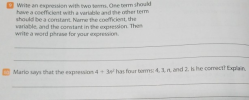 Write an expression with two terms. One term should have a coefficient with a variable and the other term should be a constant. Name the coefficient, the variable, and the constant in the expression. Then write a word phrase for your expression. 10 Mario says that the expression 4 + 3nhas four terms: 4,3, n, and 2. Is he correct? Explain.
1. Consider an ensemble of systems each made up of a large number of magnetic moments...
 1. Consider an ensemble of systems each made up of a large number of magnetic moments that are equal in magnitude. You apply a magnetic field of intensity H to the system on your laboratory bench. Each of the j magnetic moments in your laboratory system becomes oriented with respect to this magnetic field. The angle of orientation is vi for the jth magnetic moment of the oth system. Then the energy (Hamiltonian) of the jth magnetic moment in the...
Indicate whether each of the following molecules R, S, Z or E. Label the substituents according...
 Indicate whether each of the following molecules R, S, Z or E. Label the substituents according to priority. The third molecule is a Fischer projection. Cl H2C SH H CH3 CH3 Label each pair of molecules as enantiomers, diasteromers, identical molecules constitutional isomers, or not isomers at all. No partial credit. H3C SH CH3 CH(CH3)2 H3C CH2CH2F CH(CH3)2 H3C CH2CH3 and H CH3 and H SH Cl HOH OH and CH3
6 The Fermionic Oscillator Suppose that we constructed a harmonic oscillator Hamiltonian H in terms of...
 6 The Fermionic Oscillator Suppose that we constructed a harmonic oscillator Hamiltonian H in terms of raising and lowering operators a+,a in the usual way, such that but now whereaa obey the anticommutation relationn (Be careful! The a+,a are operators, rather than numbers.) (a) Suppose I give you a wavefunction that solves the time-independent Schrödinger equation, i.e. such that HUn-EUn-hw (n + ) ψη. Is a+Un also a solution to the time-independent Schrödinger equation If so, what is its energy...
2. (12 marks) Shown below are structural diagrams for six pairs of molecules. From the list...
 2. (12 marks) Shown below are structural diagrams for six pairs
of molecules. From the list of four terms given below, choose the
single term that best describes each pair and write it on the line
below the pair of structures. Note that a term may be used more
than once if necessary
. 2. (12 marks) Shown below are structural diagrams for six pairs of molecules. From the list of four terms given below, choose the single term that...
2. (12 marks) Shown below are structural diagrams for six pairs
of molecules. From the list of four terms given below, choose the
single term that best describes each pair and write it on the line
below the pair of structures. Note that a term may be used more
than once if necessary
. 2. (12 marks) Shown below are structural diagrams for six pairs of molecules. From the list of four terms given below, choose the single term that...
As described in class, the Poisson Bracket [F, G] between two functions Fand G of the generalized positions q, and momenta pi is defined as: Consider a system with Hamiltonian H-P2/2m-Vr = (P, 2+py 2...
 As described in class, the Poisson Bracket [F, G] between two functions Fand G of the generalized positions q, and momenta pi is defined as: Consider a system with Hamiltonian H-P2/2m-Vr = (P, 2+py 2+pz2y2m)-y(x"2 + y"2 + z ^2)-U2 where yis a constant. a) Evaluate [Lz, H] and interpret the result in two ways i.e. what it says about L, and what it says about H b) Using the Poisson Bracket and the given Hamiltonian, find the value of...
 1. Give the Schrodinger equation for free electrons. Explain all terms: Hamiltonian, potential. 2. Solve the Schrodinger equation and find the wavefunction and the energy. 3. Draw the energy dispersion.
 Simple molecular orbital theory for the ethylene
molecule.
(a) (5 points) Write down a Hamiltonian matrix for the pi electrons of ethylene, using a 2p basis function on each C atom, and assuming that the matrix elements of the Hamiltonian are α for on-site interaction you a 2 by 2 matrix - it is known as the Huckel Hamiltonian s, and B for the interactions between nearest neighbors This should give (b) (10 points) Write down the secular equation for...
Simple molecular orbital theory for the ethylene
molecule.
(a) (5 points) Write down a Hamiltonian matrix for the pi electrons of ethylene, using a 2p basis function on each C atom, and assuming that the matrix elements of the Hamiltonian are α for on-site interaction you a 2 by 2 matrix - it is known as the Huckel Hamiltonian s, and B for the interactions between nearest neighbors This should give (b) (10 points) Write down the secular equation for...
 For the Hamiltonian syste m we did in class: 2. 3 Ic (1) Show that it's a Hamiltonian system with a Hamiltonian function (2) Show that for each c > 0, {(z,y) є R2 . H(z,y) c} is a bounded invariant set of the dynamical system (in fact, it's also closed) (3) Find all the equilibria of this system. Show that H-() is made up of one equilibium point and two homoclinic orbits attached to it. (4) Sketch the invariant...
 Write an expression with two terms. One term should have a coefficient with a variable and the other term should be a constant. Name the coefficient, the variable, and the constant in the expression. Then write a word phrase for your expression. 10 Mario says that the expression 4 + 3nhas four terms: 4,3, n, and 2. Is he correct? Explain.
 1. Consider an ensemble of systems each made up of a large number of magnetic moments that are equal in magnitude. You apply a magnetic field of intensity H to the system on your laboratory bench. Each of the j magnetic moments in your laboratory system becomes oriented with respect to this magnetic field. The angle of orientation is vi for the jth magnetic moment of the oth system. Then the energy (Hamiltonian) of the jth magnetic moment in the...
 Indicate whether each of the following molecules R, S, Z or E. Label the substituents according to priority. The third molecule is a Fischer projection. Cl H2C SH H CH3 CH3 Label each pair of molecules as enantiomers, diasteromers, identical molecules constitutional isomers, or not isomers at all. No partial credit. H3C SH CH3 CH(CH3)2 H3C CH2CH2F CH(CH3)2 H3C CH2CH3 and H CH3 and H SH Cl HOH OH and CH3
 6 The Fermionic Oscillator Suppose that we constructed a harmonic oscillator Hamiltonian H in terms of raising and lowering operators a+,a in the usual way, such that but now whereaa obey the anticommutation relationn (Be careful! The a+,a are operators, rather than numbers.) (a) Suppose I give you a wavefunction that solves the time-independent Schrödinger equation, i.e. such that HUn-EUn-hw (n + ) ψη. Is a+Un also a solution to the time-independent Schrödinger equation If so, what is its energy...
 2. (12 marks) Shown below are structural diagrams for six pairs
of molecules. From the list of four terms given below, choose the
single term that best describes each pair and write it on the line
below the pair of structures. Note that a term may be used more
than once if necessary
. 2. (12 marks) Shown below are structural diagrams for six pairs of molecules. From the list of four terms given below, choose the single term that...
2. (12 marks) Shown below are structural diagrams for six pairs
of molecules. From the list of four terms given below, choose the
single term that best describes each pair and write it on the line
below the pair of structures. Note that a term may be used more
than once if necessary
. 2. (12 marks) Shown below are structural diagrams for six pairs of molecules. From the list of four terms given below, choose the single term that...
 As described in class, the Poisson Bracket [F, G] between two functions Fand G of the generalized positions q, and momenta pi is defined as: Consider a system with Hamiltonian H-P2/2m-Vr = (P, 2+py 2+pz2y2m)-y(x"2 + y"2 + z ^2)-U2 where yis a constant. a) Evaluate [Lz, H] and interpret the result in two ways i.e. what it says about L, and what it says about H b) Using the Poisson Bracket and the given Hamiltonian, find the value of...
Most questions answered within 3 hours.
-
Where is the error in this code sequence?
String s1 = "Hello";
String s2 = "ello";...
asked 10 months ago -
Financial data for Joel de Paris, Inc., for last year
follow:
Joel de Paris, Inc.
Balance...
asked 10 months ago -
Consider this reaction:
Al2(SO4)3 (aq)+ BaCl3
(aq) Al2Cl6 (aq)- +
3BaSO4(s) . What is the...
asked 10 months ago -
Suppose that Savneet is considering increasing her
recent random sample from 20 car rentals to 40...
asked 10 months ago -
Trucks arrive at an unloading terminal at an average rate of 120
per hour.
Trucks arrive...
asked 10 months ago -
Why are methanol and ethanol completely soluble in water while
octanol is not very little soluble....
asked 10 months ago -
A facilities manager at a university reads in a research report
that the mean amount of...
asked 10 months ago -
When the CuSO4 is rehydrated by adding water to the anhydrous
compound, is this an endothermic...
asked 10 months ago -
A ray of sunlight is passing from diamond into crown glass; the
angle of incidence is...
asked 10 months ago -
A block of mass 0.249 kg is placed on top of a light, vertical
spring of...
asked 10 months ago -
how do the kidneys compensate in the presences of acidosis
a) trigger hyperventilate
b) reserve acid...
asked 10 months ago -
Question 501 pts
The rental rate of capital to the firm increases. Which of the
following...
asked 10 months ago