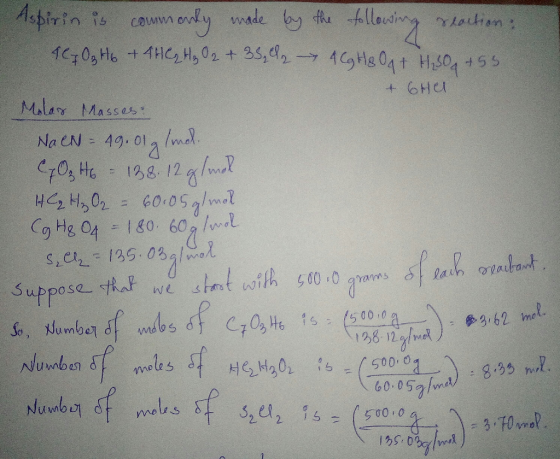
Aspirin is commonly made by the following reaction: 4C7O3H6 + 4HC2H3O2 + 3S2Cl2 4C9H8O4 + H2SO4...
Aspirin is commonly made by the following reaction:
4C7O3H6 + 4HC2H3O2 + 3S2Cl2  4C9H8O4 +
H2SO4 + 5 S +6 HCl
4C9H8O4 +
H2SO4 + 5 S +6 HCl
Suppose that you start with 500.0 grams of each reactant:
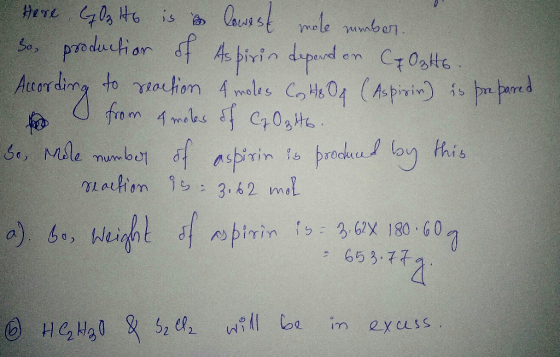
(a) How many grams of aspirin can be made?
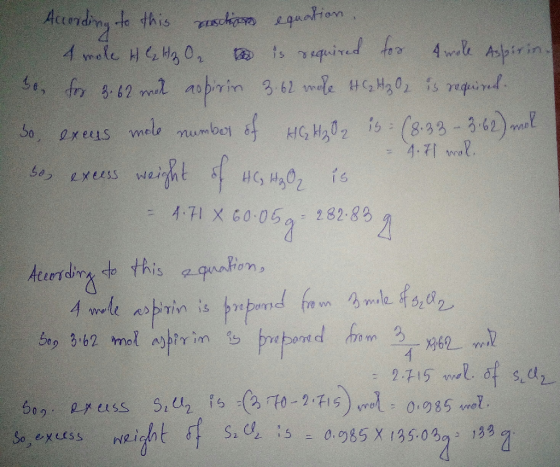
(b) Determine which two reactants will be in excess and by how many grams?
Molar Masses
NaCN=49.01g/mol
C7O3H6=138.12g/mol
HC2H3O2=60.05g/mol
C9H8O4=180.60g/mol
S2Cl2=135.03g/mol
Homework Answers
Add Answer to:
Aspirin is commonly made by the following reaction:
4C7O3H6 + 4HC2H3O2 + 3S2Cl2 4C9H8O4 +
H2SO4...
Aspirin can be made by reacting acetic anhydride (C4H6O3) with salicylic acid (C7H6O3) to form aspirin...
Aspirin can be made by reacting acetic anhydride (C4H6O3) with salicylic acid (C7H6O3) to form aspirin (C9H8O4). C4H6O3 + C7H6O3 --> C2H4O2 + C9H8O4 When synthesizing aspirin, a student began with 3.05 mL of acetic anhydride (density = 1.08 g/mL) and 1.85 g of salicylic acid. The reaction was allowed to run its course and 1.84 grams of aspirin was collected by the student. Determine the limiting reactant, theoretical yield of aspirin, and percent yield for the reaction.
Name Extra Credit 3. (a) Disulfide, SCl, is produced by the reaction of sulfur with chlorine...
 Name Extra Credit 3. (a) Disulfide, SCl, is produced by the reaction of sulfur with chlorine gas. How many grams of SC may be produced by the reaction of 15.0 g of S with 15.0g of Ca? Step 1: Balance the chemical equation: Se 1Cl2) 45,Cl) Step 2: Determine how many grams of S2Cl2 would be produced from 15.0 g Se. Start with grams of Se, use the molar mass of Se to get moles of Se. 16158mel ast as...
Chemistry 172 pre-lab questions 1. ch aspirin was made from a lab experiment. Preparation of Aspirin...
 Chemistry 172 pre-lab questions 1. ch aspirin was made from a lab experiment. Preparation of Aspirin A student would like to determine how much aspirin was made from The following is the lab data: Mass of flask 73.86 g Mass of flask & salicylic acid 77.88 g Mass of salicylic acid 4.02 g Mass of watch glass + filter paper 34.63 Mass of watch glass, filter paper & aspirin 38.29 g a. How much aspirin was made? b. The mass...
Learning Goal: To understand how to use stoichiometry to convert between quantities of reactants and products...
 Learning Goal: To understand how to use stoichiometry to convert between quantities of reactants and products in chemical equations Stoichiometry describes the quantitative relationships among the reactants and products of a balanced reaction by directly comparing mole ratios Stoichiometry can be used to convert mass, number of moles or number of particles between products and reactants, as shown in the flowchart displayed in the figure Review Constants Periodic Table To convert from a given quantity of one reactant or product...
CHIOMETRY: CHEMICAL REACTION CALCUATIONS: merical relationship among the reactants and products in a balanced equation (Chemic-...
 CHIOMETRY: CHEMICAL REACTION CALCUATIONS: merical relationship among the reactants and products in a balanced equation (Chemic- For example: Two magnesium atoms (a solid) when ignited, reacts with oxygen atoms to form eaction) The Balanced equation A balanced equation shows a chemical reaction in shorthand: magnesium oxide The meaning of a balanced Chemical Equation: A bookkeeping system The balanced equation- mole to mole ratios These mole to mole ratios are exact numbers. II. The Stoichiometric Pathway: # of particles of Known...
Phosphoric acid can be prepared from calcium phosphate according to the following reaction: Ca3(PO4)2 (s) +...
Phosphoric acid can be prepared from calcium phosphate according to the following reaction: Ca3(PO4)2 (s) + 3 H2SO4 (l) → 3 CaSO4 (s) + 2 H3PO4 (l) 310. g/mol 98.0 g/mol 136 g/mol 98.0 g/mol [a] If 0.664 mole of Ca3(PO4)2 are combined with 1.53 mole of H2SO4, how many grams of H3PO4 can be produced? [4 pts] [b] If 62.6 g of H3PO4 is actually produced in the above reaction, what is the percent yield for the reaction? [2...
Instructions: Use the following reaction to answer the questions in part ad Tom aspirin acetic acid...
 Instructions: Use the following reaction to answer the questions in part ad Tom aspirin acetic acid Salicylic P.M. - 138g/mol acetic anhydride P.M. -102.1g/mol PM180.2g/mol a. Calculate the theoretical yield if 6.0g of salicylic acid are reacted with 12mL of acetic anhydride (density 1.08g/ml) b. What is the limiting REAGENT and what is the excess REAGENT? c. How many moles of excess reagent did not react with the limiting reagent? d. f 6.9 g of aspirin are produced in an...
the first step in the reaction of Alka-Seltzer with stomach acid consists of one mole of...
 the first step in the reaction of Alka-Seltzer with stomach
acid consists of one mole of sodium bicarbonate (NaHCO3) reacting
with one mole of hydrochloric acid (HCl) to produce one mole of
carbonic acid (H2CO3), and one mole CNN of sodium chloride.
(NaCl)
Using this chemical stoichiometry, determine the number of moles of carbonic acid that can be produced from 5 mol NaHCO, and 8 mol HCI. moles of carbonic acid : mol Which of the two reactants limits the...
the first step in the reaction of Alka-Seltzer with stomach
acid consists of one mole of sodium bicarbonate (NaHCO3) reacting
with one mole of hydrochloric acid (HCl) to produce one mole of
carbonic acid (H2CO3), and one mole CNN of sodium chloride.
(NaCl)
Using this chemical stoichiometry, determine the number of moles of carbonic acid that can be produced from 5 mol NaHCO, and 8 mol HCI. moles of carbonic acid : mol Which of the two reactants limits the...
A iz- Requires Respondus LockDown Browser Time Left:0:45:19 Christian Velasquez: Attempt 1 Next Page Page 3...
 A iz- Requires Respondus LockDown Browser Time Left:0:45:19 Christian Velasquez: Attempt 1 Next Page Page 3 of 3 Question 3 (16 points) ✓ Saved Tetraphosphorus hexaoxide is formed by the reaction of phosphorus with oxygen gas. (Molar masses of P40g: 219.9 g/mol; P4: 123.88 g/mol; O2: 31.9988 g/mol). P4() + 302(9) - --------->P,Og(s) If a mixture of 75.3 g of phosphorus and 38.7 g of oxygen produce of P.06 a. Identify by calculations the limiting reactant (write the name not...
Exercise 7: The % Yield of Aspirin Name Date Read Exercise 7 in your lab manual....
 Exercise 7: The % Yield of Aspirin Name Date Read Exercise 7 in your lab manual. Complete the Pre-lab Assignment. In this substitute lab exercise, you will watch a short video on preparing aspirin. The video is posted on the course Moodle page, and it provides the masses of the reactants and the product; you should be able to calculate the theoretical yield and the % yield from the data given by the video. Submit the completed assignment by March...
 Name Extra Credit 3. (a) Disulfide, SCl, is produced by the reaction of sulfur with chlorine gas. How many grams of SC may be produced by the reaction of 15.0 g of S with 15.0g of Ca? Step 1: Balance the chemical equation: Se 1Cl2) 45,Cl) Step 2: Determine how many grams of S2Cl2 would be produced from 15.0 g Se. Start with grams of Se, use the molar mass of Se to get moles of Se. 16158mel ast as...
 Chemistry 172 pre-lab questions 1. ch aspirin was made from a lab experiment. Preparation of Aspirin A student would like to determine how much aspirin was made from The following is the lab data: Mass of flask 73.86 g Mass of flask & salicylic acid 77.88 g Mass of salicylic acid 4.02 g Mass of watch glass + filter paper 34.63 Mass of watch glass, filter paper & aspirin 38.29 g a. How much aspirin was made? b. The mass...
 Learning Goal: To understand how to use stoichiometry to convert between quantities of reactants and products in chemical equations Stoichiometry describes the quantitative relationships among the reactants and products of a balanced reaction by directly comparing mole ratios Stoichiometry can be used to convert mass, number of moles or number of particles between products and reactants, as shown in the flowchart displayed in the figure Review Constants Periodic Table To convert from a given quantity of one reactant or product...
 CHIOMETRY: CHEMICAL REACTION CALCUATIONS: merical relationship among the reactants and products in a balanced equation (Chemic- For example: Two magnesium atoms (a solid) when ignited, reacts with oxygen atoms to form eaction) The Balanced equation A balanced equation shows a chemical reaction in shorthand: magnesium oxide The meaning of a balanced Chemical Equation: A bookkeeping system The balanced equation- mole to mole ratios These mole to mole ratios are exact numbers. II. The Stoichiometric Pathway: # of particles of Known...
 Instructions: Use the following reaction to answer the questions in part ad Tom aspirin acetic acid Salicylic P.M. - 138g/mol acetic anhydride P.M. -102.1g/mol PM180.2g/mol a. Calculate the theoretical yield if 6.0g of salicylic acid are reacted with 12mL of acetic anhydride (density 1.08g/ml) b. What is the limiting REAGENT and what is the excess REAGENT? c. How many moles of excess reagent did not react with the limiting reagent? d. f 6.9 g of aspirin are produced in an...
 the first step in the reaction of Alka-Seltzer with stomach
acid consists of one mole of sodium bicarbonate (NaHCO3) reacting
with one mole of hydrochloric acid (HCl) to produce one mole of
carbonic acid (H2CO3), and one mole CNN of sodium chloride.
(NaCl)
Using this chemical stoichiometry, determine the number of moles of carbonic acid that can be produced from 5 mol NaHCO, and 8 mol HCI. moles of carbonic acid : mol Which of the two reactants limits the...
the first step in the reaction of Alka-Seltzer with stomach
acid consists of one mole of sodium bicarbonate (NaHCO3) reacting
with one mole of hydrochloric acid (HCl) to produce one mole of
carbonic acid (H2CO3), and one mole CNN of sodium chloride.
(NaCl)
Using this chemical stoichiometry, determine the number of moles of carbonic acid that can be produced from 5 mol NaHCO, and 8 mol HCI. moles of carbonic acid : mol Which of the two reactants limits the...
 A iz- Requires Respondus LockDown Browser Time Left:0:45:19 Christian Velasquez: Attempt 1 Next Page Page 3 of 3 Question 3 (16 points) ✓ Saved Tetraphosphorus hexaoxide is formed by the reaction of phosphorus with oxygen gas. (Molar masses of P40g: 219.9 g/mol; P4: 123.88 g/mol; O2: 31.9988 g/mol). P4() + 302(9) - --------->P,Og(s) If a mixture of 75.3 g of phosphorus and 38.7 g of oxygen produce of P.06 a. Identify by calculations the limiting reactant (write the name not...
 Exercise 7: The % Yield of Aspirin Name Date Read Exercise 7 in your lab manual. Complete the Pre-lab Assignment. In this substitute lab exercise, you will watch a short video on preparing aspirin. The video is posted on the course Moodle page, and it provides the masses of the reactants and the product; you should be able to calculate the theoretical yield and the % yield from the data given by the video. Submit the completed assignment by March...
Most questions answered within 3 hours.
-
Where is the error in this code sequence?
String s1 = "Hello";
String s2 = "ello";...
asked 10 months ago -
Financial data for Joel de Paris, Inc., for last year
follow:
Joel de Paris, Inc.
Balance...
asked 10 months ago -
Consider this reaction:
Al2(SO4)3 (aq)+ BaCl3
(aq) Al2Cl6 (aq)- +
3BaSO4(s) . What is the...
asked 10 months ago -
Suppose that Savneet is considering increasing her
recent random sample from 20 car rentals to 40...
asked 10 months ago -
Trucks arrive at an unloading terminal at an average rate of 120
per hour.
Trucks arrive...
asked 10 months ago -
Why are methanol and ethanol completely soluble in water while
octanol is not very little soluble....
asked 10 months ago -
A facilities manager at a university reads in a research report
that the mean amount of...
asked 10 months ago -
When the CuSO4 is rehydrated by adding water to the anhydrous
compound, is this an endothermic...
asked 10 months ago -
A ray of sunlight is passing from diamond into crown glass; the
angle of incidence is...
asked 10 months ago -
A block of mass 0.249 kg is placed on top of a light, vertical
spring of...
asked 10 months ago -
how do the kidneys compensate in the presences of acidosis
a) trigger hyperventilate
b) reserve acid...
asked 10 months ago -
Question 501 pts
The rental rate of capital to the firm increases. Which of the
following...
asked 10 months ago