
Homework Answers
Add Answer to:
Consider the solid that lies below the surface z = xy and above the following rectangle....
Estimate the volume of the solid that lies below the surface z = xy and above...
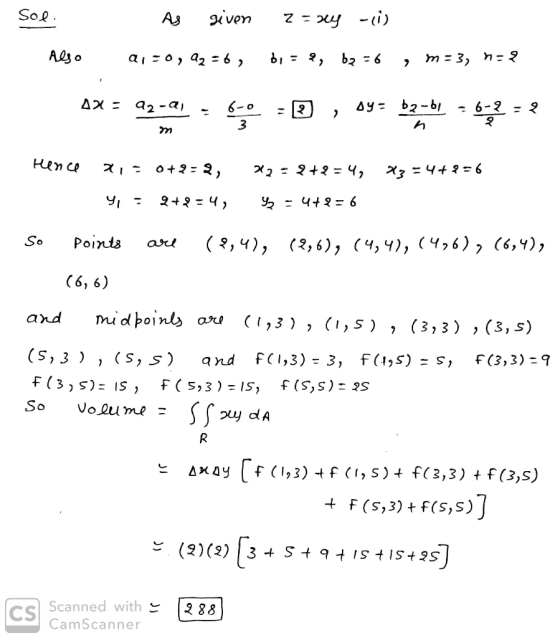
 Estimate the volume of the solid that lies below the surface z = xy and above the following rectangle. R = = {(x, y) | 2 5x58,2 sys vs6} (a) Use a Riemann sum with m = 3, n = 2, and take the sample point to be the upper right corner of each square. (b) Use the Midpoint Rule to estimate the volume of the solid.
(1 point) Consider the solid that lies above the rectangle (in the xy-plane) R = [-2,...
 (1 point) Consider the solid that lies above the rectangle (in the xy-plane) R = [-2, 2] x [0, 2], and below the surface z = x2 - 7y + 14. (A) Estimate the volume by dividing Rinto 4 rectangles of equal size, each twice as wide as high, and choosing the sample points to result in the largest possible Riemann sum. Riemann sum = (B) Estimate the volume by dividing Rinto 4 rectangles of equal size, each twice as...
Estimate the volume of the solid that lies below the surface z=1+x^2+3y
Estimate the volume of the solid that lies below the surface z=1+x^2+3y and above the rectangle R= [1,2] X [0,3]. Use a Riemann sum with m=n=2 and choose the samplepoints to be the lower left corners.
riemann sum
(a) Estimate the volume of the solid that lies below the surface z = xy and above the following rectangle.R = (x, y)|0 = x = 6, 6 = y = 10Use a Riemann sum with m = 3, n = 2, and take the sample point to be the upper right corner of each square. (please give exact answer)V = ______V = ______
Find the volume of the solid lying under the surface z = xy and above the...
 Find the volume of the solid lying under the surface z = xy and above the rectangle [0,1] [0,2]. Evaluate the double integral where D is the region bounded by the y-axis, 2y = x, and y = 1. e-y²/2dA D
(1 point) Consider the solid that lies above the square (in the xy-plane) R = [0,2]...
 (1 point) Consider the solid that lies above the square (in the xy-plane) R = [0,2] x [0,2], and below the elliptic paraboloid z = = 64 – x2 – 2y2. (A) Estimate the volume by dividing R into 4 equal squares and choosing the sample points to lie in the lower left hand corners. (B) Estimate the volume by dividing R into 4 equal squares and choosing the sample points to lie in the upper right hand corners. (C)...
Find the volume of the solid bounded above by the surface z = f(x,y) and below by the plane regio...
Find the volume of the solid bounded above by the surface z = f(x,y) and below by the plane region R. f(x, y) = x2 + y2; R is the rectangle with vertices (0, 0), (9, 0), (9, 6), (0, 6) ( ) cu units
Let E be the solid that lies inside the cylinder x^2 + y^2 = 1, above the xy-plane, and below the...
 Let E be the solid that lies inside the cylinder x^2 + y^2 = 1,
above the xy-plane, and below the plane z = 1 + x. Let S be the
surface that encloses E. Note that S consists of three sides: S1 is
given by the cylinder x^2 + y^2 = 1, the bottom S2 is the disk x^2
+ y^2 ≤ 1 in the plane z = 0, and the top S3 is part of the plane z...
Let E be the solid that lies inside the cylinder x^2 + y^2 = 1,
above the xy-plane, and below the plane z = 1 + x. Let S be the
surface that encloses E. Note that S consists of three sides: S1 is
given by the cylinder x^2 + y^2 = 1, the bottom S2 is the disk x^2
+ y^2 ≤ 1 in the plane z = 0, and the top S3 is part of the plane z...
EXAMPLE 4 Find the volume of the solid that lies under the paraboloid z 5x2 - 5y2, above the xy-p...
 EXAMPLE 4 Find the volume of the solid that lies under the paraboloid z 5x2 - 5y2, above the xy-plane, and inside the cylinder x2 + y2-2x (x-1)2 + y2=1 or r 2 cos 8 SOLUTION The solid lies above the disk D whose boundary circle has equation x2 +y2x or, after completing the square, In polar coordinates we have x2 +y Thus the disk D is given by and x-r cos(), so the boundary circle becomes 2r cos(), or...
Use a change of variables to find the volume of the solid region lying below the surface -f(x, y) and above the plane region R x, y)xy)e- R: region bounded by the square with vertices (4, 0), (6, 2),...
 Use a change of variables to find the volume of the solid region lying below the surface -f(x, y) and above the plane region R x, y)xy)e- R: region bounded by the square with vertices (4, 0), (6, 2), (4, 4), (2, 2)
Use a change of variables to find the volume of the solid region lying below the surface -f(x, y) and above the plane region R x, y)xy)e- R: region bounded by the square with vertices (4, 0),...
Use a change of variables to find the volume of the solid region lying below the surface -f(x, y) and above the plane region R x, y)xy)e- R: region bounded by the square with vertices (4, 0), (6, 2), (4, 4), (2, 2)
Use a change of variables to find the volume of the solid region lying below the surface -f(x, y) and above the plane region R x, y)xy)e- R: region bounded by the square with vertices (4, 0),...
 Estimate the volume of the solid that lies below the surface z = xy and above the following rectangle. R = = {(x, y) | 2 5x58,2 sys vs6} (a) Use a Riemann sum with m = 3, n = 2, and take the sample point to be the upper right corner of each square. (b) Use the Midpoint Rule to estimate the volume of the solid.
 (1 point) Consider the solid that lies above the rectangle (in the xy-plane) R = [-2, 2] x [0, 2], and below the surface z = x2 - 7y + 14. (A) Estimate the volume by dividing Rinto 4 rectangles of equal size, each twice as wide as high, and choosing the sample points to result in the largest possible Riemann sum. Riemann sum = (B) Estimate the volume by dividing Rinto 4 rectangles of equal size, each twice as...
 Find the volume of the solid lying under the surface z = xy and above the rectangle [0,1] [0,2]. Evaluate the double integral where D is the region bounded by the y-axis, 2y = x, and y = 1. e-y²/2dA D
 (1 point) Consider the solid that lies above the square (in the xy-plane) R = [0,2] x [0,2], and below the elliptic paraboloid z = = 64 – x2 – 2y2. (A) Estimate the volume by dividing R into 4 equal squares and choosing the sample points to lie in the lower left hand corners. (B) Estimate the volume by dividing R into 4 equal squares and choosing the sample points to lie in the upper right hand corners. (C)...
 Let E be the solid that lies inside the cylinder x^2 + y^2 = 1,
above the xy-plane, and below the plane z = 1 + x. Let S be the
surface that encloses E. Note that S consists of three sides: S1 is
given by the cylinder x^2 + y^2 = 1, the bottom S2 is the disk x^2
+ y^2 ≤ 1 in the plane z = 0, and the top S3 is part of the plane z...
Let E be the solid that lies inside the cylinder x^2 + y^2 = 1,
above the xy-plane, and below the plane z = 1 + x. Let S be the
surface that encloses E. Note that S consists of three sides: S1 is
given by the cylinder x^2 + y^2 = 1, the bottom S2 is the disk x^2
+ y^2 ≤ 1 in the plane z = 0, and the top S3 is part of the plane z...
 EXAMPLE 4 Find the volume of the solid that lies under the paraboloid z 5x2 - 5y2, above the xy-plane, and inside the cylinder x2 + y2-2x (x-1)2 + y2=1 or r 2 cos 8 SOLUTION The solid lies above the disk D whose boundary circle has equation x2 +y2x or, after completing the square, In polar coordinates we have x2 +y Thus the disk D is given by and x-r cos(), so the boundary circle becomes 2r cos(), or...
 Use a change of variables to find the volume of the solid region lying below the surface -f(x, y) and above the plane region R x, y)xy)e- R: region bounded by the square with vertices (4, 0), (6, 2), (4, 4), (2, 2)
Use a change of variables to find the volume of the solid region lying below the surface -f(x, y) and above the plane region R x, y)xy)e- R: region bounded by the square with vertices (4, 0),...
Use a change of variables to find the volume of the solid region lying below the surface -f(x, y) and above the plane region R x, y)xy)e- R: region bounded by the square with vertices (4, 0), (6, 2), (4, 4), (2, 2)
Use a change of variables to find the volume of the solid region lying below the surface -f(x, y) and above the plane region R x, y)xy)e- R: region bounded by the square with vertices (4, 0),...
Most questions answered within 3 hours.
-
Where is the error in this code sequence?
String s1 = "Hello";
String s2 = "ello";...
asked 10 months ago -
Financial data for Joel de Paris, Inc., for last year
follow:
Joel de Paris, Inc.
Balance...
asked 10 months ago -
Consider this reaction:
Al2(SO4)3 (aq)+ BaCl3
(aq) Al2Cl6 (aq)- +
3BaSO4(s) . What is the...
asked 10 months ago -
Suppose that Savneet is considering increasing her
recent random sample from 20 car rentals to 40...
asked 10 months ago -
Trucks arrive at an unloading terminal at an average rate of 120
per hour.
Trucks arrive...
asked 10 months ago -
Why are methanol and ethanol completely soluble in water while
octanol is not very little soluble....
asked 10 months ago -
A facilities manager at a university reads in a research report
that the mean amount of...
asked 10 months ago -
When the CuSO4 is rehydrated by adding water to the anhydrous
compound, is this an endothermic...
asked 10 months ago -
A ray of sunlight is passing from diamond into crown glass; the
angle of incidence is...
asked 10 months ago -
A block of mass 0.249 kg is placed on top of a light, vertical
spring of...
asked 10 months ago -
how do the kidneys compensate in the presences of acidosis
a) trigger hyperventilate
b) reserve acid...
asked 10 months ago -
Question 501 pts
The rental rate of capital to the firm increases. Which of the
following...
asked 10 months ago