
Homework Answers
Add Answer to:
In this problem we consider rotational motion of a diatomic molecule such as carbon monoxide or...
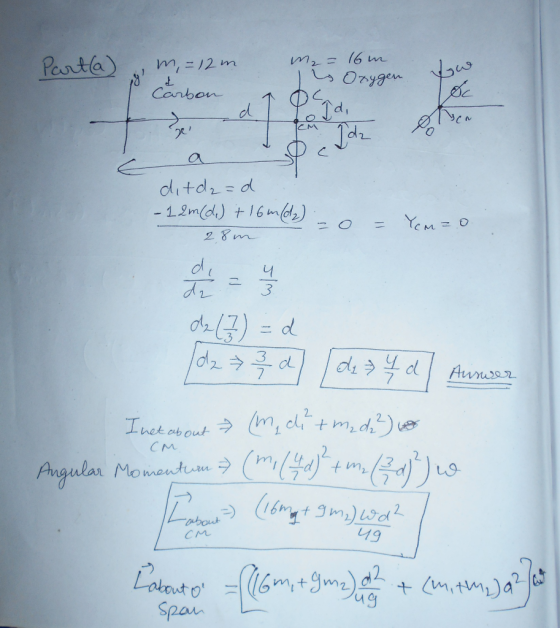
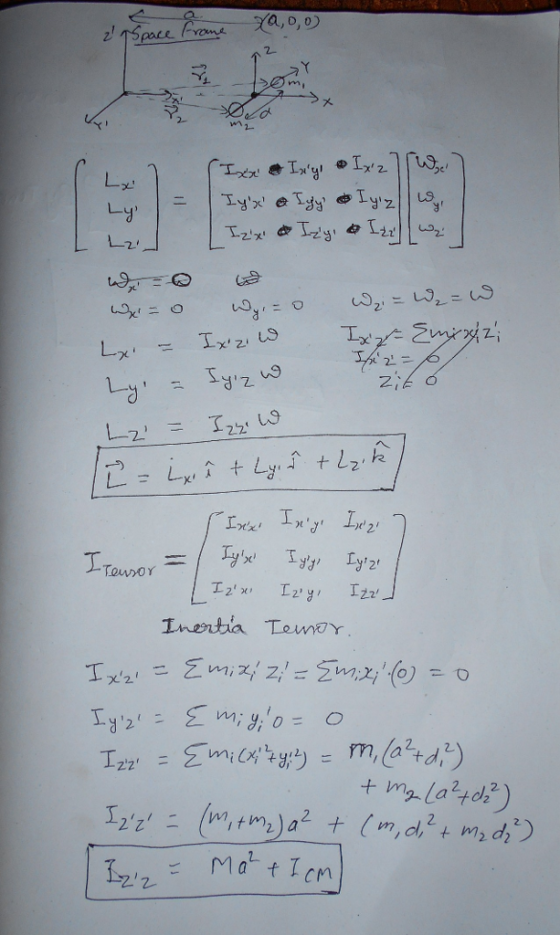
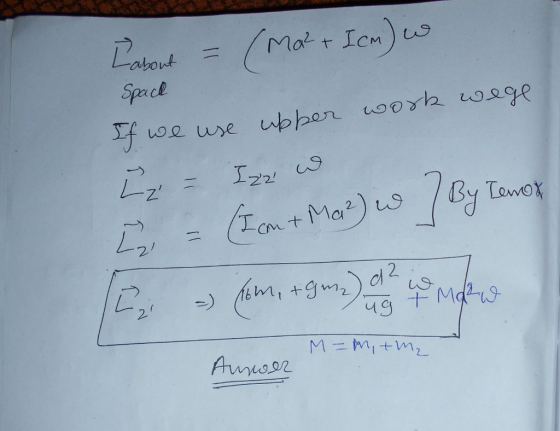
Consider a rigid heteronuclear diatomic molecule of bond length d rotating in the xy plane about...
 Consider a rigid heteronuclear diatomic molecule of bond length d rotating in the xy plane about the z-axis. We have seen that the Hamiltonian for this system is H = P2/(2), where y is the reduced mass, and p = ( y) is the relative momentum. Define the angular momentum operator about the z-axis as L. = fpy - yp... a. Show that Ê, Î2] = 0. b. Show, therefore, that the eigenfunctions of A are also eigenfunctions of L....
Please fully answer ALL parts! :-) Thank you so much in advance!! 1) This week, we...
 Please fully answer ALL parts!
:-) Thank you so much in advance!!
1) This week, we introduced a new model, the rigid rotor, that can be used to describe rotating molecules. Before we get into problems that describe the quantum properties of a rigid rotor, let's quickly review the classical behavior of a rotating molecule. Consider a single atom with mass m rotating about the origin in a circular orbit with radius r. If the particle's linear momentum is p...
Please fully answer ALL parts!
:-) Thank you so much in advance!!
1) This week, we introduced a new model, the rigid rotor, that can be used to describe rotating molecules. Before we get into problems that describe the quantum properties of a rigid rotor, let's quickly review the classical behavior of a rotating molecule. Consider a single atom with mass m rotating about the origin in a circular orbit with radius r. If the particle's linear momentum is p...
Problem 1 (5 pt.) In the last class, we will consider the gyroscopie motion of a...
 Problem 1 (5 pt.) In the last class, we will consider the gyroscopie motion of a heavy symmetrical top whose lowest point is fixed. The effective potential energy of the top is given by + mgl cos ?, where M, is the constant angular momentum component along the vertical Z axis (fixed), Ms is the constant angular momentum component along the zs axis (the moving axis of symmetry of the top), i is the principal moment of inertia about the...
Please solve only (e), and only if you're certain you're correct. Thank you. Angular momentum and...
 Please solve only (e), and only if you're certain you're
correct. Thank you.
Angular momentum and choice of origin: Adding angular momentum to a collision problem often feels confusing or ad hoc. What we're going to do here is verify that adding angular momentum to a collision problem isn't incompatible with anything we've done previously, by considering a very simple collision problem: One particle, moving with a velocity vo, collides with another, sticks with it, and then they move together...
Please solve only (e), and only if you're certain you're
correct. Thank you.
Angular momentum and choice of origin: Adding angular momentum to a collision problem often feels confusing or ad hoc. What we're going to do here is verify that adding angular momentum to a collision problem isn't incompatible with anything we've done previously, by considering a very simple collision problem: One particle, moving with a velocity vo, collides with another, sticks with it, and then they move together...
please guys this is one question with 2 parts. A student sits on a freely rotating...
 please guys this is one question with 2
parts.
A student sits on a freely rotating stool holding two dumbbells, each of mass 3.05 kg (see figure below). When his arms are extended horizontally (Figure a), the dumbbells are 1.07 m from the axis of rotation and the student rotates with an angular speed of 0.740 rad's. The moment of inertia of the student plus stool is 2.57 kg: m2 and is assumed to be constant. The student pulls the...
please guys this is one question with 2
parts.
A student sits on a freely rotating stool holding two dumbbells, each of mass 3.05 kg (see figure below). When his arms are extended horizontally (Figure a), the dumbbells are 1.07 m from the axis of rotation and the student rotates with an angular speed of 0.740 rad's. The moment of inertia of the student plus stool is 2.57 kg: m2 and is assumed to be constant. The student pulls the...
Problem 2 (10 pt.) A homogeneous sphere of mass m and radius b is rolling on...
 Problem 2 (10 pt.) A homogeneous sphere of mass m and radius b is rolling on an inclined plane with inclination angle ? in the gravitational field g. Follow the steps below to find the velocity V of the center of mass of the sphere as a function of time if the sphere is initially at rest. Bold font represents vectors. There exists a reaction force R at the point of contact between the sphere and the plane. The equations...
The tidal forces between the Earth and the Moon slowed down the Moon’s rotation about its own axis until the rotation period became equal to the Moon’s orbital period around the Earth as we observe today.
 The tidal forces between the Earth and the Moon slowed down the Moon's rotation about its own axis until the rotation period became equal to the Moon's orbital period around the Earth as we observe today. The same effect is also slowing down the Earth's rotation about its own axis and increasing the separation \(D\) between the Moon and the Earth at a rate of \(\Delta D / \Delta t=3.8 \mathrm{~cm}\) per year. In this problem, you can ignore the...
could you please solve a and b? Chapier 2i. Note: you needn't derive Kepler's laws-but do...
 could you please solve a and b?
Chapier 2i. Note: you needn't derive Kepler's laws-but do mention when you are using them, an describe the physical concepts involved and the meanings behind the variables. u) Consider two stars Mi and M; bound together by their mutual gravitational force (and isolated from other forces) moving in elliptical orbits (of eccentricity e and semi-major axes ai and az) at distances 11 in n and r from their center of mass located at...
could you please solve a and b?
Chapier 2i. Note: you needn't derive Kepler's laws-but do mention when you are using them, an describe the physical concepts involved and the meanings behind the variables. u) Consider two stars Mi and M; bound together by their mutual gravitational force (and isolated from other forces) moving in elliptical orbits (of eccentricity e and semi-major axes ai and az) at distances 11 in n and r from their center of mass located at...
the question is in last picture. i provided the lab content... I need guidance. thank you....
 the question is in last picture. i provided the lab content...
I need guidance. thank you.
INVESTIGATION 10 ROTATIONAL MOTION OBJECTIVE To determine the moment of inertia I of a heavy composite disk by plotting measured values of torque versus angular acceleration. THEORY Newton's second law states that for translational motion (motion in a straight line) an unbalanced force on an object results in an acceleration which is proportional to the mass of the object. This means that the heavier...
the question is in last picture. i provided the lab content...
I need guidance. thank you.
INVESTIGATION 10 ROTATIONAL MOTION OBJECTIVE To determine the moment of inertia I of a heavy composite disk by plotting measured values of torque versus angular acceleration. THEORY Newton's second law states that for translational motion (motion in a straight line) an unbalanced force on an object results in an acceleration which is proportional to the mass of the object. This means that the heavier...
Procedure 1, 2, 3 Mass of a clamp: 21.5 True mass of meter stick: _133.6 g...
 Procedure 1, 2, 3 Mass of a clamp: 21.5 True mass of meter stick: _133.6 g Center of mass of meter stick: _50 cm True weight of unknown mass: _212.99_ Procedure 4 Position of the 100-g mass: 10.0 cm Position of equilibrium: _30.9 cm Mass of the stick from method of torques: Procedure 5 Position of the 100-g mass: 10.0 cm Position of the 200-g mass: _90.0 cm Position of equilibrium of meter stick: Procedure 6 Position of unknown mass...
 Consider a rigid heteronuclear diatomic molecule of bond length d rotating in the xy plane about the z-axis. We have seen that the Hamiltonian for this system is H = P2/(2), where y is the reduced mass, and p = ( y) is the relative momentum. Define the angular momentum operator about the z-axis as L. = fpy - yp... a. Show that Ê, Î2] = 0. b. Show, therefore, that the eigenfunctions of A are also eigenfunctions of L....
 Please fully answer ALL parts!
:-) Thank you so much in advance!!
1) This week, we introduced a new model, the rigid rotor, that can be used to describe rotating molecules. Before we get into problems that describe the quantum properties of a rigid rotor, let's quickly review the classical behavior of a rotating molecule. Consider a single atom with mass m rotating about the origin in a circular orbit with radius r. If the particle's linear momentum is p...
Please fully answer ALL parts!
:-) Thank you so much in advance!!
1) This week, we introduced a new model, the rigid rotor, that can be used to describe rotating molecules. Before we get into problems that describe the quantum properties of a rigid rotor, let's quickly review the classical behavior of a rotating molecule. Consider a single atom with mass m rotating about the origin in a circular orbit with radius r. If the particle's linear momentum is p...
 Problem 1 (5 pt.) In the last class, we will consider the gyroscopie motion of a heavy symmetrical top whose lowest point is fixed. The effective potential energy of the top is given by + mgl cos ?, where M, is the constant angular momentum component along the vertical Z axis (fixed), Ms is the constant angular momentum component along the zs axis (the moving axis of symmetry of the top), i is the principal moment of inertia about the...
 Please solve only (e), and only if you're certain you're
correct. Thank you.
Angular momentum and choice of origin: Adding angular momentum to a collision problem often feels confusing or ad hoc. What we're going to do here is verify that adding angular momentum to a collision problem isn't incompatible with anything we've done previously, by considering a very simple collision problem: One particle, moving with a velocity vo, collides with another, sticks with it, and then they move together...
Please solve only (e), and only if you're certain you're
correct. Thank you.
Angular momentum and choice of origin: Adding angular momentum to a collision problem often feels confusing or ad hoc. What we're going to do here is verify that adding angular momentum to a collision problem isn't incompatible with anything we've done previously, by considering a very simple collision problem: One particle, moving with a velocity vo, collides with another, sticks with it, and then they move together...
 please guys this is one question with 2
parts.
A student sits on a freely rotating stool holding two dumbbells, each of mass 3.05 kg (see figure below). When his arms are extended horizontally (Figure a), the dumbbells are 1.07 m from the axis of rotation and the student rotates with an angular speed of 0.740 rad's. The moment of inertia of the student plus stool is 2.57 kg: m2 and is assumed to be constant. The student pulls the...
please guys this is one question with 2
parts.
A student sits on a freely rotating stool holding two dumbbells, each of mass 3.05 kg (see figure below). When his arms are extended horizontally (Figure a), the dumbbells are 1.07 m from the axis of rotation and the student rotates with an angular speed of 0.740 rad's. The moment of inertia of the student plus stool is 2.57 kg: m2 and is assumed to be constant. The student pulls the...
 Problem 2 (10 pt.) A homogeneous sphere of mass m and radius b is rolling on an inclined plane with inclination angle ? in the gravitational field g. Follow the steps below to find the velocity V of the center of mass of the sphere as a function of time if the sphere is initially at rest. Bold font represents vectors. There exists a reaction force R at the point of contact between the sphere and the plane. The equations...
 could you please solve a and b?
Chapier 2i. Note: you needn't derive Kepler's laws-but do mention when you are using them, an describe the physical concepts involved and the meanings behind the variables. u) Consider two stars Mi and M; bound together by their mutual gravitational force (and isolated from other forces) moving in elliptical orbits (of eccentricity e and semi-major axes ai and az) at distances 11 in n and r from their center of mass located at...
could you please solve a and b?
Chapier 2i. Note: you needn't derive Kepler's laws-but do mention when you are using them, an describe the physical concepts involved and the meanings behind the variables. u) Consider two stars Mi and M; bound together by their mutual gravitational force (and isolated from other forces) moving in elliptical orbits (of eccentricity e and semi-major axes ai and az) at distances 11 in n and r from their center of mass located at...
 the question is in last picture. i provided the lab content...
I need guidance. thank you.
INVESTIGATION 10 ROTATIONAL MOTION OBJECTIVE To determine the moment of inertia I of a heavy composite disk by plotting measured values of torque versus angular acceleration. THEORY Newton's second law states that for translational motion (motion in a straight line) an unbalanced force on an object results in an acceleration which is proportional to the mass of the object. This means that the heavier...
the question is in last picture. i provided the lab content...
I need guidance. thank you.
INVESTIGATION 10 ROTATIONAL MOTION OBJECTIVE To determine the moment of inertia I of a heavy composite disk by plotting measured values of torque versus angular acceleration. THEORY Newton's second law states that for translational motion (motion in a straight line) an unbalanced force on an object results in an acceleration which is proportional to the mass of the object. This means that the heavier...
 Procedure 1, 2, 3 Mass of a clamp: 21.5 True mass of meter stick: _133.6 g Center of mass of meter stick: _50 cm True weight of unknown mass: _212.99_ Procedure 4 Position of the 100-g mass: 10.0 cm Position of equilibrium: _30.9 cm Mass of the stick from method of torques: Procedure 5 Position of the 100-g mass: 10.0 cm Position of the 200-g mass: _90.0 cm Position of equilibrium of meter stick: Procedure 6 Position of unknown mass...
Most questions answered within 3 hours.
-
Where is the error in this code sequence?
String s1 = "Hello";
String s2 = "ello";...
asked 11 months ago -
Financial data for Joel de Paris, Inc., for last year
follow:
Joel de Paris, Inc.
Balance...
asked 11 months ago -
Consider this reaction:
Al2(SO4)3 (aq)+ BaCl3
(aq) Al2Cl6 (aq)- +
3BaSO4(s) . What is the...
asked 11 months ago -
Suppose that Savneet is considering increasing her
recent random sample from 20 car rentals to 40...
asked 11 months ago -
Trucks arrive at an unloading terminal at an average rate of 120
per hour.
Trucks arrive...
asked 11 months ago -
Why are methanol and ethanol completely soluble in water while
octanol is not very little soluble....
asked 11 months ago -
A facilities manager at a university reads in a research report
that the mean amount of...
asked 11 months ago -
When the CuSO4 is rehydrated by adding water to the anhydrous
compound, is this an endothermic...
asked 11 months ago -
A ray of sunlight is passing from diamond into crown glass; the
angle of incidence is...
asked 11 months ago -
A block of mass 0.249 kg is placed on top of a light, vertical
spring of...
asked 11 months ago -
how do the kidneys compensate in the presences of acidosis
a) trigger hyperventilate
b) reserve acid...
asked 11 months ago -
Question 501 pts
The rental rate of capital to the firm increases. Which of the
following...
asked 11 months ago