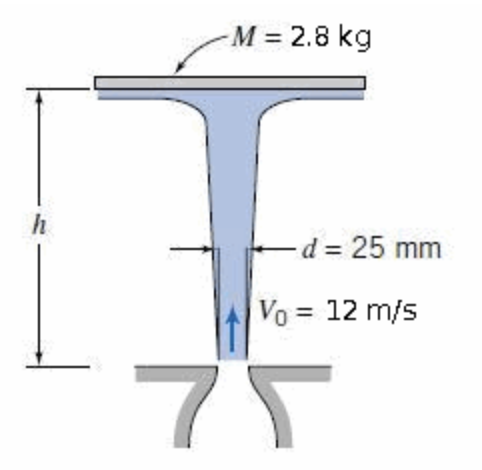
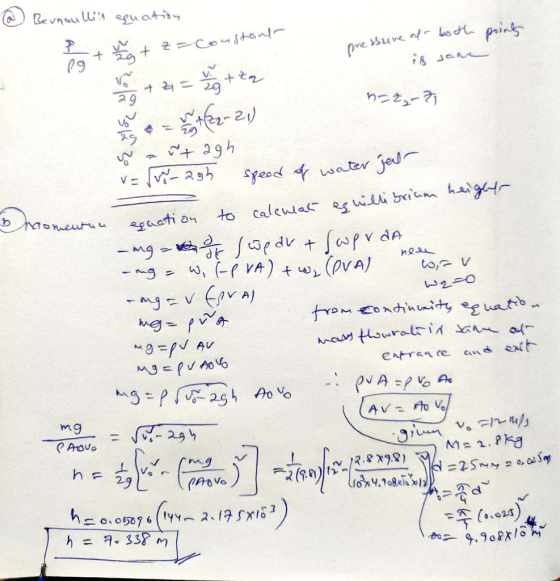
A 2.8-kg disk is constrained horizontally but is free to move vertically. The disk is struck from below by a vertical jet of water. The speed and diameter of the water jet are 12 m/s and 25 mm at the nozzle exit. (a) Obtain a general expression for the speed of the water jet as a function of height, h. (b) Find the height to which the disk will rise and remain stationary.
Homework Answers
Add Answer to:
A 2.8-kg disk is constrained horizontally but is free to move
vertically. The disk is struck...
Problem 6.031 A cone that is held stable by a wire is free to move in...
 Problem 6.031 A cone that is held stable by a wire is free to move in the vertical direction and has a jet of water (at 10°C) striking it from below. The cone weighs 30 N. The initial speed of the jet as it comes from the orifice is 35 m/s, and the initial jet diameter is 2 cm. Find the height to which the cone will rise and remain stationary. Note: The wire is only for stability and should...
* * * FIVE STAR * * 1. A projectile of mass 0.30 kg moving horizontally...
 * * * FIVE STAR * * 1. A projectile of mass 0.30 kg moving horizontally with speed 20 m/s strikes a stationary mass (3.8 kg) suspended by strings. Subsequently, the masses rise to a height of H. What is the final height H? (see lecture note chapter 7)
Question 2 (6 marks) A vane with an angle of 30° is attached to a cart...
 Question 2 (6 marks) A vane with an angle of 30° is attached to a cart (Figure 2). The cart and vane (mass of 75 kg) move on a level track with a constant speed of 10 m/s. The vane receives a jet of water (p = 1000 kg/m) that leaves a stationary nozzle with speed of 35 m/s. The nozzle exit area is 0.003 m². Assume that this cross-sectional area of the water stream does not change as it...
Water (p = 1,000 kg/m?) flows steadily through a 90° elbow and exits as a free...
 Water (p = 1,000 kg/m?) flows steadily through a 90° elbow and exits as a free jet through a nozzle, as shown below. The measured upstream gage pressure is 800 kPa. Neglect body forces and viscous effects, and disregard the height of the elbow/nozzle combination. The water velocity at any cross section is assumed to be uniform. However, the water velocity inside the elbow is not negligible compared to that in the nozzle. Consider the following: Determine the velocities V,...
Problem 14.47) Disks A, B, C, and D can ślide freely on a frictionless horizontal surface. Disks B, C, and D are connected by light rods and are at rest in the position shown when disk B is str...
 Problem 14.47) Disks A, B, C, and D can ślide freely on a frictionless horizontal surface. Disks B, C, and D are connected by light rods and are at rest in the position shown when disk B is struck squarely by disk A which is moving to the right with a velocity vo 12 m/s. The masses of the disks are m,-m,-mc - 7.5 kg, and m 15 kg. Knowing that after impact disks A and B are bound togetherV)...
V cart Nozzle V. jet- 4. (20 pts) A 3-cm-diameter water jet moving at 40 m/s...
 V cart Nozzle V. jet- 4. (20 pts) A 3-cm-diameter water jet moving at 40 m/s velocity in x-direction strikes the vertical back surface of a cart moving horizontally at a constant speed of 10 m/s in the flow direction. After the strike, the water stream splatters off in all directions in the plane of the back surface. Using the moving control volume indicated with dashed lines in the figure, determine: Waterjeti F. Rx X a) The relative velocity and...
A 0.00600 kg bullet traveling horizontally with speed 1.00 103 m/s strikes a 20.8 kg door, embedding itself 11.0 cm from the side opposite the hinges. The 1.00 m wide door is free to swing on its frictionless hinges.
 A 0.00600 kg bullet traveling horizontally with speed 1.00 103 m/s strikes a 20.8 kg door, embedding itself 11.0 cm from the side opposite the hinges as shown in the figure below. The 1.00 m wide door is free to swing on its frictionless hinges.What is the angular momentum? At what angular speed (rad/s) does the door swing open immediately after the collision? Calculate the total energy of the bullet-door system and determine whether it is less than or equal...
1.) Rotational Motion a.) A thin solid disk of radius R = 0.5 m and mass...
1.) Rotational Motion a.) A thin solid disk of radius R = 0.5 m and mass M = 2.0 kg is rolling without slipping on a horizontal surface with a linear speed v = 5.0 m/s. The disk now rolls without slipping up an inclined plane that is at an angle of 60 degrees to the vertical. Calculate the maximum height that the disk rolls up the incline. A. 5.1 m B. 2.6 m C. 2.9 m D. 3.1 m ...
Problem 1: A car of mass 1000 kg moves at a constant speed of 20 m/s...
 Problem 1: A car of mass 1000 kg moves at a constant speed of 20 m/s along a horizontal road where a frictional force is 200N. Calculate the power developed by the engine. If the car now moves up an incline at the same constant speed, calculate the new power developed by the engine. Assume that the frictional force is still 200 N and that sin(theta)=1/20 where theta is the angle of the incline to the horizontal. Problem 2: An...
PLEASE EXPLAIN ALL ANSWERS 3 kg vertically cing is 10 kg g is used to frictionless...
 PLEASE EXPLAIN ALL ANSWERS
3 kg vertically cing is 10 kg g is used to frictionless maximum these ag is most 11. Three blocks, A, B, and C. of masses 1, 2, and 3 kg, respectively, are initially at rest on a frictionless surface as indicated in the figure above. What force has to be applied on block C 5= 200 mis? to accelerate the three blocks at 2 m/s? (A) 0.33 N (2) +22) 4362) 16 V=20mis (B) 1.5...
PLEASE EXPLAIN ALL ANSWERS
3 kg vertically cing is 10 kg g is used to frictionless maximum these ag is most 11. Three blocks, A, B, and C. of masses 1, 2, and 3 kg, respectively, are initially at rest on a frictionless surface as indicated in the figure above. What force has to be applied on block C 5= 200 mis? to accelerate the three blocks at 2 m/s? (A) 0.33 N (2) +22) 4362) 16 V=20mis (B) 1.5...
 Problem 6.031 A cone that is held stable by a wire is free to move in the vertical direction and has a jet of water (at 10°C) striking it from below. The cone weighs 30 N. The initial speed of the jet as it comes from the orifice is 35 m/s, and the initial jet diameter is 2 cm. Find the height to which the cone will rise and remain stationary. Note: The wire is only for stability and should...
 * * * FIVE STAR * * 1. A projectile of mass 0.30 kg moving horizontally with speed 20 m/s strikes a stationary mass (3.8 kg) suspended by strings. Subsequently, the masses rise to a height of H. What is the final height H? (see lecture note chapter 7)
 Question 2 (6 marks) A vane with an angle of 30° is attached to a cart (Figure 2). The cart and vane (mass of 75 kg) move on a level track with a constant speed of 10 m/s. The vane receives a jet of water (p = 1000 kg/m) that leaves a stationary nozzle with speed of 35 m/s. The nozzle exit area is 0.003 m². Assume that this cross-sectional area of the water stream does not change as it...
 Water (p = 1,000 kg/m?) flows steadily through a 90° elbow and exits as a free jet through a nozzle, as shown below. The measured upstream gage pressure is 800 kPa. Neglect body forces and viscous effects, and disregard the height of the elbow/nozzle combination. The water velocity at any cross section is assumed to be uniform. However, the water velocity inside the elbow is not negligible compared to that in the nozzle. Consider the following: Determine the velocities V,...
 Problem 14.47) Disks A, B, C, and D can ślide freely on a frictionless horizontal surface. Disks B, C, and D are connected by light rods and are at rest in the position shown when disk B is struck squarely by disk A which is moving to the right with a velocity vo 12 m/s. The masses of the disks are m,-m,-mc - 7.5 kg, and m 15 kg. Knowing that after impact disks A and B are bound togetherV)...
 V cart Nozzle V. jet- 4. (20 pts) A 3-cm-diameter water jet moving at 40 m/s velocity in x-direction strikes the vertical back surface of a cart moving horizontally at a constant speed of 10 m/s in the flow direction. After the strike, the water stream splatters off in all directions in the plane of the back surface. Using the moving control volume indicated with dashed lines in the figure, determine: Waterjeti F. Rx X a) The relative velocity and...
 Problem 1: A car of mass 1000 kg moves at a constant speed of 20 m/s along a horizontal road where a frictional force is 200N. Calculate the power developed by the engine. If the car now moves up an incline at the same constant speed, calculate the new power developed by the engine. Assume that the frictional force is still 200 N and that sin(theta)=1/20 where theta is the angle of the incline to the horizontal. Problem 2: An...
 PLEASE EXPLAIN ALL ANSWERS
3 kg vertically cing is 10 kg g is used to frictionless maximum these ag is most 11. Three blocks, A, B, and C. of masses 1, 2, and 3 kg, respectively, are initially at rest on a frictionless surface as indicated in the figure above. What force has to be applied on block C 5= 200 mis? to accelerate the three blocks at 2 m/s? (A) 0.33 N (2) +22) 4362) 16 V=20mis (B) 1.5...
PLEASE EXPLAIN ALL ANSWERS
3 kg vertically cing is 10 kg g is used to frictionless maximum these ag is most 11. Three blocks, A, B, and C. of masses 1, 2, and 3 kg, respectively, are initially at rest on a frictionless surface as indicated in the figure above. What force has to be applied on block C 5= 200 mis? to accelerate the three blocks at 2 m/s? (A) 0.33 N (2) +22) 4362) 16 V=20mis (B) 1.5...
Most questions answered within 3 hours.
-
Where is the error in this code sequence?
String s1 = "Hello";
String s2 = "ello";...
asked 10 months ago -
Financial data for Joel de Paris, Inc., for last year
follow:
Joel de Paris, Inc.
Balance...
asked 10 months ago -
Consider this reaction:
Al2(SO4)3 (aq)+ BaCl3
(aq) Al2Cl6 (aq)- +
3BaSO4(s) . What is the...
asked 10 months ago -
Suppose that Savneet is considering increasing her
recent random sample from 20 car rentals to 40...
asked 10 months ago -
Trucks arrive at an unloading terminal at an average rate of 120
per hour.
Trucks arrive...
asked 10 months ago -
Why are methanol and ethanol completely soluble in water while
octanol is not very little soluble....
asked 10 months ago -
A facilities manager at a university reads in a research report
that the mean amount of...
asked 10 months ago -
When the CuSO4 is rehydrated by adding water to the anhydrous
compound, is this an endothermic...
asked 10 months ago -
A ray of sunlight is passing from diamond into crown glass; the
angle of incidence is...
asked 10 months ago -
A block of mass 0.249 kg is placed on top of a light, vertical
spring of...
asked 10 months ago -
how do the kidneys compensate in the presences of acidosis
a) trigger hyperventilate
b) reserve acid...
asked 10 months ago -
Question 501 pts
The rental rate of capital to the firm increases. Which of the
following...
asked 10 months ago