
Homework Answers
The given mass of Earth is M = 6.0  1024 kg, the radius of Earth is R = 6400 km, mass of the
satellite is m = 70 kg and the altitude is h = 600 km. Thus the
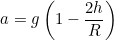
acceleration with which satellite is falling on Earth can be
calculated as,
1024 kg, the radius of Earth is R = 6400 km, mass of the
satellite is m = 70 kg and the altitude is h = 600 km. Thus the
acceleration with which satellite is falling on Earth can be
calculated as,


Add Answer to:
All questions please
101. The mass of the Earth is almost 6.0x10⁴ kg, and the average...
An artificial satellite circles the Earth in a circular orbit at a location where the acceleration...
 An artificial satellite circles the Earth in a circular orbit at a location where the acceleration due to gravity is 9.00 m/s^2. Determine the orbital period of the satellite. I_o, a satellite of Jupiter, has an orbital period of 1.77 days and an orbital radius of 4.22 times 10^5 km. From these data, determine the mass of Jupiter. A minimum-energy transfer orbit to an outer planet consists of putting a spacecraft on an elliptical trajectory with the departure planet corresponding...
A planet has a mass of 7.24 × 1024 kg and a radius of 7240 km....
A planet has a mass of 7.24 × 1024 kg and a radius of 7240 km. (a) Find the orbital radius of a satellite that is to complete 1 orbit every 3.4 hours. (b) Find the tangential velocity of a satellite that is to orbit 560 km above this planet’s surface. (c) Find the time period of a satellite that has an orbital radius of 9.35 × 10⁷ m around this planet.
6. Using Nowton's version of Kepler's Third Law (15 points). a) (5pt) Compute the semimajor the...
 6. Using Nowton's version of Kepler's Third Law (15 points). a) (5pt) Compute the semimajor the mass of the Sun from the fact that the Earth's orbital period is 1 year and axis is 1 AU. Assume that the mass of the Earth is much smaller than the mass of the Sun. Is this assumption justified? pt) Compute the orbital period of a cubesat orbiting the Earth at an altitude of 400 km above the Earth's surface. c) (5pt) Estimate...
The semimajor axis of Mars orbit is about 1.52 astronomical units (au), where an au is the Earth's average distance from the Sun, meaning the semimajor axis of Earth's orbit is 1 au. To go from Earth to Mars and use the least energy from rocket fuel, th
The semimajor axis of Mars orbit is about 1.52 astronomical units (au), where an au is the Earth's average distance from the Sun, meaning the semimajor axis of Earth's orbit is 1 au. To go from Earth to Mars and use the least energy from rocket fuel, the orbit has a semimajor axis of 1.26 au and an eccentricity of about 0.21. Starting at Earth's orbit, to follow this path we give the spacecraft an orbital velocity of 40 km/s. ...
Kepler’s Third Law indicates that the Period (P) of an orbit is related to the semi-major...
Kepler’s Third Law indicates that the Period (P) of an orbit is related to the semi-major axis (a) of the orbit with: P 2 = ka3 . Kepler noticed that the value of the constant k changes when we observe systems with different central objects. This means that the orbits of all of the planets in the Solar System have the same value for k, but that value is different for the Moon because all of the planets orbit the...
12. A distant planet, X, has a mass double that of Earth and a radius triple...
12. A distant planet, X, has a mass double that of Earth and a radius triple that of Earth. What would the gravitational acceleration of planet X be at its surface? Assume g = 9.81 m/s2 , and use Google to look up any constants you feel you might need to solve this problem. (a) 2.18 m/s2 (b) 4.37 m/s2 (c) 6.54 m/s2 (d) 13.1 m/s2 13. A satellite is placed in orbit around the Earth such that it has...
A 544-kg satellite is in a circular orbit about Earth at a height above Earth equal...
 A 544-kg satellite is in a circular orbit about Earth at a height above Earth equal to Earth's mean radius. (a) Find the satellite's orbital speed. m/s (b) Find the period of its revolution. (c) Find the gravitational force acting on it A satellite of Mars, called Phobos, has an orbital radius of 9.4 x 10⁶ m and a period of 2.8 104 s. Assuming the orbit is circular, determine the mass of Mars. x 10 s. Assuming kg
QUESTION 1: The International Space Station has a mass of 4.19 ✕ 105 kg and orbits...
QUESTION 1: The International Space Station has a mass of 4.19 ✕ 105 kg and orbits at a radius of 6.79 ✕ 106 m from the center of Earth. Find the gravitational force exerted by Earth on the space station, the space station's gravitational potential energy, and the weight of a 92.3 kgastronaut living inside the station. HINT (a) the gravitational force (in N) exerted by Earth on the space station (Enter the magnitude.) N (b) the space station's gravitational...
A satellite is in a circular orbit around the Earth at an altitude of 2.24 x...
 A satellite is in a circular orbit around the Earth at an altitude of 2.24 x 10⁶ m. (a) Find the period of the orbit. (Hint: Modify Kepler's third law so it is suitable for objects orbiting the Earth rather than the Sun. The radius of the Earth is 6.38 x 10⁶ m, and the mass of the Earth is 5.98 x 1024 kg.) h (b) Find the speed of the satellite. km/s (c) Find the acceleration of the satellite....
HD209458b was discovered in 1999, becoming the first exoplanet to be discovered using the transit method:...
HD209458b was discovered in 1999, becoming the first exoplanet to be discovered using the transit method: this planet’s orbit is oriented just right, so that it regularly passes in front of its star, as seen from Earth. When this happens, it blocks out a portion of the star’s light. If astronomers notice the star’s brightness dipping for a short time over and over with a consistent period, it suggests a planet is responsible. Further observations of the star’s Doppler shift...
 An artificial satellite circles the Earth in a circular orbit at a location where the acceleration due to gravity is 9.00 m/s^2. Determine the orbital period of the satellite. I_o, a satellite of Jupiter, has an orbital period of 1.77 days and an orbital radius of 4.22 times 10^5 km. From these data, determine the mass of Jupiter. A minimum-energy transfer orbit to an outer planet consists of putting a spacecraft on an elliptical trajectory with the departure planet corresponding...
 6. Using Nowton's version of Kepler's Third Law (15 points). a) (5pt) Compute the semimajor the mass of the Sun from the fact that the Earth's orbital period is 1 year and axis is 1 AU. Assume that the mass of the Earth is much smaller than the mass of the Sun. Is this assumption justified? pt) Compute the orbital period of a cubesat orbiting the Earth at an altitude of 400 km above the Earth's surface. c) (5pt) Estimate...
 A 544-kg satellite is in a circular orbit about Earth at a height above Earth equal to Earth's mean radius. (a) Find the satellite's orbital speed. m/s (b) Find the period of its revolution. (c) Find the gravitational force acting on it A satellite of Mars, called Phobos, has an orbital radius of 9.4 x 10⁶ m and a period of 2.8 104 s. Assuming the orbit is circular, determine the mass of Mars. x 10 s. Assuming kg
 A satellite is in a circular orbit around the Earth at an altitude of 2.24 x 10⁶ m. (a) Find the period of the orbit. (Hint: Modify Kepler's third law so it is suitable for objects orbiting the Earth rather than the Sun. The radius of the Earth is 6.38 x 10⁶ m, and the mass of the Earth is 5.98 x 1024 kg.) h (b) Find the speed of the satellite. km/s (c) Find the acceleration of the satellite....
Most questions answered within 3 hours.
-
Where is the error in this code sequence?
String s1 = "Hello";
String s2 = "ello";...
asked 11 months ago -
Financial data for Joel de Paris, Inc., for last year
follow:
Joel de Paris, Inc.
Balance...
asked 11 months ago -
Consider this reaction:
Al2(SO4)3 (aq)+ BaCl3
(aq) Al2Cl6 (aq)- +
3BaSO4(s) . What is the...
asked 11 months ago -
Suppose that Savneet is considering increasing her
recent random sample from 20 car rentals to 40...
asked 11 months ago -
Trucks arrive at an unloading terminal at an average rate of 120
per hour.
Trucks arrive...
asked 11 months ago -
Why are methanol and ethanol completely soluble in water while
octanol is not very little soluble....
asked 11 months ago -
A facilities manager at a university reads in a research report
that the mean amount of...
asked 11 months ago -
When the CuSO4 is rehydrated by adding water to the anhydrous
compound, is this an endothermic...
asked 11 months ago -
A ray of sunlight is passing from diamond into crown glass; the
angle of incidence is...
asked 11 months ago -
A block of mass 0.249 kg is placed on top of a light, vertical
spring of...
asked 11 months ago -
how do the kidneys compensate in the presences of acidosis
a) trigger hyperventilate
b) reserve acid...
asked 11 months ago -
Question 501 pts
The rental rate of capital to the firm increases. Which of the
following...
asked 11 months ago