
Homework Answers
Request Answer!
We need at least 10 more requests to produce the answer.
0 / 10 have requested this problem solution
The more requests, the faster the answer.
Add Answer to:
Below is a figure from your lab instructions. Through a string and using a pulley a...
Two blocks are connected by a lightweight string passing over a pulley, as shown in the figure below. The block with ma...
Two blocks are connected by a lightweight string passing over a pulley, as shown in the figure below. The block with mass m1 = 16.5 kg on the incline plane accelerates up the plane with negligible friction. The block's acceleration is a = 1.40 m/s2, and the tension in the segment of string attached to this block is T1. The hanging block has a mass of m2 = 23.5 kg, and the tension in the string attached to it is T2....
Two blocks are connected by a lightweight string passing over a pulley, as shown in the...
 Two blocks are connected by a lightweight string passing over a pulley, as shown in the figure below. The block with mass m = 16.5 kg on the incline plane accelerates up the plane with negligible friction. The block's acceleration is a = 1.80 m/s2, and the tension in the segment of string attached to this block is T,. The hanging block has a mass of m, = 23.5 kg, and the tension in the string attached to it is...
Two blocks are connected by a lightweight string passing over a pulley, as shown in the figure below. The block with ma...
 Two blocks are connected by a lightweight string passing over a
pulley, as shown in the figure below. The block with mass
m1 = 16.5 kg on the incline plane accelerates
up the plane with negligible friction. The block's acceleration is
a = 1.80 m/s2, and the tension in the segment
of string attached to this block is T1. The
hanging block has a mass of m2 = 22.5 kg, and
the tension in the string attached to it is...
Two blocks are connected by a lightweight string passing over a
pulley, as shown in the figure below. The block with mass
m1 = 16.5 kg on the incline plane accelerates
up the plane with negligible friction. The block's acceleration is
a = 1.80 m/s2, and the tension in the segment
of string attached to this block is T1. The
hanging block has a mass of m2 = 22.5 kg, and
the tension in the string attached to it is...
A weight of mass 1.66 kg is suspended by a string wrapped around a pulley wheel,...
A weight of mass 1.66 kg is suspended by a string wrapped around a pulley wheel, which consists of a solid disk of mass 4.03 kg and radius 0.603 m. The system is released from rest. Over what vertical distance does the hanging mass move in 3.0 seconds? Ignore friction and drag forces, and assume that the string does not slip.
A weight of mass 1.03 kg is suspended by a string wrapped around a pulley wheel,...
A weight of mass 1.03 kg is suspended by a string wrapped around a pulley wheel, which consists of a solid disk of mass 4.96 kg and radius 1.37 m. The system is released from rest. Over what vertical distance does the hanging mass move in 3.0 seconds? Ignore friction and drag forces, and assume that the string does not slip.
#K5-11 A rough horizontal track, a pulley and two blocks connected by a string are located...
 #K5-11 A rough horizontal track, a pulley and two blocks connected by a string are located in a laboratory near the surface of a planet. Block I has mass m, and block 2 has mass m,. The gravitational acceleration of the planet has magnitude g and is directed straight down. The coefficient of kinetic friction between block I and the track isA. The string connecting the blocks has negligible mass and constant length. The pulley is also very light. Block...
Consider the scenario shown in the diagram below. A box (mass m1) is on a slope,...
 Consider the scenario shown in the diagram below. A box (mass m1) is on a slope, which is inclined at an angle theta with respect to the horizontal. The box is connected via a string and pulley to a hanging weight (mass m2). The string and the pulley are assumed to be massless and frictionless, but there is friction between the box and the incline (with coefficient of kinetic friction mu k). Find an expression for the tension T in...
I dont understand what the procedure would be to figure this out. is M the weight...
 I dont understand what the procedure would be to figure this out.
is M the weight of the glider or a variable that needs to be solved
for? to find g do I just use the equation for a and solve for g?
how does time from the photogates play a part in my data?
You will have a level air track, glider with flag, and two photogates. The glider will have a hook on it and a string will...
I dont understand what the procedure would be to figure this out.
is M the weight of the glider or a variable that needs to be solved
for? to find g do I just use the equation for a and solve for g?
how does time from the photogates play a part in my data?
You will have a level air track, glider with flag, and two photogates. The glider will have a hook on it and a string will...
A low friction pulley, light string deal with two masses is set up as shown. If...
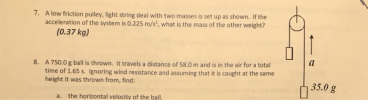 A low friction pulley, light string deal with two masses is set up as shown. If acceleration of the system is 0.225 m/s, what is the mass of the other weight? 7. (0.37 kg) (l A750.0g ball is thrown. It travels a distance of 58.0 m and is in the air for a total time of 1.65 s. Ignoring wind resistance and assuming that it is caught at the same height it was thrown from, find: 8. 35.0 g a....
There are two graphs that needs to be made in this lab: 1. Total Energy Vs...
 There are two graphs that needs to be made in this lab:
1. Total Energy Vs time with m = 20g
2. Total Energy Vs time with m = 40g
A) Explain the nature of the plots .(Linear or non
linear?) The expected slope is zero in both cases. Why? Explain
with the use of law of conservation of energy. What is the
significance of the intercept?
B) Suppose you drew the Kinetic Energy Vs potential
Energy graph: The expected...
There are two graphs that needs to be made in this lab:
1. Total Energy Vs time with m = 20g
2. Total Energy Vs time with m = 40g
A) Explain the nature of the plots .(Linear or non
linear?) The expected slope is zero in both cases. Why? Explain
with the use of law of conservation of energy. What is the
significance of the intercept?
B) Suppose you drew the Kinetic Energy Vs potential
Energy graph: The expected...
 Two blocks are connected by a lightweight string passing over a pulley, as shown in the figure below. The block with mass m = 16.5 kg on the incline plane accelerates up the plane with negligible friction. The block's acceleration is a = 1.80 m/s2, and the tension in the segment of string attached to this block is T,. The hanging block has a mass of m, = 23.5 kg, and the tension in the string attached to it is...
 Two blocks are connected by a lightweight string passing over a
pulley, as shown in the figure below. The block with mass
m1 = 16.5 kg on the incline plane accelerates
up the plane with negligible friction. The block's acceleration is
a = 1.80 m/s2, and the tension in the segment
of string attached to this block is T1. The
hanging block has a mass of m2 = 22.5 kg, and
the tension in the string attached to it is...
Two blocks are connected by a lightweight string passing over a
pulley, as shown in the figure below. The block with mass
m1 = 16.5 kg on the incline plane accelerates
up the plane with negligible friction. The block's acceleration is
a = 1.80 m/s2, and the tension in the segment
of string attached to this block is T1. The
hanging block has a mass of m2 = 22.5 kg, and
the tension in the string attached to it is...
 #K5-11 A rough horizontal track, a pulley and two blocks connected by a string are located in a laboratory near the surface of a planet. Block I has mass m, and block 2 has mass m,. The gravitational acceleration of the planet has magnitude g and is directed straight down. The coefficient of kinetic friction between block I and the track isA. The string connecting the blocks has negligible mass and constant length. The pulley is also very light. Block...
 Consider the scenario shown in the diagram below. A box (mass m1) is on a slope, which is inclined at an angle theta with respect to the horizontal. The box is connected via a string and pulley to a hanging weight (mass m2). The string and the pulley are assumed to be massless and frictionless, but there is friction between the box and the incline (with coefficient of kinetic friction mu k). Find an expression for the tension T in...
 I dont understand what the procedure would be to figure this out.
is M the weight of the glider or a variable that needs to be solved
for? to find g do I just use the equation for a and solve for g?
how does time from the photogates play a part in my data?
You will have a level air track, glider with flag, and two photogates. The glider will have a hook on it and a string will...
I dont understand what the procedure would be to figure this out.
is M the weight of the glider or a variable that needs to be solved
for? to find g do I just use the equation for a and solve for g?
how does time from the photogates play a part in my data?
You will have a level air track, glider with flag, and two photogates. The glider will have a hook on it and a string will...
 A low friction pulley, light string deal with two masses is set up as shown. If acceleration of the system is 0.225 m/s, what is the mass of the other weight? 7. (0.37 kg) (l A750.0g ball is thrown. It travels a distance of 58.0 m and is in the air for a total time of 1.65 s. Ignoring wind resistance and assuming that it is caught at the same height it was thrown from, find: 8. 35.0 g a....
 There are two graphs that needs to be made in this lab:
1. Total Energy Vs time with m = 20g
2. Total Energy Vs time with m = 40g
A) Explain the nature of the plots .(Linear or non
linear?) The expected slope is zero in both cases. Why? Explain
with the use of law of conservation of energy. What is the
significance of the intercept?
B) Suppose you drew the Kinetic Energy Vs potential
Energy graph: The expected...
There are two graphs that needs to be made in this lab:
1. Total Energy Vs time with m = 20g
2. Total Energy Vs time with m = 40g
A) Explain the nature of the plots .(Linear or non
linear?) The expected slope is zero in both cases. Why? Explain
with the use of law of conservation of energy. What is the
significance of the intercept?
B) Suppose you drew the Kinetic Energy Vs potential
Energy graph: The expected...
Most questions answered within 3 hours.
-
Where is the error in this code sequence?
String s1 = "Hello";
String s2 = "ello";...
asked 10 months ago -
Financial data for Joel de Paris, Inc., for last year
follow:
Joel de Paris, Inc.
Balance...
asked 10 months ago -
Consider this reaction:
Al2(SO4)3 (aq)+ BaCl3
(aq) Al2Cl6 (aq)- +
3BaSO4(s) . What is the...
asked 10 months ago -
Suppose that Savneet is considering increasing her
recent random sample from 20 car rentals to 40...
asked 10 months ago -
Trucks arrive at an unloading terminal at an average rate of 120
per hour.
Trucks arrive...
asked 10 months ago -
Why are methanol and ethanol completely soluble in water while
octanol is not very little soluble....
asked 10 months ago -
A facilities manager at a university reads in a research report
that the mean amount of...
asked 10 months ago -
When the CuSO4 is rehydrated by adding water to the anhydrous
compound, is this an endothermic...
asked 10 months ago -
A ray of sunlight is passing from diamond into crown glass; the
angle of incidence is...
asked 10 months ago -
A block of mass 0.249 kg is placed on top of a light, vertical
spring of...
asked 10 months ago -
how do the kidneys compensate in the presences of acidosis
a) trigger hyperventilate
b) reserve acid...
asked 10 months ago -
Question 501 pts
The rental rate of capital to the firm increases. Which of the
following...
asked 10 months ago