
Homework Answers
Add Answer to:
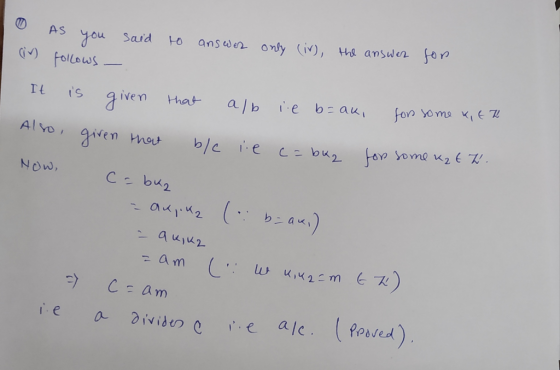
It’s question 2.3.7 that needs to be answered but only do (iv)
please explain with details...
Only need answer from (IV) to (VI) Only need answer from (IV) to (VI) Math 3140...
 Only need answer from (IV) to (VI)
Math 3140 page 1 of 7 1. (30) Let R be the group of real numbers under addition, and let U = {e® : 0 E R} be the group of all complex numbers on the unit circle under multiplication. Let o: R U be the map given by = e is a homomorphism of groups. (i) Prove that (i) Find the kernel of . (Don't...
Only need answer from (IV) to (VI)
Only need answer from (IV) to (VI)
Math 3140 page 1 of 7 1. (30) Let R be the group of real numbers under addition, and let U = {e® : 0 E R} be the group of all complex numbers on the unit circle under multiplication. Let o: R U be the map given by = e is a homomorphism of groups. (i) Prove that (i) Find the kernel of . (Don't...
Part 1: For each of the following structures, indicate the integration expected for the signal associated...
 Part 1: For each of the following structures, indicate the
integration expected for the signal associated with the indicated
hydrogen(s).
a)
i)
ii)
iii)
iv)
b)
i)
ii)
iii)
c)
i)
ii)
iii)
d)
i)
ii)
iii)
iv)
v)
vi)
e)
i)
ii)
iii)
iv)
f)
i)
ii)
iii)
iv)
v)
vi)
Part 2: For each of the following structures, indicate the
coupling (a.k.a, splitting) pattern expected for the signal
associated with the indicated hydrogen(s) by placing the
appropriate letter(s)...
Part 1: For each of the following structures, indicate the
integration expected for the signal associated with the indicated
hydrogen(s).
a)
i)
ii)
iii)
iv)
b)
i)
ii)
iii)
c)
i)
ii)
iii)
d)
i)
ii)
iii)
iv)
v)
vi)
e)
i)
ii)
iii)
iv)
f)
i)
ii)
iii)
iv)
v)
vi)
Part 2: For each of the following structures, indicate the
coupling (a.k.a, splitting) pattern expected for the signal
associated with the indicated hydrogen(s) by placing the
appropriate letter(s)...
4. For this question, we define the following matrices: 1-2 0 To 61 C= 0 -1...
 4. For this question, we define the following matrices: 1-2 0 To 61 C= 0 -1 2 , D= 3 1 . [3 24 L-2 -1] (a) For each of the following, state whether or not the expression can be evaluated. If it can be, evaluate it. If it cannot be, explain why. i. B? +D ii. AD iii. C + DB iv. CT-C (b) Find three distinct vectors X1, X2, X3 such that Bx; = 0 for i =...
PLEASE can you solve C , d only For the following circuit: Load 1 Baad2 10...
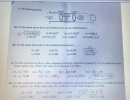 PLEASE can you solve C , d only
For the following circuit: Load 1 Baad2 10 KVAR V-120 V (ms 10 kW p0.857 laging (a) For the circuit shown above, the complex power for the combined load is 14134.0 28.07° v) 30/11.90 ii) 50-36.87° vi) 81.8 -11.90 ) 42.11-28.070 vii) 13.4 28.07 iv) 34,042.1 vil) 16,86 -11.9° (b) For the circuit shown above, the combined power factor is i) 1.867 V) 0.800 ii) 0.742 vi) -0.882 iii) -0.950 vii) 0.687...
PLEASE can you solve C , d only
For the following circuit: Load 1 Baad2 10 KVAR V-120 V (ms 10 kW p0.857 laging (a) For the circuit shown above, the complex power for the combined load is 14134.0 28.07° v) 30/11.90 ii) 50-36.87° vi) 81.8 -11.90 ) 42.11-28.070 vii) 13.4 28.07 iv) 34,042.1 vil) 16,86 -11.9° (b) For the circuit shown above, the combined power factor is i) 1.867 V) 0.800 ii) 0.742 vi) -0.882 iii) -0.950 vii) 0.687...
Please show the solutions for all 4 parts! Problem 1 Let m E Z that is...
 Please show the solutions for all 4 parts!
Problem 1 Let m E Z that is not the square of an integer (ie. mメ0, 1.4.9, ). Let α-Vm (so you have a失Q as mentioned above) (i) Prove the following:Qla aba: a,b Q is a subring of C, Za]a +ba: a, b E Z is a subring of Qla], and the fraction field of Z[a] is Q[a]. (3pts) (ii) Prove that Z[x]/(X2-m) Z[a] and Qx/(x2 mQ[a]. (3pts) i Let n be...
Please show the solutions for all 4 parts!
Problem 1 Let m E Z that is not the square of an integer (ie. mメ0, 1.4.9, ). Let α-Vm (so you have a失Q as mentioned above) (i) Prove the following:Qla aba: a,b Q is a subring of C, Za]a +ba: a, b E Z is a subring of Qla], and the fraction field of Z[a] is Q[a]. (3pts) (ii) Prove that Z[x]/(X2-m) Z[a] and Qx/(x2 mQ[a]. (3pts) i Let n be...
Consider the function below. y z= 2+x+ (a) Match the function with its graph (labeled A-F)....
 Consider the function below. y z= 2+x+ (a) Match the function with its graph (labeled A-F). (b) Match the function with its contour map (labeled 1-VI). O V VI Give reasons for your choices. Select- Also, the values of z approach 0 as we use This function is not periodic, ruling out the graphs in (b) Match the function with its contour map (labeled I-VI) II III IV V VI Give reasons for your choices. This function is not periodic,...
1. Consider the three reaction energy diagrams below. Make sure you can justify your answer for...
 1. Consider the three reaction energy diagrams below. Make sure you can justify your answer for the purposes of Exam 3 – simply guessing on this multiple choice question will NOT help you when you're asked to explain your reasoning on the exam! energy energy energy reaction coordinate reaction coordinate reaction coordinate i) Which forward reaction do you expect to proceed fastest, assuming the same energy scale for each? ii) Which reaction do you expect to be the most favorable...
1. Consider the three reaction energy diagrams below. Make sure you can justify your answer for...
 1. Consider the three reaction energy diagrams below. Make sure you can justify your answer for the purposes of Exam 3 - simply guessing on this multiple choice question will NOT help you when you're asked to explain your reasoning on the exam! energy- energy- reaction coordinate reaction coordinate reaction coordinate i) Which forward reaction do you expect to proceed fastest, assuming the same energy scale for each? ii) Which reaction do you expect to be the most favorable in...
Question 1 Which of the following hydrogens is the most acidic? II IV I III A....
 Question 1 Which of the following hydrogens is the most acidic? II IV I III A. IV B. V C. III D.I E. II Question 2 What is the product, Z, of the following reaction sequence? iz H30+ T-H20)* ia. CI H307 + Z مل I II III IV A. IV B. II C. III D.V E.
Question # 1 - A) Explain the characteristics of dry friction. B) Discuss Moment Of Force in...
Question # 1 - A) Explain the characteristics of dry friction. B) Discuss Moment Of Force in brief . Question # 2 - Define the following Terms: (i) Moment of Couple (ii) Moment of force (iii) Equilibrium (iv) Rigid body(v) Scalar Quantity (vi) Vector Quantity (vii) Work (viii) Friction (ix) Centre of gravity (x) Rectilinear Motion Question # 3 - (i) explain perpendicular axis theorem (ii) discuss Parallel axis theorem
 Only need answer from (IV) to (VI)
Math 3140 page 1 of 7 1. (30) Let R be the group of real numbers under addition, and let U = {e® : 0 E R} be the group of all complex numbers on the unit circle under multiplication. Let o: R U be the map given by = e is a homomorphism of groups. (i) Prove that (i) Find the kernel of . (Don't...
Only need answer from (IV) to (VI)
Only need answer from (IV) to (VI)
Math 3140 page 1 of 7 1. (30) Let R be the group of real numbers under addition, and let U = {e® : 0 E R} be the group of all complex numbers on the unit circle under multiplication. Let o: R U be the map given by = e is a homomorphism of groups. (i) Prove that (i) Find the kernel of . (Don't...
 Part 1: For each of the following structures, indicate the
integration expected for the signal associated with the indicated
hydrogen(s).
a)
i)
ii)
iii)
iv)
b)
i)
ii)
iii)
c)
i)
ii)
iii)
d)
i)
ii)
iii)
iv)
v)
vi)
e)
i)
ii)
iii)
iv)
f)
i)
ii)
iii)
iv)
v)
vi)
Part 2: For each of the following structures, indicate the
coupling (a.k.a, splitting) pattern expected for the signal
associated with the indicated hydrogen(s) by placing the
appropriate letter(s)...
Part 1: For each of the following structures, indicate the
integration expected for the signal associated with the indicated
hydrogen(s).
a)
i)
ii)
iii)
iv)
b)
i)
ii)
iii)
c)
i)
ii)
iii)
d)
i)
ii)
iii)
iv)
v)
vi)
e)
i)
ii)
iii)
iv)
f)
i)
ii)
iii)
iv)
v)
vi)
Part 2: For each of the following structures, indicate the
coupling (a.k.a, splitting) pattern expected for the signal
associated with the indicated hydrogen(s) by placing the
appropriate letter(s)...
 4. For this question, we define the following matrices: 1-2 0 To 61 C= 0 -1 2 , D= 3 1 . [3 24 L-2 -1] (a) For each of the following, state whether or not the expression can be evaluated. If it can be, evaluate it. If it cannot be, explain why. i. B? +D ii. AD iii. C + DB iv. CT-C (b) Find three distinct vectors X1, X2, X3 such that Bx; = 0 for i =...
 PLEASE can you solve C , d only
For the following circuit: Load 1 Baad2 10 KVAR V-120 V (ms 10 kW p0.857 laging (a) For the circuit shown above, the complex power for the combined load is 14134.0 28.07° v) 30/11.90 ii) 50-36.87° vi) 81.8 -11.90 ) 42.11-28.070 vii) 13.4 28.07 iv) 34,042.1 vil) 16,86 -11.9° (b) For the circuit shown above, the combined power factor is i) 1.867 V) 0.800 ii) 0.742 vi) -0.882 iii) -0.950 vii) 0.687...
PLEASE can you solve C , d only
For the following circuit: Load 1 Baad2 10 KVAR V-120 V (ms 10 kW p0.857 laging (a) For the circuit shown above, the complex power for the combined load is 14134.0 28.07° v) 30/11.90 ii) 50-36.87° vi) 81.8 -11.90 ) 42.11-28.070 vii) 13.4 28.07 iv) 34,042.1 vil) 16,86 -11.9° (b) For the circuit shown above, the combined power factor is i) 1.867 V) 0.800 ii) 0.742 vi) -0.882 iii) -0.950 vii) 0.687...
 Please show the solutions for all 4 parts!
Problem 1 Let m E Z that is not the square of an integer (ie. mメ0, 1.4.9, ). Let α-Vm (so you have a失Q as mentioned above) (i) Prove the following:Qla aba: a,b Q is a subring of C, Za]a +ba: a, b E Z is a subring of Qla], and the fraction field of Z[a] is Q[a]. (3pts) (ii) Prove that Z[x]/(X2-m) Z[a] and Qx/(x2 mQ[a]. (3pts) i Let n be...
Please show the solutions for all 4 parts!
Problem 1 Let m E Z that is not the square of an integer (ie. mメ0, 1.4.9, ). Let α-Vm (so you have a失Q as mentioned above) (i) Prove the following:Qla aba: a,b Q is a subring of C, Za]a +ba: a, b E Z is a subring of Qla], and the fraction field of Z[a] is Q[a]. (3pts) (ii) Prove that Z[x]/(X2-m) Z[a] and Qx/(x2 mQ[a]. (3pts) i Let n be...
 Consider the function below. y z= 2+x+ (a) Match the function with its graph (labeled A-F). (b) Match the function with its contour map (labeled 1-VI). O V VI Give reasons for your choices. Select- Also, the values of z approach 0 as we use This function is not periodic, ruling out the graphs in (b) Match the function with its contour map (labeled I-VI) II III IV V VI Give reasons for your choices. This function is not periodic,...
 1. Consider the three reaction energy diagrams below. Make sure you can justify your answer for the purposes of Exam 3 – simply guessing on this multiple choice question will NOT help you when you're asked to explain your reasoning on the exam! energy energy energy reaction coordinate reaction coordinate reaction coordinate i) Which forward reaction do you expect to proceed fastest, assuming the same energy scale for each? ii) Which reaction do you expect to be the most favorable...
 1. Consider the three reaction energy diagrams below. Make sure you can justify your answer for the purposes of Exam 3 - simply guessing on this multiple choice question will NOT help you when you're asked to explain your reasoning on the exam! energy- energy- reaction coordinate reaction coordinate reaction coordinate i) Which forward reaction do you expect to proceed fastest, assuming the same energy scale for each? ii) Which reaction do you expect to be the most favorable in...
 Question 1 Which of the following hydrogens is the most acidic? II IV I III A. IV B. V C. III D.I E. II Question 2 What is the product, Z, of the following reaction sequence? iz H30+ T-H20)* ia. CI H307 + Z مل I II III IV A. IV B. II C. III D.V E.
Most questions answered within 3 hours.
-
Where is the error in this code sequence?
String s1 = "Hello";
String s2 = "ello";...
asked 10 months ago -
Financial data for Joel de Paris, Inc., for last year
follow:
Joel de Paris, Inc.
Balance...
asked 10 months ago -
Consider this reaction:
Al2(SO4)3 (aq)+ BaCl3
(aq) Al2Cl6 (aq)- +
3BaSO4(s) . What is the...
asked 10 months ago -
Suppose that Savneet is considering increasing her
recent random sample from 20 car rentals to 40...
asked 10 months ago -
Trucks arrive at an unloading terminal at an average rate of 120
per hour.
Trucks arrive...
asked 10 months ago -
Why are methanol and ethanol completely soluble in water while
octanol is not very little soluble....
asked 10 months ago -
A facilities manager at a university reads in a research report
that the mean amount of...
asked 10 months ago -
When the CuSO4 is rehydrated by adding water to the anhydrous
compound, is this an endothermic...
asked 10 months ago -
A ray of sunlight is passing from diamond into crown glass; the
angle of incidence is...
asked 10 months ago -
A block of mass 0.249 kg is placed on top of a light, vertical
spring of...
asked 10 months ago -
how do the kidneys compensate in the presences of acidosis
a) trigger hyperventilate
b) reserve acid...
asked 10 months ago -
Question 501 pts
The rental rate of capital to the firm increases. Which of the
following...
asked 10 months ago