
Homework Answers

Add Answer to:
Question 5 O pts Provide the complete mechanism that shows the formation of the major product...
Concept Question - Mechanism. (10 pts) Draw the mechanism for this process, using proper arrows, ...
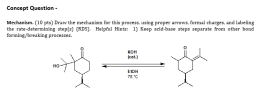 Concept Question - Mechanism. (10 pts) Draw the mechanism for this process, using proper arrows, formal charges, and labeling the rate-determining steps (RDS) Helpful Hints: 1) Keep acid-base steps separate from other bond forming/breaking processes. 0 0 KOH (cat.) Hie EtOH 78 'C
Concept Question - Mechanism. (10 pts) Draw the mechanism for this process, using proper arrows, formal charges, and labeling the rate-determining steps (RDS) Helpful Hints: 1) Keep acid-base steps separate from other bond forming/breaking processes. 0 0...
Concept Question - Mechanism. (10 pts) Draw the mechanism for this process, using proper arrows, formal charges, and labeling the rate-determining steps (RDS) Helpful Hints: 1) Keep acid-base steps separate from other bond forming/breaking processes. 0 0 KOH (cat.) Hie EtOH 78 'C
Concept Question - Mechanism. (10 pts) Draw the mechanism for this process, using proper arrows, formal charges, and labeling the rate-determining steps (RDS) Helpful Hints: 1) Keep acid-base steps separate from other bond forming/breaking processes. 0 0...
Predict the product or provide the mechanism Predict the Product. Provide the stable organic product(s) for...
 Predict the product or provide the mechanism
Predict the Product. Provide the stable organic product(s) for the reactions below. 1. Mgº, CH3CH,OCH CH3 2. CO2 (g) 3. H2O, HCI W MgBr (xs) 2. H2O, HCI 1. K Cr2O7, H2SO4, H2O 2. CH3MgBr (1 eq.) OH 3. H2O, HCI 1. Mgº, CH3CH2OCH2CH3 2. H2O, HCI Mechanism. The following Grignard reaction has been observed to yield products A and B. 1. Me Me MCI THF, -70 °C SOH OH ole er periodo...
Predict the product or provide the mechanism
Predict the Product. Provide the stable organic product(s) for the reactions below. 1. Mgº, CH3CH,OCH CH3 2. CO2 (g) 3. H2O, HCI W MgBr (xs) 2. H2O, HCI 1. K Cr2O7, H2SO4, H2O 2. CH3MgBr (1 eq.) OH 3. H2O, HCI 1. Mgº, CH3CH2OCH2CH3 2. H2O, HCI Mechanism. The following Grignard reaction has been observed to yield products A and B. 1. Me Me MCI THF, -70 °C SOH OH ole er periodo...
On a blank piece of paper, draw a complete mechanism for the reaction below. Include all...
 On a blank piece of paper, draw a complete mechanism for the reaction below. Include all intermediates and show electron movement via curved arrows. HVH H2NNH2 H2SO4 (cat.) N-H Take a picture or scan your mechanism, and submit it for your answer using the file upload option. Upload Choose a File Question 4 10 pts
help! chemistry predict the products and mechanism! the Product. Provide the stable organic product(s) for the...
 help! chemistry predict the products and mechanism!
the Product. Provide the stable organic product(s) for the reactions below. predict the Pro 1. Mgº, CH,CH,OCH,CH 2. CO (9) 3. H,O, HCI MgBr (X) 2. H,0,HCI 1. K Cr2O, H,SO, H,0 2. CH, MgBr (1 eq.) 3. H2O, HCI 1. Mgº, CH,CH,OCHCH 2. H20, HCI echanism. The following Grignard reaction has been observed to yield products A and B. MgCI THF-70 C 2. HCI, H20 0. Org. Chem. 1980, 45, 4952-4954. https://pubs.acs.org/doi/pdf/10.1021/acs.joc.8b01430)...
help! chemistry predict the products and mechanism!
the Product. Provide the stable organic product(s) for the reactions below. predict the Pro 1. Mgº, CH,CH,OCH,CH 2. CO (9) 3. H,O, HCI MgBr (X) 2. H,0,HCI 1. K Cr2O, H,SO, H,0 2. CH, MgBr (1 eq.) 3. H2O, HCI 1. Mgº, CH,CH,OCHCH 2. H20, HCI echanism. The following Grignard reaction has been observed to yield products A and B. MgCI THF-70 C 2. HCI, H20 0. Org. Chem. 1980, 45, 4952-4954. https://pubs.acs.org/doi/pdf/10.1021/acs.joc.8b01430)...
3 (15 marks). Draw a reasonable mechanism that accounts for the formation of the unexpected product...
 3 (15 marks). Draw a reasonable mechanism that accounts for the formation of the unexpected product shown below. Use curved arrows to show the movement of electrons and show the structures of all intermediates. Do not draw the structures of transition states. Do not include stereochemistry. Be sure to include formal charges and lone pairs of electrons where appropriate. OH HCI ether
Predict the major substitution product(s) and provide a curved arrow mechanism for the formation of the...
 Predict the major substitution product(s) and provide a curved arrow mechanism for the formation of the product. H20 Draw the major product(s). Include stereochemistry in your answer. ? Edit Draw step 1. Loss of leaving group. Include lone pairs, formal charges and stereochemistry in your answer. ? Edit Draw step 2. Carbocation rearrangement. Include lone pairs, formal charges and stereochemistry in your answer. dy ? Edit Drawstep 3. Nucleophilic attack. Draw both enantiomers in products if any. Include one pairs,...
Question 2 2 pts What is the major product and mechanism of the following series of...
 Question 2 2 pts What is the major product and mechanism of the following series of reactions: 1. P(Ph). 2. nBuLi 3. O Upload Choose a File
Testbank, Question 051 Predict the product for the following reaction and provide a curved arrow mechanism...
 Testbank, Question 051
Predict the product for the following reaction and provide a
curved arrow mechanism for the formation of the product.
Testbank, Question 051 Predict the product for the following reaction and provide a curved arrow mechanism for the formation of the product. NaOH Get help answering Molecular Drawing questions. Your answer is correct. Draw the product(s) of the reaction. CH3 Edit SHOW ANSWER Get help answering Molecular Drawing questions. x Your answer is incorrect. Try again. Draw step...
Testbank, Question 051
Predict the product for the following reaction and provide a
curved arrow mechanism for the formation of the product.
Testbank, Question 051 Predict the product for the following reaction and provide a curved arrow mechanism for the formation of the product. NaOH Get help answering Molecular Drawing questions. Your answer is correct. Draw the product(s) of the reaction. CH3 Edit SHOW ANSWER Get help answering Molecular Drawing questions. x Your answer is incorrect. Try again. Draw step...
5. Provide a detailed mechanism including curved arrows showing electron flow, intermediate structures, formal charges, and...
 5. Provide a detailed mechanism including curved arrows showing electron flow, intermediate structures, formal charges, and reaction arrows. Be sure to show all relevant bonds. Then, answer the associated question. (11 points) TIP: This is much more straightforward than it looks. It's just two Michael Addition reactions. SiMey Me,Si Me 1. (2 equiv base), THF -78 °C to 0 °C -Me Me Me Me 2. H2O, HCI OMe Mel COMe Me Me td .OMe H-0-1 a. Lithium hexamethyldisilazide (LiHMDS) operates...
5. Provide a detailed mechanism including curved arrows showing electron flow intermediate structures, formal charges, and...
 5. Provide a detailed mechanism including curved arrows showing electron flow intermediate structures, formal charges, and reaction arrows. Be sure to show relevant bonds. Then, answer the associated question. (11 points) TIP: This is much more straightforward than it looks. It's two Michael Addition reactions Me Me 1. (2 equiv base), THF -7B C to 0 C 2. H,O, HCI a. Lithium hexamethyldisilazide (LIHMDS) operates as a base in this mechanism. Another name for this is lithium bis(trimethylsilyl)amide or abbreviated...
 Concept Question - Mechanism. (10 pts) Draw the mechanism for this process, using proper arrows, formal charges, and labeling the rate-determining steps (RDS) Helpful Hints: 1) Keep acid-base steps separate from other bond forming/breaking processes. 0 0 KOH (cat.) Hie EtOH 78 'C
Concept Question - Mechanism. (10 pts) Draw the mechanism for this process, using proper arrows, formal charges, and labeling the rate-determining steps (RDS) Helpful Hints: 1) Keep acid-base steps separate from other bond forming/breaking processes. 0 0...
Concept Question - Mechanism. (10 pts) Draw the mechanism for this process, using proper arrows, formal charges, and labeling the rate-determining steps (RDS) Helpful Hints: 1) Keep acid-base steps separate from other bond forming/breaking processes. 0 0 KOH (cat.) Hie EtOH 78 'C
Concept Question - Mechanism. (10 pts) Draw the mechanism for this process, using proper arrows, formal charges, and labeling the rate-determining steps (RDS) Helpful Hints: 1) Keep acid-base steps separate from other bond forming/breaking processes. 0 0...
 Predict the product or provide the mechanism
Predict the Product. Provide the stable organic product(s) for the reactions below. 1. Mgº, CH3CH,OCH CH3 2. CO2 (g) 3. H2O, HCI W MgBr (xs) 2. H2O, HCI 1. K Cr2O7, H2SO4, H2O 2. CH3MgBr (1 eq.) OH 3. H2O, HCI 1. Mgº, CH3CH2OCH2CH3 2. H2O, HCI Mechanism. The following Grignard reaction has been observed to yield products A and B. 1. Me Me MCI THF, -70 °C SOH OH ole er periodo...
Predict the product or provide the mechanism
Predict the Product. Provide the stable organic product(s) for the reactions below. 1. Mgº, CH3CH,OCH CH3 2. CO2 (g) 3. H2O, HCI W MgBr (xs) 2. H2O, HCI 1. K Cr2O7, H2SO4, H2O 2. CH3MgBr (1 eq.) OH 3. H2O, HCI 1. Mgº, CH3CH2OCH2CH3 2. H2O, HCI Mechanism. The following Grignard reaction has been observed to yield products A and B. 1. Me Me MCI THF, -70 °C SOH OH ole er periodo...
 On a blank piece of paper, draw a complete mechanism for the reaction below. Include all intermediates and show electron movement via curved arrows. HVH H2NNH2 H2SO4 (cat.) N-H Take a picture or scan your mechanism, and submit it for your answer using the file upload option. Upload Choose a File Question 4 10 pts
 help! chemistry predict the products and mechanism!
the Product. Provide the stable organic product(s) for the reactions below. predict the Pro 1. Mgº, CH,CH,OCH,CH 2. CO (9) 3. H,O, HCI MgBr (X) 2. H,0,HCI 1. K Cr2O, H,SO, H,0 2. CH, MgBr (1 eq.) 3. H2O, HCI 1. Mgº, CH,CH,OCHCH 2. H20, HCI echanism. The following Grignard reaction has been observed to yield products A and B. MgCI THF-70 C 2. HCI, H20 0. Org. Chem. 1980, 45, 4952-4954. https://pubs.acs.org/doi/pdf/10.1021/acs.joc.8b01430)...
help! chemistry predict the products and mechanism!
the Product. Provide the stable organic product(s) for the reactions below. predict the Pro 1. Mgº, CH,CH,OCH,CH 2. CO (9) 3. H,O, HCI MgBr (X) 2. H,0,HCI 1. K Cr2O, H,SO, H,0 2. CH, MgBr (1 eq.) 3. H2O, HCI 1. Mgº, CH,CH,OCHCH 2. H20, HCI echanism. The following Grignard reaction has been observed to yield products A and B. MgCI THF-70 C 2. HCI, H20 0. Org. Chem. 1980, 45, 4952-4954. https://pubs.acs.org/doi/pdf/10.1021/acs.joc.8b01430)...
 3 (15 marks). Draw a reasonable mechanism that accounts for the formation of the unexpected product shown below. Use curved arrows to show the movement of electrons and show the structures of all intermediates. Do not draw the structures of transition states. Do not include stereochemistry. Be sure to include formal charges and lone pairs of electrons where appropriate. OH HCI ether
 Predict the major substitution product(s) and provide a curved arrow mechanism for the formation of the product. H20 Draw the major product(s). Include stereochemistry in your answer. ? Edit Draw step 1. Loss of leaving group. Include lone pairs, formal charges and stereochemistry in your answer. ? Edit Draw step 2. Carbocation rearrangement. Include lone pairs, formal charges and stereochemistry in your answer. dy ? Edit Drawstep 3. Nucleophilic attack. Draw both enantiomers in products if any. Include one pairs,...
 Question 2 2 pts What is the major product and mechanism of the following series of reactions: 1. P(Ph). 2. nBuLi 3. O Upload Choose a File
 Testbank, Question 051
Predict the product for the following reaction and provide a
curved arrow mechanism for the formation of the product.
Testbank, Question 051 Predict the product for the following reaction and provide a curved arrow mechanism for the formation of the product. NaOH Get help answering Molecular Drawing questions. Your answer is correct. Draw the product(s) of the reaction. CH3 Edit SHOW ANSWER Get help answering Molecular Drawing questions. x Your answer is incorrect. Try again. Draw step...
Testbank, Question 051
Predict the product for the following reaction and provide a
curved arrow mechanism for the formation of the product.
Testbank, Question 051 Predict the product for the following reaction and provide a curved arrow mechanism for the formation of the product. NaOH Get help answering Molecular Drawing questions. Your answer is correct. Draw the product(s) of the reaction. CH3 Edit SHOW ANSWER Get help answering Molecular Drawing questions. x Your answer is incorrect. Try again. Draw step...
 5. Provide a detailed mechanism including curved arrows showing electron flow, intermediate structures, formal charges, and reaction arrows. Be sure to show all relevant bonds. Then, answer the associated question. (11 points) TIP: This is much more straightforward than it looks. It's just two Michael Addition reactions. SiMey Me,Si Me 1. (2 equiv base), THF -78 °C to 0 °C -Me Me Me Me 2. H2O, HCI OMe Mel COMe Me Me td .OMe H-0-1 a. Lithium hexamethyldisilazide (LiHMDS) operates...
 5. Provide a detailed mechanism including curved arrows showing electron flow intermediate structures, formal charges, and reaction arrows. Be sure to show relevant bonds. Then, answer the associated question. (11 points) TIP: This is much more straightforward than it looks. It's two Michael Addition reactions Me Me 1. (2 equiv base), THF -7B C to 0 C 2. H,O, HCI a. Lithium hexamethyldisilazide (LIHMDS) operates as a base in this mechanism. Another name for this is lithium bis(trimethylsilyl)amide or abbreviated...
Most questions answered within 3 hours.
-
Where is the error in this code sequence?
String s1 = "Hello";
String s2 = "ello";...
asked 10 months ago -
Financial data for Joel de Paris, Inc., for last year
follow:
Joel de Paris, Inc.
Balance...
asked 10 months ago -
Consider this reaction:
Al2(SO4)3 (aq)+ BaCl3
(aq) Al2Cl6 (aq)- +
3BaSO4(s) . What is the...
asked 10 months ago -
Suppose that Savneet is considering increasing her
recent random sample from 20 car rentals to 40...
asked 10 months ago -
Trucks arrive at an unloading terminal at an average rate of 120
per hour.
Trucks arrive...
asked 10 months ago -
Why are methanol and ethanol completely soluble in water while
octanol is not very little soluble....
asked 10 months ago -
A facilities manager at a university reads in a research report
that the mean amount of...
asked 10 months ago -
When the CuSO4 is rehydrated by adding water to the anhydrous
compound, is this an endothermic...
asked 10 months ago -
A ray of sunlight is passing from diamond into crown glass; the
angle of incidence is...
asked 10 months ago -
A block of mass 0.249 kg is placed on top of a light, vertical
spring of...
asked 10 months ago -
how do the kidneys compensate in the presences of acidosis
a) trigger hyperventilate
b) reserve acid...
asked 10 months ago -
Question 501 pts
The rental rate of capital to the firm increases. Which of the
following...
asked 10 months ago