Homework Answers


In an oscillating RLC circuit with L = 70 mH, C = 7.5 µF, and R...
In an oscillating RLC circuit with L = 70 mH, C = 7.5 µF, and R = 4.0 Ω, how much time (in ms) elapses before the amplitude of the oscillations drops to half its initial value?
A series RLC circuit with L = 17.5 mH, C = 3 µF, and R =...
A series RLC circuit with L = 17.5 mH, C = 3 µF, and R = 15 Ω is driven by a generator with a maximum emf of 120 V and a variable angular frequency ω. Find the resonant frequency ω0. Answer in units of rad/s.
In an oscillating RLC circuit, R = 3.9 Ω, L = 6.0 mH, and C = 600 µF. What is the angular frequency of the oscillations...
In an oscillating RLC circuit, R = 3.9 Ω, L = 6.0 mH, and C = 600 µF. What is the angular frequency of the oscillations (in rad/s)? ___________________________ rad/s
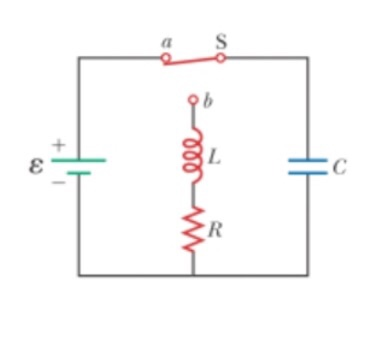
In the figure below, let R = 7.50 Ω, L = 2.10 mH, and C =...
 In the figure below, let R = 7.50 Ω, L = 2.10 mH, and C = 1.60
µF.
(a) Calculate the frequency of the damped oscillation of the
circuit when the switch is thrown to position b. ? kHz
(b) What is the critical resistance for damped oscillations? ?
Ω
In the figure below, let R = 7.50 Ω, L = 2.10 mH, and C = 1.60
µF.
(a) Calculate the frequency of the damped oscillation of the
circuit when the switch is thrown to position b. ? kHz
(b) What is the critical resistance for damped oscillations? ?
Ω
What resistance R (in Ω) must be connected in series with a 600 mH inductor and...
What resistance R (in Ω) must be connected in series with a 600 mH inductor and a 8.0 µF capacitor if the resulting RLC oscillating circuit is to decay to 50% of its initial value of charge in 90 cycles? Ω What is the resistance (in Ω) if the charge is to decay to 0.10% of its initial value in 90 cycles? Ω
In an oscillating LC circuit with L = 48 mH and C = 5.0 μF, the...
In an oscillating LC circuit with L = 48 mH and C = 5.0 μF, the current is initially a maximum. How long will it take before the capacitor is fully charged for the first time?
In an oscillating RLC circuit with L = 50 mH, C = 9.5 UF, and R...
 In an oscillating RLC circuit with L = 50 mH, C = 9.5 UF, and R = 6.0 2, how much time (in ms) elapses before the amplitude of the oscillations drops to half its initial value? ms
In the figure below, let R = 7.00 Ω, L = 2.50 mH, and C =...
 In the figure below, let R = 7.00 Ω, L = 2.50
mH, and C = 1.75 µF.
The circuit is a rectangular loop with a vertical wire in the
middle that extends from the bottom side of the loop to almost
reach the top side, ending at point b below the top side.
The left side contains a battery of emf ℰ with the
positive terminal above the negative terminal. The right side
contains a capacitor C. The top...
In the figure below, let R = 7.00 Ω, L = 2.50
mH, and C = 1.75 µF.
The circuit is a rectangular loop with a vertical wire in the
middle that extends from the bottom side of the loop to almost
reach the top side, ending at point b below the top side.
The left side contains a battery of emf ℰ with the
positive terminal above the negative terminal. The right side
contains a capacitor C. The top...
a) What resistance R (in Ω) must be connected in series with a 250 mH inductor...
a) What resistance R (in Ω) must be connected in series with a 250 mH inductor and a 2.0 µF capacitor if the resulting RLC oscillating circuit is to decay to 50% of its initial value of charge in 20 cycles? ___________________________Ω b) What is the resistance (in Ω) if the charge is to decay to 0.10% of its initial value in 20 cycles? ___________________________Ω
In the figure, R = 12 Ω, C =8 μF, and L = 3 mH, and...
 In the figure, R = 12 Ω, C =8 μF, and
L = 3 mH, and the ideal battery has emf = 32 V.
The switch is kept in position a for a long time and then
thrown to position b. What are
(a) the maximum charge in the capacitor
plates?
(b) the angular frequency of the charge
oscillations?
(c) the maximum value of the current in the
circuit?
(d) the maximum electromagnetic energy in the
circuit?
WHE R a...
In the figure, R = 12 Ω, C =8 μF, and
L = 3 mH, and the ideal battery has emf = 32 V.
The switch is kept in position a for a long time and then
thrown to position b. What are
(a) the maximum charge in the capacitor
plates?
(b) the angular frequency of the charge
oscillations?
(c) the maximum value of the current in the
circuit?
(d) the maximum electromagnetic energy in the
circuit?
WHE R a...
 In the figure below, let R = 7.50 Ω, L = 2.10 mH, and C = 1.60
µF.
(a) Calculate the frequency of the damped oscillation of the
circuit when the switch is thrown to position b. ? kHz
(b) What is the critical resistance for damped oscillations? ?
Ω
In the figure below, let R = 7.50 Ω, L = 2.10 mH, and C = 1.60
µF.
(a) Calculate the frequency of the damped oscillation of the
circuit when the switch is thrown to position b. ? kHz
(b) What is the critical resistance for damped oscillations? ?
Ω
 In an oscillating RLC circuit with L = 50 mH, C = 9.5 UF, and R = 6.0 2, how much time (in ms) elapses before the amplitude of the oscillations drops to half its initial value? ms
 In the figure below, let R = 7.00 Ω, L = 2.50
mH, and C = 1.75 µF.
The circuit is a rectangular loop with a vertical wire in the
middle that extends from the bottom side of the loop to almost
reach the top side, ending at point b below the top side.
The left side contains a battery of emf ℰ with the
positive terminal above the negative terminal. The right side
contains a capacitor C. The top...
In the figure below, let R = 7.00 Ω, L = 2.50
mH, and C = 1.75 µF.
The circuit is a rectangular loop with a vertical wire in the
middle that extends from the bottom side of the loop to almost
reach the top side, ending at point b below the top side.
The left side contains a battery of emf ℰ with the
positive terminal above the negative terminal. The right side
contains a capacitor C. The top...
 In the figure, R = 12 Ω, C =8 μF, and
L = 3 mH, and the ideal battery has emf = 32 V.
The switch is kept in position a for a long time and then
thrown to position b. What are
(a) the maximum charge in the capacitor
plates?
(b) the angular frequency of the charge
oscillations?
(c) the maximum value of the current in the
circuit?
(d) the maximum electromagnetic energy in the
circuit?
WHE R a...
In the figure, R = 12 Ω, C =8 μF, and
L = 3 mH, and the ideal battery has emf = 32 V.
The switch is kept in position a for a long time and then
thrown to position b. What are
(a) the maximum charge in the capacitor
plates?
(b) the angular frequency of the charge
oscillations?
(c) the maximum value of the current in the
circuit?
(d) the maximum electromagnetic energy in the
circuit?
WHE R a...
Most questions answered within 3 hours.
-
Where is the error in this code sequence?
String s1 = "Hello";
String s2 = "ello";...
asked 11 months ago -
Financial data for Joel de Paris, Inc., for last year
follow:
Joel de Paris, Inc.
Balance...
asked 11 months ago -
Consider this reaction:
Al2(SO4)3 (aq)+ BaCl3
(aq) Al2Cl6 (aq)- +
3BaSO4(s) . What is the...
asked 11 months ago -
Suppose that Savneet is considering increasing her
recent random sample from 20 car rentals to 40...
asked 11 months ago -
Trucks arrive at an unloading terminal at an average rate of 120
per hour.
Trucks arrive...
asked 11 months ago -
Why are methanol and ethanol completely soluble in water while
octanol is not very little soluble....
asked 11 months ago -
A facilities manager at a university reads in a research report
that the mean amount of...
asked 11 months ago -
When the CuSO4 is rehydrated by adding water to the anhydrous
compound, is this an endothermic...
asked 11 months ago -
A ray of sunlight is passing from diamond into crown glass; the
angle of incidence is...
asked 11 months ago -
A block of mass 0.249 kg is placed on top of a light, vertical
spring of...
asked 11 months ago -
how do the kidneys compensate in the presences of acidosis
a) trigger hyperventilate
b) reserve acid...
asked 11 months ago -
Question 501 pts
The rental rate of capital to the firm increases. Which of the
following...
asked 11 months ago